
News
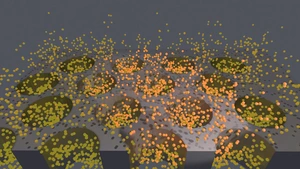
Efficient conversion of the wavelength
By “upconversion” of photons, researchers at HZB and BAM achieve an up to a one-thousand-fold increase in the electric field strength of the light waves:
The region of the spectrum that can be utilised for producing electrical energy can be considerably extended by converting low-energy (longer wavelength) photons into high-energy (shorter wavelength) photons. But so…
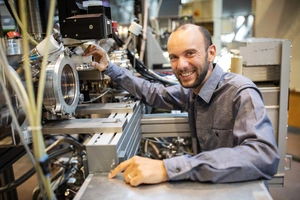
ERC Starting Grant for Tristan Petit
The researcher is investigating a new class of materials for energy storage at Helmholtz-Zentrum:
Dr. Tristan Petit has received a prestigious Starting Grant from the European Research Council for 1.5 million euros over the next five years. The materials researcher will use the grant to investigate a new class of…
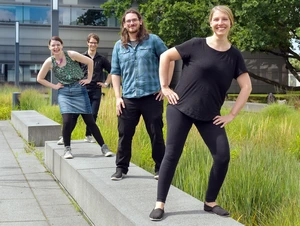
Webinars replacing face-to-face events
BAM gets creative in the wake of the coronavirus crisis:
Need is the mother of invention. The solution is often right in front of us. When the pandemic threw planning into disarray, the team of the Federal Institute for Materials Research and Testing (BAM) got pretty…

Humboldt-University Berlin appoints Jan Lüning
HZB’s Scientific Director was appointed Professor of Electronic Properties of Materials/X-ray Analysis:
Prof. Dr. Jan Lüning, Scientific Director at Helmholtz-Zentrum Berlin (HZB), was appointed to an S-W3 professorship at Humboldt University in Berlin in July. The professorship is entitled “Electronic Properties of…

Hope for better batteries
HZB researchers follow live the charging and discharging of silicon electrodess, which promise higher capacities:
Using silicon as a material for electrodes in lithium-ion batteries promises a significant increase in battery amp-hour capacity.The shortcoming of this material is that it is easily damaged by the stress caused by…
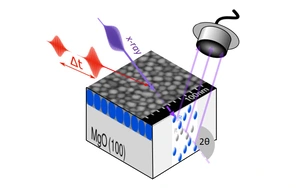
Robust high-performance data storage through magnetic anisotropy
Research group from HZB and the University of Potsdam investigated different iron-platinum thin films used as material for HAMR memories:
The latest generation of magnetic hard drives is made of magnetic thin films, which are invar materials. They allow extremely robust and high data storage density by local heating of ultrasmall nano-domains with a…
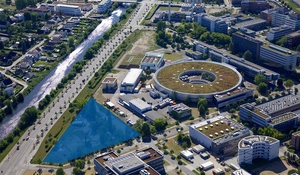
Start for new Center for Catalysis Research in Adlershof
Helmholtz-Zentrum Berlin (HZB) initiates architectural competition for an innovative laboratory and office building:
The Helmholtz-Zentrum Berlin (HZB) is launching a major new project with an interdisciplinary architectural competition: An innovative laboratory and office building for catalysis research, in which the scientific…

Turning science fiction into science fact
Professor Jürgen P. Rabe, director of the Integrative Research Institute for the Sciences IRIS Adlershof, about building bridges, joint labs, and a new research building:
Ten years of IRIS Adlershof: what exactly goes on here? Jürgen P. Rabe: It all begins with asking good questions – questions that impose themselves on us, that we can provide answers to by using our scientific…

A hub for basic research, teaching, and industrial application
How the Integrative Research Institute for the Sciences IRIS Adlershof supports many different technology start-ups :
For almost two decades now, Prof. Emil List-Kratochvil has been dealing with a technology that many think holds a promise for the future: printed electronics. The Austrian-born solid-state physicist has been…

Focusing on advanced materials
A graduate school in Adlershof offers top qualification and turns teams into families:
Advanced materials are a cutting-edge field. Diodes, solar cells, transistors, and storage elements – they are all based on state-of-the-art electronic materials. The products containing these ‘advanced and novel…
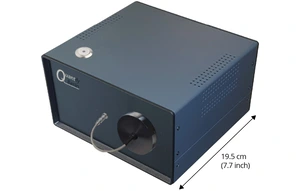
Optimize opto-electronic devices with new compact measuring system
HZB team receives Field Study Fellowship from the Helmholtz Association for the further development of the “LumY Pro” measuring device:
In order to develop efficient opto-electronic devices such as solar cells or LEDs, it is crucial to improve the quality of the semiconductors. To achieve this, it is necessary to determine the luminescence yield of…
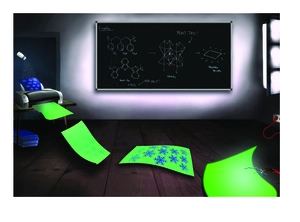
First solar cells from an inkjet printer, now light-emitting diodes too
Team of HZB and HU Berlin succeeds in inkjet printing of perovskite LED:
A team of researchers from the Helmholtz-Zentrum Berlin (HZB) and Humboldt-Universität zu Berlin has succeeded for the first time in producing light-emitting diodes (LEDs) from a hybrid perovskite semiconductor…
LUM quality management system again certified according to ISO 9001:2015
LUM GmbH is a leading international provider of innovative measurement technology for particle characterization in the nano and micro range, for dispersion analysis and for materials testing:
Effective May 20, 2020, LUM continues to be certified, now for the scope: Design, production and marketing of measurement- and analysis techniques for particle, dispersion and materials characterization as well as…
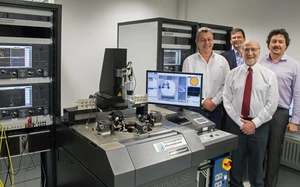
Unique measurement system for 5G-MIMO and space applications put into operation at FBH
State-of-the-art equipment for microelectronic research in Germany:
With the delivery of Keysight Technologies’ custom-designed wideband microwave downconverters, all key components for the novel 5G-MIMO system are now in place at Ferdinand-Braun-Institut. The system was funded within…
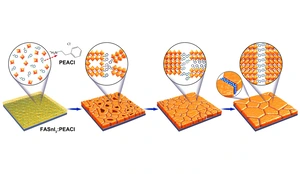
On the road to non-toxic and stable perovskite solar cells
International cooperation led by HZB has developed new materials with tin instead of lead:
The promising halide perovskite materials for solar energy conversion show high efficiencies, but this comes at a cost: The best perovskite materials incorporate toxic lead which poses a hazard to the environment. To…
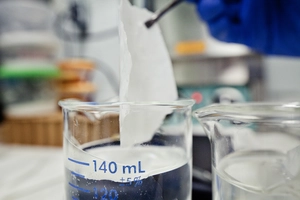
How new materials increase the efficiency of direct ethanol fuel cells
Research group investigated novel composite membrane at BESSY II:
A group from Brazil and an HZB team have investigated a novel composite membrane for ethanol fuel cells. It consists of the polymer Nafion, in which nanoparticles of a titanium compound are embedded by the rarely…
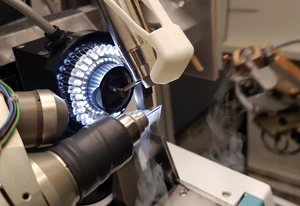
Corona research: Consortium of Berlin research and industry seeks active ingredients
The HZB is making all existing infrastructures available to the joint project:
The Berlin biotech company Molox GmbH and a team at the Helmholtz-Zentrum Berlin (HZB) have initiated a consortium of regional research groups and BASF. Together, they want to identify a starting point for the…

Maximum capacities at the theoretical limit
Chemist Michael J. Bojdys' proposal for an ERC Proof of Concept Grant for the project “LiAnMAT” has been retained for funding:
On April 27, the European Research Council (ERC) announced the recipients of the Proof of Concept (PoC) Grant scheme: one of them is Michael J. Bojdys, materials chemist and junior research group leader at IRIS…
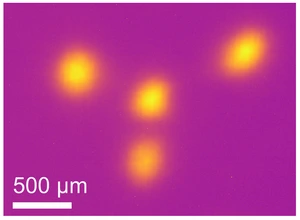
BESSY II: Ultra-fast switching of helicity of circularly polarized light pulses
Fast switching can make processes in magnetic materials visible and allows completely new experiments at the electron storage ring:
At the BESSY II storage ring, a joint team of accelerator physicists, undulator experts and experimenters has shown how the helicity of circularly polarized synchrotron radiation can be switched faster – up to a…
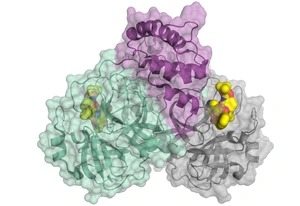
Coronavirus: BESSY II data accelerate drug development
Scientists have decoded the three-dimensional architecture of the main protease of SARS-CoV-2:
A coronavirus is keeping the world in suspense. SARS-CoV-2 is highly infectious and can cause severe pneumonia with respiratory distress (COVID-19). Scientists are doing research in order to prevent the viruses from…