
News
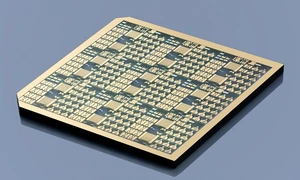
Gallium oxide power transistors with record values
Ferdinand-Braun-Institut achieves breakthrough in the field of energy-efficient power electronics:
Powerful electronic components are indispensable for future communications, for the digital transformation of society and for artificial intelligence applications. On a footprint as small as possible, they should…
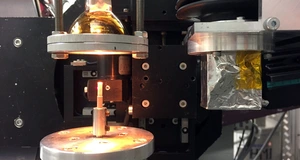
New imaging method developed at HZB
Tomoscopy provides insights into dynamic processes with over 200 3D X-ray images per second:
An international research team at the Swiss Light Source (SLS) has set a new tomography world record using a rotary sample table developed at the HZB. With 208 three-dimensional tomographic X-ray images per second,…
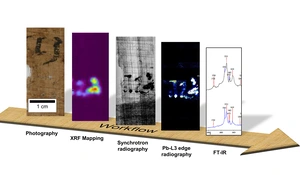
HZB researchers unveil “secret ink” on ancient Nile papyrus
Non-destructive examination of the fragile papyrus with Bessy II:
Researchers from the Egyptian Museum and Papyrus Collection, Berlin universities and Helmholtz-Zentrum Berlin studied a small piece of papyrus that was excavated on the island of Elephantine on the River Nile a little…
IKZ researcher Dr. Reinhard Uecker receives Frank Prize from the International Organization for Crystal Growth (IOCG)
Award for new findings in the field of crystal growing:
Prof. Dr. Darrell Schlom, Cornell University, USA, and Dr. Reinhard Uecker, Leibniz-Institut für Kristallzüchtung (IKZ), Germany, received the Frank Prize of the International Organization for Crystal Growth (IOCG)…
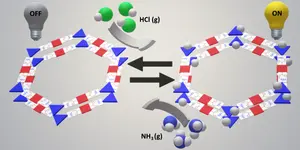
More versatile materials
Article of IRIS junior research group leader Michael J. Bojdys published in Nature Communications:
The IRIS junior research group leader Michael J. Bojdys and his international team have achieved a great success: Their article “Real-time optical and electronic sensing with a β-amino enone linked,…
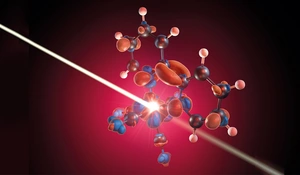
Research team at HZB investigates electronic processes of metal atoms and their ligands for the first time
Short X-ray pulses of Bessy II were used to analyze charge transfer within transition metal dyes:
Transition-metal complexes in dye-based solar cells are responsible for converting light into electrical energy. A model of spatial charge separation within the molecule has been used to describe this conversion.…
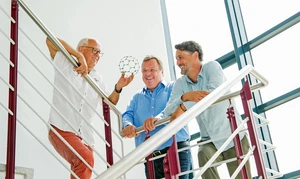
Neighbourly cooperation and fluoride innovation
How a meeting at a cafeteria resulted in a project to improve fire safety:
Sometimes all you need to advance potentially life-saving innovations is a lateral thinker, two specialists, and a random meet-up at the cafeteria. A typical story from Adlershof. They had been working on various…
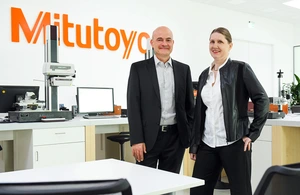
Japanese cherries and measurement technology
Japanese culture is everywhere at the Adlershof-based branch of the measurement technology company Mitutoyo:
‘Everything started with a calliper,’ says Ralph Streckfuß. The head of the Adlershof-based branch of the Japanese company Mitutoyo puts a curved, grey metallic tool on the table and starts turning on its screw. The…
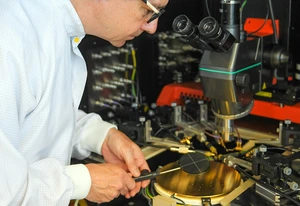
From research into practice
Numerous spin-offs of FBH and BAM prove how cooperation is boosted in Adlershof:
Laser, proteins, plasma – every day a vast network of scientists works to advance research of new and improved products for the benefit of society. Cooperating with the private sector can prove essential for research…
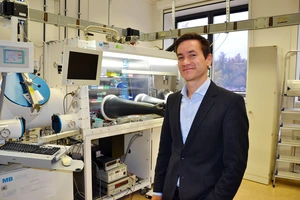
Steve Albrecht wins the 2019 Karl Scheel Prize
The Physikalische Gesellschaft zu Berlin honours the researcher of the Helmholtz-Zentrum Berlin for his work in the field of highly efficient tandem solar cell absorbers made of metal-halide perovskites:
The award will be presented to Prof. Steve Albrecht in Magnus House of the Physikalische Gesellschaft zu Berlin on Friday, June 28, 2019. Albrecht will also deliver a lecture entitled “Highly Efficient Tandem Solar…
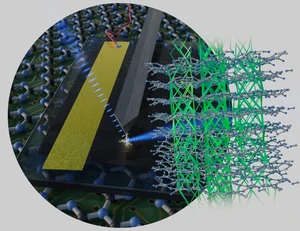
Organic electronics: a novel semiconductor from the family of carbon nitrides
Research teams from HU and HZB have investigated a triazine-based graphitic carbon nitride that is useful in optoelectronic applications:
Research teams from the Humboldt-Universität and the Helmholtz Zentrum Berlin (HZB) have investigated a new material from the family of carbon nitrides. Triazine-based graphitic carbon nitride (TGCN) is a…
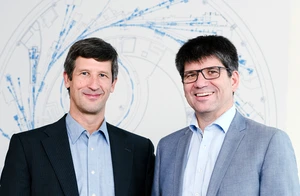
New scientific management at the Helmholtz-Zentrum Berlin
As of 1 June 2019, Prof. Dr. Bernd Rech and Prof. Dr. Jan Lüning are the new scientific directors of HZB:
As of 1 June 2019, Prof. Dr. Bernd Rech and Prof. Dr. Jan Lüning are the new scientific directors of Helmholtz-Zentrum Berlin für Materialien und Energie. Bernd Rech is responsible for the “Energy and Information”…

14th International Symposium on Functional π-Electron Systems in the Berlin-Adlershof Science and Technology park
More than 400 participants are expected to attend the conference on June 2nd to 7th, 2019:
The “14th International Symposium on Functional π-Electron Systems” is part of a regular international conference series that began in 1989 in Osaka, Japan. The 14th edition of this series is jointly organized by the…
Success in funding of innovative research
Collaborative Research Centre 951 (CRC 951) receives funding by the DFG for another four years:
The Collaborative Research Centre 951 "HIOS - Hybrid Inorganic / Organic Systems for Opto-Electronics" (HIOS) will receive funding for another four years. This was decided by the German Research Foundation (DFG) at…
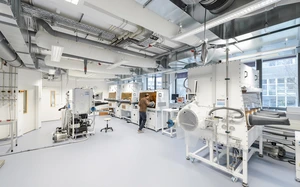
Launch of European Perovskite Initiative EPKI
HZB is participating in the initiative for the development of Perovskite based solar technology:
Perovskite based solar cells have made tremendous progress over the last decade achieving lab-scale efficiencies of 24.2% early 2019 in single-junction architecture and up to 28% in tandem (perovskite associated with…
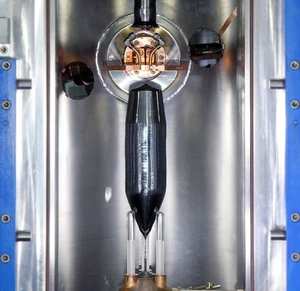
The NEW KILOGRAM: Powered by Adlershof Technology
Leibniz-Institut für Kristallzüchtung (IKZ) helped to replace original masure by new International System of Units (SI):
In addition to Ampere, Kelvin, Mol and Co., the kilogram also is now defined by a natural constant. In concrete terms, this means that the original kilogram, which has been the measure of all things for 130 years, has…
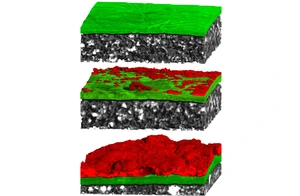
3D tomographic imagery reveals how lithium batteries age
Researchers have documented the degradation process of lithium electrodes in detail for the first time:
Lithium batteries lose amp-hour capacity over time. Microstructures can form on the electrodes with each new charge cycle, which further reduces battery capacity. Now an HZB team together with battery researchers from…
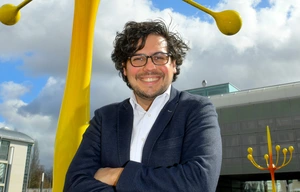
Light Nudges for Isotopes
BAM research provides conclusive proof of origin from strawberries to poison gas, which could soon put a stop to counterfeiters and war criminals:
After having been awarded his PhD, Carlos Enrique Abad Andrade did not see any reason to turn his back on the BAM Federal Institute for Materials Research and Testing in Adlershof. Instead he decided to continue to…
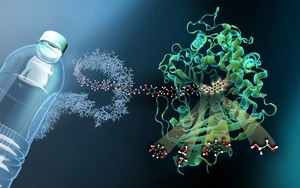
“Molecular scissors” for plastic waste
At BESSY II, an enzyme for decomposing PET plastics was decoded:
A research team from the University of Greifswald and Helmholtz-Zentrum-Berlin (HZB) has solved the molecular structure of the important enzyme MHETase at BESSY II. MHETase was discovered in bacteria and together with…
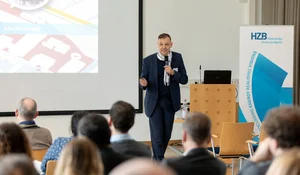
Fruitful networking at HZB Industry Day
Shaping the future of optoelectronics and photovoltaics with industrial partners:
On 28th March, Helmholtz-Zentrum Berlin invited industry key players in the fields of optoelectronics and photovoltaics to an industry day in Berlin-Adlershof to discuss around the key topics material and components…