
News
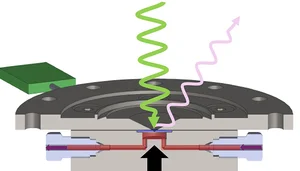
New sample environment at BESSY II allows glimpse into thermocatalytic processes
A novel measurement cell allows, for the first time, X-ray investigations under high pressures and temperatures:
A novel measurement cell allows, for the first time, soft and hard X-ray investigations under high pressures of up to 20 bar and temperatures of up to 400°C. This provides new insights into thermocatalytic processes,…
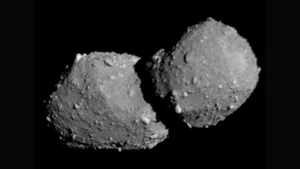
Spectacular high-speed flyby of the asteroid Torifune
DLR will support the scientific analysis of data taken by the Hayabusa2♯ asteroid probe:
On Sunday 5 July 2026, the Japanese Hayabusa2♯ asteroid mission flew past asteroid (98943) Torifune at very close range and at an extremely high speed of approximately five kilometres per second (18,000 kilometres per…
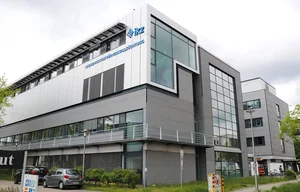
IKZ impresses in Leibniz evaluation with top rating and strategic momentum
Funding for the institute confirmed for a further seven-year period:
The Leibniz-Institut für Kristallzüchtung (IKZ) has successfully completed its periodic evaluation by the Leibniz Association. The Leibniz Senate reviewed the evaluation report in July 2026 and confirmed the…

Autonomous rail transport: between optimism and scepticism
At the DLR Transport Research Institute, the acceptance conditions for automated rail transport were investigated:
In future, autonomous vehicles could be used for both local and long-distance transport. The Acceptance GoA3+ project, which investigated the attitudes of passengers and staff towards this, has now been…
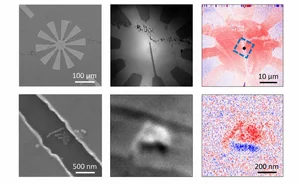
New insights into quantum materials using magnetic imaging
Micro-flowers increase the local magnetic field and expand the range of applications for photoemission electron microscopy:
Materials with magnetic nanostructures have many potential applications such as in spintronics. To explore such materials, nanoscale magnetic-sensitive imaging techniques are very useful, but up to now only weak…
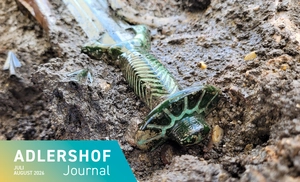
Materials research: BESSY and the bronze sword
A historic artefact was examined at the Adlershof Particle Accelerator:
A weapon is not the sort of object you would expect to find at a particle accelerator. Yet earlier this year, a Bronze Age sword found its way to Berlin: 60 centimetres long, richly decorated, more than 3,400 years…
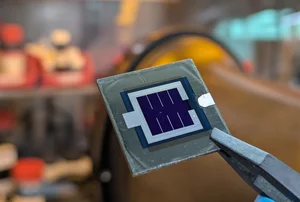
New world record set for the efficiency of a tandem solar cell
A research team from HU and HZB has succeeded in converting 25.5 per cent of sunlight into electrical energy by combining a CIGSe semiconductor layer with perovskite:
With this record, the Berlin-based team of researchers from the Centre for the Science of Materials Berlin (CSMB) at Humboldt University of Berlin (HU) and the Helmholtz-Zentrum Berlin (HZB) has broken its own record…
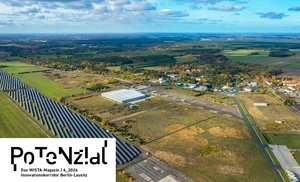
From airfield to innovation laboratory
Lausitz Science Park is taking shape in Cottbus as a science and business park with ambitious plans to give Lusatia a new perspective:
Much of the site is still under construction. Roads need to be built, land developed and buildings planned. But anyone speaking to Julia Raunick and Markus Schwenke, who coordinate the planning and development phase…
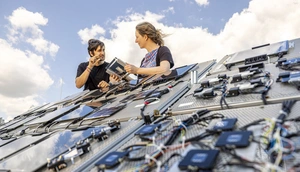
How long do perovskite solar cells last?
Study from the HZB shows which methods are useful for predicting long-term stability and where further research is needed:
Perovskite solar cells (PSCs) could conquer the mass market within a few years, perhaps even being produced in Europe. Their large-scale production is highly cost-effective, and unlike silicon solar cells, their…
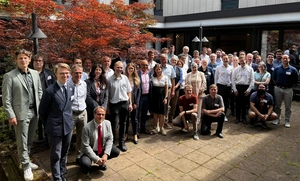
BAM takes a key role in major European research project
The EU project MaterialsCommons is establishing a networked data and AI infrastructure for materials research:
The Federal Institute for Materials Research and Testing (BAM) is taking on a central role in the major European project “MaterialsCommons”, which kicked off in June. Coordinated by Fraunhofer IWM, 26 research…
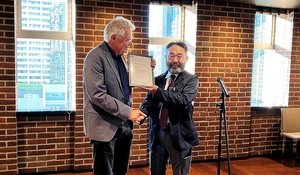
ISO honors Michael Krumrey for excellence
The International Organization for Standardization recognizes the PTB scientist for his many years of leadership:
The head of the department 7.2 “X-ray metrology with synchrotron radiation” at the National Metrology Institute of Germany, PTB, in Adlershof, Dr Michael Krumrey, has received the ISO Excellence Award. The award…
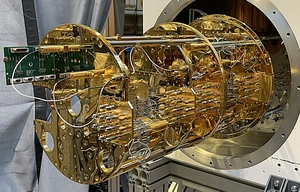
Superconducting TES array X-ray spectrometer goes into operation at BESSY II
The instrument is around 100 to 1,000 times more efficient at detecting photons than conventional devices:
The TES-Spectrometer was developed within a collaboration between the HZB, the MPI-CEC (Mühlheim-an-der-Ruhr, Germany) and the NIST (Boulder CO, USA) and is now in operation at BESSY II, as the only TES-Spectrometer…

ASCEND – A New Era in Catalysis
Federal Research Minister Dorothee Bär launches €30 million project in Berlin:
On 11 June 2026, the Helmholtz-Zentrum Berlin (HZB) in Adlershof hosted the launch of ASCEND (Accelerated Solutions for Catalysis using Emerging Nanotechnology and Digital Innovation). The event took place in the…
Tutorial on the analysis of liposomes and lipid nanoparticles published
PTB contributes to the measurement of key structural parameters for the characterisation of materials:
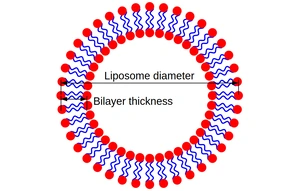
Liposomes and lipid nanoparticles (LNPs) are frequently used as carriers in drug delivery and are able to encapsulate active substances such as nucleic acids and peptides and transport them to the site of treatment in…

The Long Night of Science in Adlershof once again delighted thousands
On 6 June, large numbers of visitors came to the Technology Park:
Following the spectacular drone show to mark the 25th anniversary, the 2026 Long Night of Science in Adlershof saw a return to something closer to “business as usual”. However, enthusiasm for science remains…

X-ray analysis reveals overpainted fascist symbols
At HZB, a work by painter Erich Mercker was examined:
Erich Mercker was a successful painter during the Nazi era and in the years that followed. After 1945, he covered up Nazi symbols in at least one of his paintings. With an interdisciplinary team, physicist Dr Ioanna…

Radiation damage or intrinsic material change?
PTB study reveals dose limits for reliable X-ray analysis of battery materials:
X-ray radiation provides insight into the chemical changes in battery materials during battery operation ("operando"), but is also the cause of radiation-generated effects that can superimpose and falsify measurement…

Magnon momentum microscopy: A new window into nanoscale spin-waves
A new type of momentum microscopy makes it possible to image magnons directly in two-dimensional reciprocal space:
An international team lead by the Max Born Institute has developed a new type of momentum microscopy to image magnons — the quanta of collectively excited spins — directly in two-dimensional reciprocal space using…

Magnetic field during catalyst synthesis triples ammonia yield
Team at HZB demonstrates a scalable strategy for developing next-generation electrocatalysts for efficient and sustainable chemical production:
Applying an external magnetic field during the synthesis of CoFe₂O₄ electrocatalysts triples the ammonia yield during electrocatalytic conversion. The magnetic field alters the surface states of the spinel oxide thin…

Striking a cord in battery research with own scientific contributions
Co-author Dietmar Lerche honoured for a Top viewed Wiley article in 2025:
LUM GmbH is renowned for its scientific and metrological expertise, specializing in particle characterization, stability assessment of suspensions and emulsions, determination of adhesion strengths, as well as quality…