
News

Catalysis App – Structured Research Data for Developing Sustainable Catalysts
The platform enables reliable data sharing and provides a strong foundation for artificial-intelligence-driven analysis:
Catalysis − the reduction of activation energy in a chemical reaction by a catalyst − plays a key role in the chemical industry, as well as in the development of sustainable technologies essential for achieving a…

New calculator supports the planning of electric commercial vehicle fleets
Reiner Lemoine Institute develops an easy-to-use, hands-on service for businesses:
Reiner Lemoine Institute (RLI) has released the STELE Calculator, a new online tool designed to help companies plan their fleets of heavy-duty and commercial electric vehicles. For the first time, the tool enables a…

Electrocatalysts: New model for charge separation at the solid-liquid interface
New model describes the processes at the interface for the first time, thereby enabling targeted strategies for material design:
Hydrogen is at the heart of the transition to carbon neutrality, as both an energy carrier and a reagent for green chemistry. However, large-scale production of hydrogen via electrolysis, as well as the production of…

Environmental Chemistry at BESSY II: Radicals in waterways
HZB research group unravels the light-induced formation of hydroxyl radicals from nitrite:
How do radicals form in aqueous solutions when exposed to UV light? This question is important for health research and environmental protection, for example with regard to the overfertilisation of water bodies by…

DLR investigates mobility needs in the Lusatian region
Pathways to establishing new public transport services in rural areas:
Around 36% of Germany’s population lives in rural areas, and about 90% of them own at least one car per household, significantly higher than the national average of 80% (infas et al. 2025). Rural areas still lack…

Smartphone rapid test detects microbiologically contaminated water in less than a minute
BAM research team developed a highly sensitive detection method for urobilin:
Microbiologically contaminated water poses a significant health risk worldwide – especially in areas where laboratories are scarce and rapid testing is crucial. Researchers at the Federal Institute for Materials…

Call for Videos: Promoting early-career researchers
At the Long Night of Science, candidates for Berlin Science Week will be chosen:
How does your research improve the lives of Berliners? That’s the question asked at the Inspiration Stage during Berlin Science Week on November 7 and 8, 2026—and we can help you take the stage. As institutions in…

Chance encounter in space: JANUS camera captures interstellar comet 3I/ATLAS
ESA's Jupiter probe, JUICE, was unexpectedly perfectly lined up for observations of a comet from deep interstellar space:
The Jupiter Icy Moons Explorer (JUICE) mission, en route to Jupiter on a journey lasting over seven years, was not originally scheduled to conduct scientific operations so early in its voyage. Then, in the summer of…

AI-driven Catalyst Development: €30 Million Funding for German Consortium
The ASCEND project to accelerate material development launches on April 1:
Six partners from research and industry, including the Helmholtz-Zentrum Berlin (HZB), the Fritz Haber Institute of the Max Planck Society (FHI), BASF, Siemens Energy, Dunia Innovations, and the Technical University…

Kick-off for the new data and AI centre at HZB in Adlershof
The data centre will provide a competitive infrastructure for data-driven research in Berlin:
By establishing a new data and AI centre in Berlin, the Zuse Institute Berlin (ZIB) and the Helmholtz-Zentrum Berlin (HZB) are laying the foundations for a scalable and sovereign data infrastructure in the capital.…

DGKK Young Scientist Award for Dr. Moritz Badtke
The researcher made a significant contribution to the further development of laser crystals:
The 2026 DGKK Young Scientist Award is awarded to Dr. Moritz Badtke for his outstanding dissertation in the field of novel laser crystals. With this award, the German society for crystal growth (DGKK) honors…

Digitization of semiconductor epitaxy for power electronics
Joint project “Epi-Techno-Digital” launched with the participation of IKZ, FBH and HU Berlin:
The BMFTR joint project “Digitization for semiconductor epitaxy layers with large band gaps for power electronics” was officially launched with a kick-off meeting hosted by the project coordinator AIXTRON SE in…

Despite the 2025 arson attack: Technology Park Adlershof continues to grow and remains confident and optimistic
Germany’s largest science and technology park continues to grow amidst an ongoing economic crisis / companies recognise responsibility for Germany’s technological independence:
The Science and Technology Park Berlin Adlershof continued its positive development in 2025. Revenues and budget funds rose by around 5% to over 4.2 bn. euros (2025: 4.0 bn. euros). The number of employees also…
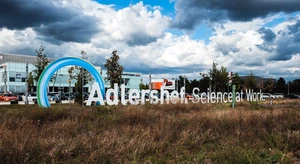
Berlin Adlershof: Facts and figures
Berlin Adlershof is Germany’s largest and most successful Science and Technology Park as well as Berlin’s largest media location—embedded in an overall urban development concept. Spanning an area of 4.6 km², the park…

Berlin Battery Lab officially inaugurated
BAM, HZB and HU are conducting joint research on sodium batteries:
The Federal Institute for Materials Research and Testing (BAM), the Helmholtz-Zentrum Berlin (HZB) and Humboldt-Universität zu Berlin (HU) officially inaugurated the Berlin Battery Lab (BBL) on 19 March. At this new…

Humboldt Fellows at HZB Institute for Solar Fuels
Grants for two researchers are funded by the Alexander von Humboldt Foundation:
Alexander R. Uhl, UBC Okanagan School of Engineering in Kelowna, Canada, aims to develop with Roel van de Krol from the HZB Institute for Solar Fuels an efficient and inexpensive photoelectrolyser for producing…

Ultrafast laser pulses bring diamond-based quantum internet closer to reality
Researchers from Berlin have demonstrated a new method for generating single photons in a diamond-based quantum system:
The controlled generation of single photons is an essential element of numerous quantum technology applications, such as quantum networks and quantum computing. A research team from the Integrated Quantum Photonics…

Research team has developed an alternative spectral imaging method
Quantum interference makes MIR spectroscopy possible using simple camera technology:
Mid-infrared (MIR) spectroscopy uses the molecular fingerprints of samples to perform biomedical or environmental analyses without chemical staining or labeling. Highly specific vibrational states of the different…

Catalysis research at HZB gets new facility
The facility built by ILS is the largest single investment in the CatLab project:
As part of the CatLab project, the Helmholtz-Zentrum Berlin (HZB) has acquired a unique facility for measuring the catalytic performance of thin-film catalysts. Built by ILS in Adlershof, it has now been delivered.…

The research coordinator
Patrick Scheele oversees the scientific direction of Ferdinand-Braun-Institut:
“I wasn’t disappointed,” says Patrick Scheele, looking back on the expectations with which he took up the post of scientific managing director of the Ferdinand-Braun-Institut, Leibniz-Institut für…