
News
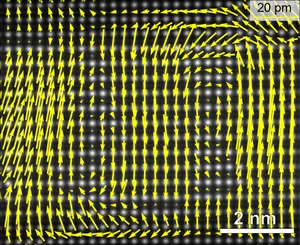
Patterns of polar vortices detected in lead-free superlattices on silicon
HZB team thus expands the possibilities for novel ferroelectric components:
A team at HZB has, for the first time, reported polar vortices in (BaTiO3/SrTiO3)10 superlattices on silicon. These results expand the range of materials and substrates on which polar topological textures can occur…
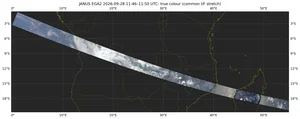
Jupiter space probe JUICE snaps flyby photos of Earth and Moon
Final rehearsal for the instruments ahead of their deployment in the Jupiter system:
On 28 September 2026, the European Space Agency's (ESA) JUICE (Jupiter Icy Moons Explorer) space probe completed its second Earth flyby manoeuvre, marking another important step on its journey to the Jupiter system.…

HZB congratulates Peter Hegemann on winning the Nobel Prize
His research groups have been using the Adlershof-based BESSY II X-ray source for their experiments for many years:
The Helmholtz-Zentrum Berlin (HZB) extends its warmest congratulations to Peter Hegemann, Professor of Neuroscience and Experimental Biophysics at Humboldt University in Berlin. Together with Prof. Georg Nagel (Julius…
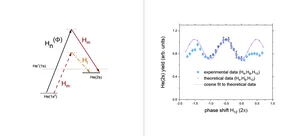
Steering electrons with extreme ultraviolet light
International team demonstrates quantum coherent control in the extreme ultraviolet:
Scientists from the Max Born Institute Berlin (Germany), the Université catholique de Louvain (Belgium), the University of Uppsala (Sweden), Universität Kassel(Germany), and Elettra Sincrotone Trieste (Italy) have…

Far-UVC LEDs transmit data at record speed
Wireless optical communication using UVC light expands the possibilities of radio-frequency technologies:
Researchers at Ferdinand-Braun-Institut (FBH) in Berlin, the Institute of Photonics at University of Strathclyde, and the LiFi Research and Development Centre at University of Cambridge have transmitted data at up to…
Record levels of purity: IKZ silicon for the mirrors of the Einstein Telescope
The institute is contributing to the preparation for the next-generation gravitational-wave detector:
The IKZ is developing the material for one of the most ambitious scientific instruments of the coming decades: high-purity crystalline silicon for the mirrors of the planned Einstein Telescope (ET). Through two…
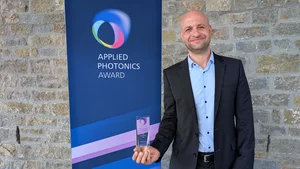
Applied Photonics Award 2026 for FBH researcher
Marc Christ was honoured for his dissertation on compact atomic quantum sensors:
The Applied Photonics Award recognizes outstanding scientific achievements in applied photonics. In his doctoral thesis, Marc Christ developed a technology platform that makes key components of atomic quantum sensors…
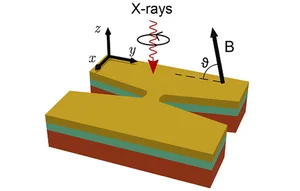
Spin waves inside a nano-oscillator imaged for the first time
The scanning transmission X-ray microscope MAXYMUS at BESSY II reveals magnetisation processes in spintronic devices:
For the first time, researchers have directly imaged the magnetisation dynamics inside a spin Hall nano-oscillator — a nanoscale device that converts direct current into tunable microwave signals and is a promising…
Watching a Carbon-Carbon Double Bond Respond to Light
Research team investigates the molecular response following the photoexcitation of ethylene:
Ethylene contains a carbon–carbon double bond, one of the most important structural motifs in organic chemistry. Carbon–carbon double bonds are present in countless molecules, and their response to light plays a…
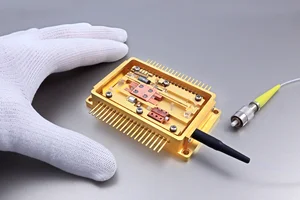
FBH at Photonics Days: from high-power diode lasers to quantum technologies
Ferdinand-Braun-Institut will present the latest developments on 7 and 8 October 2026 in Adlershof:
Ferdinand-Braun-Institut (FBH) will contribute numerous scientific presentations at Photonics Days Berlin Brandenburg on October 7 and 8, 2026. The focus will be on current developments in diode lasers and UV light…
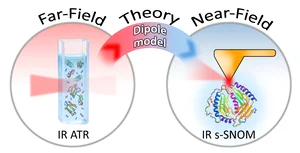
High-resolution insights into individual biomolecules and catalysts
Nanoscale infrared spectroscopy improves the ability to study biological and chemical processes at BESSY II:
Very small biological samples and even individual biomolecules can now be examined under near-physiological conditions with high confidence at the BESSY II infrared beamline with a newly validated and improved…
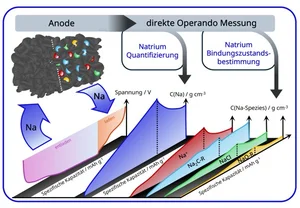
New insights into sodium transport in sodium-ion batteries
Measurements reveal movements and chemical changes in the material:
Sodium-ion batteries are regarded as a promising alternative to today’s lithium-ion batteries. Sodium is widely available and could play an important role, particularly in large-scale stationary energy storage…
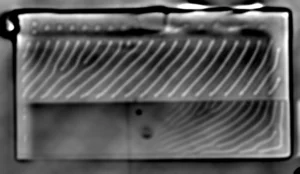
New insights for the development of functional magnetic materials
3D magnetic field experiment at BESSY II takes spintronics a step further:
(Fe0.63Ni0.3Pd0.07)3P or FNPP is a magnetic material that exhibits complex magnetic structures even at room temperature. This makes the material of interest for spintronics, a field that could enable data processing…
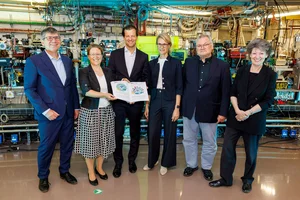
BESSY II is proving its worth – as shown by the impact analysis carried out by DIW Econ
Every euro invested in BESSY yields three euros for Germany, and as many as ten euros for the State of Berlin:
An impact analysis by DIW Econ demonstrates the scientific and economic value of BESSY II. Every euro invested yields three euros for Germany and as much as ten euros for the State of Berlin. Furthermore, the study…
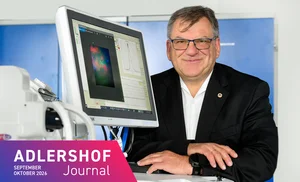
Adlershof, acne and astronauts
JenLab technology offers countless potential applications and is used worldwide:
Its customers range from the European Space Agency (ESA) and global companies such as L’Oréal, Shiseido, Colgate-Palmolive and Procter & Gamble to leading clinics in Boston, Brisbane and Berlin. JenLab was named…
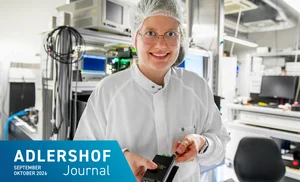
Laser Passion at the Ferdinand-Braun-Institut, Leibniz-Institut für Höchstfrequenztechnik (FBH)
Susann-Alice Seeger is working on a light-based weapon against bacteria:
The tiny beasts can hide away in the deepest recesses. But they don’t stand a chance. A glass fibre can reach them in the remote corners of the nose or throat, where they like to lurk. A pulse of light at a wavelength…
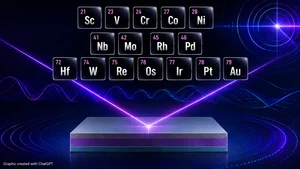
Comprehensive EUV optical constants dataset published
Result of an international collaboration led by PTB and involving eight partner institutions:
Optical constants, as fundamental material parameters, form an important basis for the development and optimisation of optical components, including applications in semiconductor lithography, at synchrotron and…

AEMtec and Micross Sign Agreement to Drive Future Growth
Adlershof-based company AEMtec GmbH to become part of the US firm Micross Components, Inc.:
At the end of July, Micross Components, Inc. signed an agreement to acquire Berlin-based AEMtec GmbH. Through this acquisition, Micross is expanding its expertise in the fields of advanced packaging, photonics and…

Two attosecond flashes capture electrons in motion
Researchers at the Max Born Institute have developed a table-top technique in which attosecond pulses both initiate and probe electronic motion:
Using all-attosecond transient absorption spectroscopy, the team resolved the oscillatory motion of an electron vacancy (an electronic “hole”) in xenon ions with a period of about three femtoseconds. The results have…

OptecNet Germany moves to Berlin
Umbrella organisation for optical technologies with new headquarters in Adlershof:
OptecNet Germany has relocated its headquarters to Berlin. With its new location, the association aims to be closer to federal policymakers and strengthen its dialogue with ministries and other key stakeholders. The…