
High-resolution insights into individual biomolecules and catalysts
Nanoscale infrared spectroscopy improves the ability to study biological and chemical processes at BESSY II
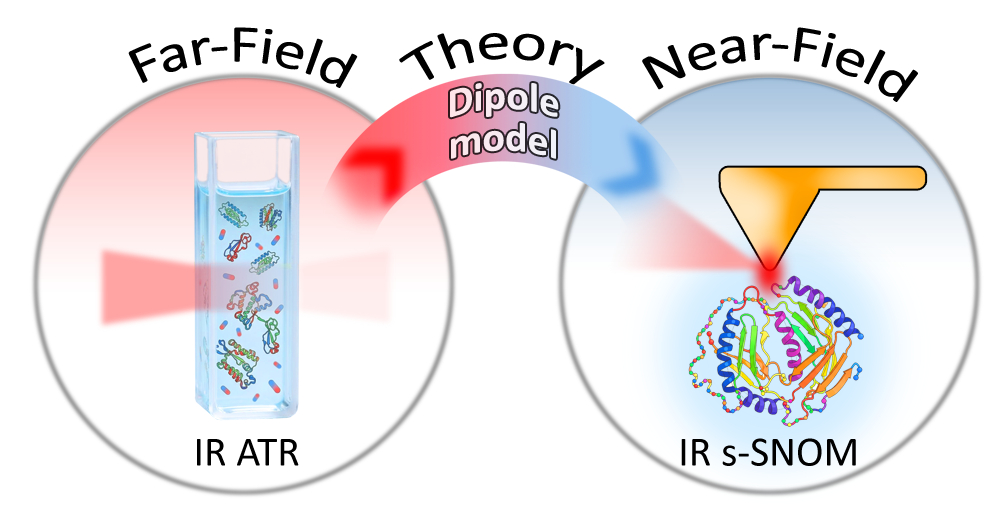
Very small biological samples and even individual biomolecules can now be examined under near-physiological conditions with high confidence at the BESSY II infrared beamline with a newly validated and improved technique: The nanoscale infrared spectroscopy (s-SNOM) with ultra-thin silicon-based membranes. An international team demonstrated after an initial proof of concept, that high-resolution (a few tens of nanometres) nano-IR measurements reliably match expected far-field IR spectra in an aqueous environment. This methodological advance provides a solid foundation for studying biomaterials or observing catalytic processes in a liquid environment.
Infrared spectroscopy can provide insights into the properties of (biological) samples, molecules and soft matter. However, the analysis requires a certain sample size, meaning that only statistical conclusions can be drawn about individual molecules. To investigate individual biomolecules, on the other hand, nanoscale spectroscopy (s-SNOM) using infrared light is ideal. In this technique, an infrared beam illuminates the tip of an atomic force microscope (AFM) while it is scanning the sample; the backscattered light provides local optical information about the near-field interaction between the tip and the sample with a resolution of up to 10 nanometres.
A protective film
Biomolecules naturally exist in aqueous environments, which makes s-SNOM analysis challenging due to strong infrared absorption by water. The initial proof-of-concept studies showed that in-liquid s-SNOM is achievable using ultra-thin silicon nitride or silicon carbide membranes between the AFM tip and the sample. These membranes act as a protective film and are transparent to the mid-infrared range. However, a comprehensive benchmark linking these local near-field measurements back to established and well-known far-field IR reference spectra remained lacking.
Various membranes tested
To address this gap, an international team led by Dr. Alexander Veber performed a systematic study using ultra-thin silicon-based membranes. By thoroughly analyzing the influence of different membrane materials and the liquid environment, they demonstrated that high-resolution nano-IR spectra acquired in aqueous environments directly correlate with standard far-field IR signatures.
“We systematically tested various silicon membranes and examined the samples both in a dry state and in an aqueous environment,” says Dr Maria Eleonora Temperini, first author of the study. The samples included bovine serum albumin and DNA molecules, as well as α-synuclein protein fibrils, which play a role in Alzheimer’s disease.
Experimental data fit to theory
To bridge the gap between conventional far-field and nanoscale near-field infrared spectroscopy, the researchers combined comprehensive experimental data with a theoretical model. "The finite dipole model proved to be the key to describing what actually happens at the nanoscale in presence of the membrane and the liquid," says Temperini. This approach proves that signals from individual biomolecules accurately mirror established reference infrared spectra (far-field), enabling researchers to chemically map biological structures with high resolution down to a few tens of nanometres.
Observing biological and chemical processes
“We can now with confidence use s-SNOM to examine biological samples exactly as they occur in nature, in aqueous environments,” says Veber. The method is particularly interesting for observing biological or chemical processes with high spatial resolution, for example protein dynamics or molecular interactions in catalytically active materials.
Note:
The initial proof-of-concept studies showed that in-liquid s-SNOM is achievable using ultra-thin silicon nitride or silicon carbide membranes between the AFM tip and the sample. The very first work is: Kaltenecker, K. J.; Gölz, T.; Bau, E.; Keilmann, F. Infrared-Spectroscopic, Dynamic near-Field Microscopy of Living Cells and Nanoparticles in Water. Sci. Rep. 2021, 11 (1), 1–12. https://doi.org/10.1038/s41598-021-01425-w.
The HZB team led by Alexander Veber was the first to do this at a synchrotron and used the SiC membranes to extend the spectra range. Veber, A.; Spedalieri, C.; Kneipp, J. Nano-Infrared Imaging and Spectroscopy of Animal Cells in Liquid Environment. Small 2025, 21 (47), 1–11. https://doi.org/10.1002/smll.202507097
Publication:
Analytical Chemistry (2026): Understanding In-liquid Sample Environments for Infrared Nano-spectroscopy of Soft Materials
Maria Eleonora Temperini, Cecilia Spedalieri, Antonia Intze, Valeria Giliberti, Michele Ortolani, Janina Kneipp, Alexander Veber
DOI: 10.1021/acs.analchem.6c03284
Contact:
Helmholtz-Zentrum Berlin für Materialien und Energie
Dr. Alexander Veber
Institute for Electronic Structure Dynamics
+49 30 8062-13443
alexander.veber(at)helmholtz-berlin.de
Dr. Antonia Rötger
Press Officer
+49 30 8062-43733
antonia.roetger(at)helmholtz-berlin.de
HZB press release, 15.09.2026