Get well soon
When you get to a certain age, conversations sooner or later inevitably turn to physical ailments. These are often little things, not actual diseases. Still, there is a seemingly inexhaustible arsenal of horrors. I’m putting it rather flippantly here. Obviously, many people experience things that are anything but funny. When you are personally affected, healthcare can often seem inadequate and medical progress painfully slow. At the same time, the coronavirus pandemic showed what science and research are capable of. Vaccines were developed in what felt like record time. So shouldn’t today’s technologies be able to defeat chronic and rare diseases, or even cancer, just as quickly? With the vast amounts of data now being collected and artificial intelligence?
Expectations are high. Two things are especially high on everyone’s wish list: detecting diseases before they cause problems, and treatments that are tailored to each individual. The good news is that breakthroughs, both large and small, are becoming more frequent, and survival rates for many types of cancer have improved significantly in recent years. The question, then, is not whether the medicine of the future will look different, but how quickly these developments will find their way into our everyday lives. An example: The German weekly DIE ZEIT reported that a medication for postpartum depression has been available in Germany since July. This is all the more encouraging given that the condition has only been the subject of intensive research for a few decades.
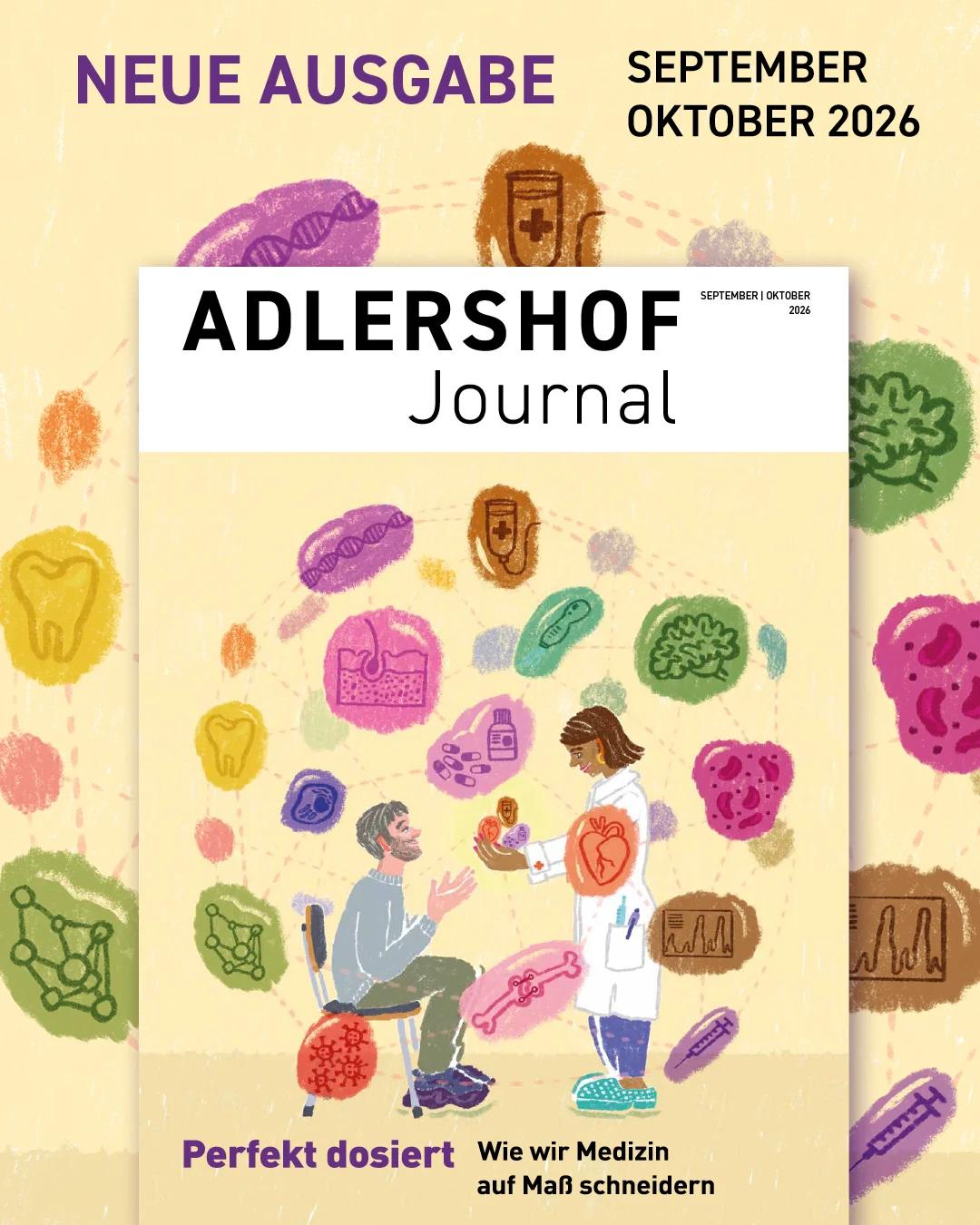
“Medicine of the future” is not only the theme of the 2026 Year of Science, but also of this autumn issue of the Journal. Start-ups, high-tech companies and scientific institutes at Adlershof, Berlin’s science and technology hub, are working on early detection, precision medicine, optimal care for people with chronic conditions, digital assistance systems, and AI-supported diagnostics, in the most impressive ways. So I won’t keep you any longer: Why not start reading this encouraging issue straight away?
Sincerely,
Peggy Mory
Editor-in-chief
Articles

From repair medicine to health medicine
Essay by David Matusiewicz, Professor of Healthcare Management at FOM University and Dean of Health & Social Care:
The medicine of the future will not simply become more digital—it will be more connected, preventive, personalised and humane. From my perspective, we are at a turning point where technological innovation and a…
In conversation with Francoise Hesse, who advises customers on stoma care solutions
“Stoma care but stylish.” That is how Francoise Hesse describes UNORA's products, which are used to care for artificially created openings in the body, such as those involving the bowel, urinary tract or trachea.…
Three recipes for the medicine of tomorrow
Osypka Medical, SEMDATEX, and Hofmann & Sommer are developing solutions for the medical sector in Adlershof:
The future of medicine looks promising. Three Adlershof-based companies show what it could look like. Though they are active in very different fields, they have a common goal: detecting diseases earlier, treating them…
Harmonising care, prevention and day-to-day work
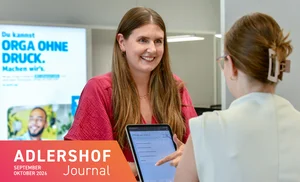
How advisory services and workplace health promotion can support employees through challenging phases of life:
“We want to keep pace with current developments,” says Jennifer Selbmann, a customer adviser at Techniker Krankenkasse (TK), a health insurance provider, in Adlershof. One such development is the growing need for care…
Adlershof, acne and astronauts
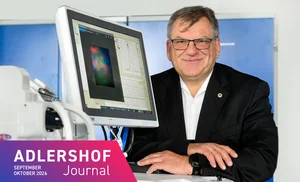
JenLab technology offers countless potential applications and is used worldwide:
Its customers range from the European Space Agency (ESA) and global companies such as L’Oréal, Shiseido, Colgate-Palmolive and Procter & Gamble to leading clinics in Boston, Brisbane and Berlin. JenLab was named…
Laser Passion at the Ferdinand-Braun-Institut, Leibniz-Institut für Höchstfrequenztechnik (FBH)
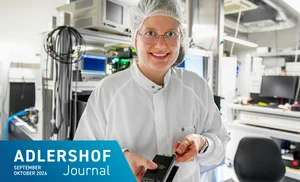
Susann-Alice Seeger is working on a light-based weapon against bacteria:
The tiny beasts can hide away in the deepest recesses. But they don’t stand a chance. A glass fibre can reach them in the remote corners of the nose or throat, where they like to lurk. A pulse of light at a wavelength…
A typo that led to a business idea
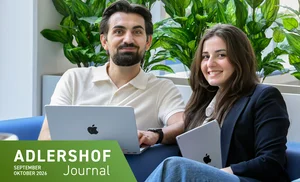
DocGaid develops digital assistants that simplify everyday medical practice operations—one step and form at a time:
During the coronavirus pandemic, Nelli Wolf is sitting at the reception desk of her mother’s dental practice in Berlin. She’s in the middle of studying dentistry in Hamburg. With in-person classes cancelled and staff…

When the chemistry is right
Christoph Arenz at Humboldt-Universität zu Berlin researches a special class of lipids:
Christoph Arenz, professor at the HU Department of Chemistry, researches a special class of lipids. What sounds abstract at first glance has very concrete applications in medicine. In this way, basic research becomes…

Adlershof goes back to school
Rethinking learning – at the new comprehensive school, the architecture and teaching methods create plenty of scope for individuality, community and modern education:
The new school year can begin: Standing in front of the impressive new building at Eisenhutweg 129, anyone can sense that a special place of learning has been created here. A place of the future in the middle of a…
News in brief
Research facilities join forces in data-driven materials research
Research data is regarded as key to materials research in the age of artificial intelligence (AI). With a Memorandum of Understanding (MoU) in July 2026, five Berlin-based research facilities agreed to establish long-term collaboration in the fields of research data, data infrastructures and AI.
The partners in this collaboration include the NFDI consortium FAIRmat, based at Humboldt University of Berlin; the Helmholtz Centre Berlin (HZB); the Leibniz Institute for Crystal Growth (IKZ); the Paul Drude Institute for Solid-State Electronics (PDI); and the Federal Institute for Materials Research and Testing (BAM).
The aim is to make research data accessible across institutions, to develop common standards for data and metadata, and to advance the use of artificial intelligence methods in materials research.
Photonics Days Berlin Brandenburg 2026
The photonics community’s networking event will take place on 7 and 8 October 2026 at WISTA Conventions, Rudower Chaussee 17. The event brings together several hundred participants. Sessions will cover forward-looking topics including laser technologies, optical design, semiconductor technologies, quantum technologies, measurement technology, ophthalmology, photonics for security and protection, innovative lighting technologies and photonic integrated circuits, as well as career opportunities in photonics. Alongside the expert presentations, an exhibition will showcase innovations from Berlin, Brandenburg, across Germany and beyond.
Organiser is Optec-Berlin-Brandenburg (OpTecBB) e. V.
https://optecbb.de/en/association/photonics-days.html
Adlershof Research Forum
Held every two years, the Adlershof Research Forum is a location conference jointly organised by Humboldt-Universität zu Berlin, IGAFA e. V. and WISTA Management GmbH. With presentations, pitches and a poster exhibition, it provides an overview of current research and technology highlights in Adlershof—the “Adlershof knowledge”. This year’s AFF will take place on Wednesday, 11 November 2026 at the Erwin Schrödinger Centre, Rudower Chaussee 26.
WISTA Welcome Tour
Discover the success story of the Technology Park Adlershof on the free WISTA Welcome Tour on 7 October 2026, from 2.30 to 5.00 pm.The tour offers a concise, engaging and inspiring introduction to the site. Following a presentation highlighting the site’s history and development, the tour continues with an exclusive look around the campus.
Information and registration:
https://www.adlershof.de/termin/entdeckt-die-erfolgsgeschichte-des-technologieparks-adlershof
Technical monument “Adlershofer Busen” restored
Built between 1959 and 1961, the thermally constant spherical laboratories at the corner of Rudower Chaussee and Am Studio are among Berlin’s most distinctive technical monuments and document the history of Adlershof as a centre of science. They have now been carefully restored by their owner, EUROPA-CENTER, in close consultation with the State Monument Authority and an interdisciplinary team of architects, conservators and specialist companies, preserving them for future generations.
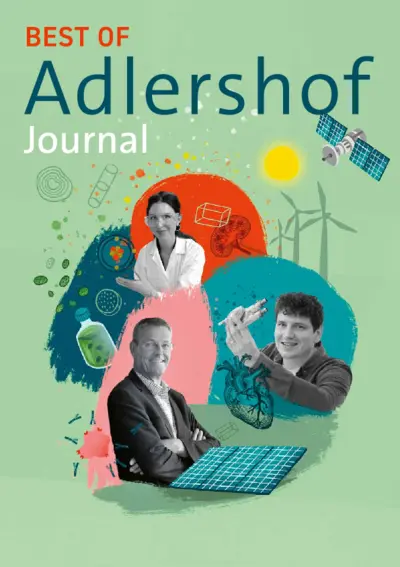
Best of “Adlershof Journal”
WISTA Magazine
We also report on the other WISTA Future Sites and cross-cutting topics in Potenzial: