
Berlin Adlershof: Facts and figures
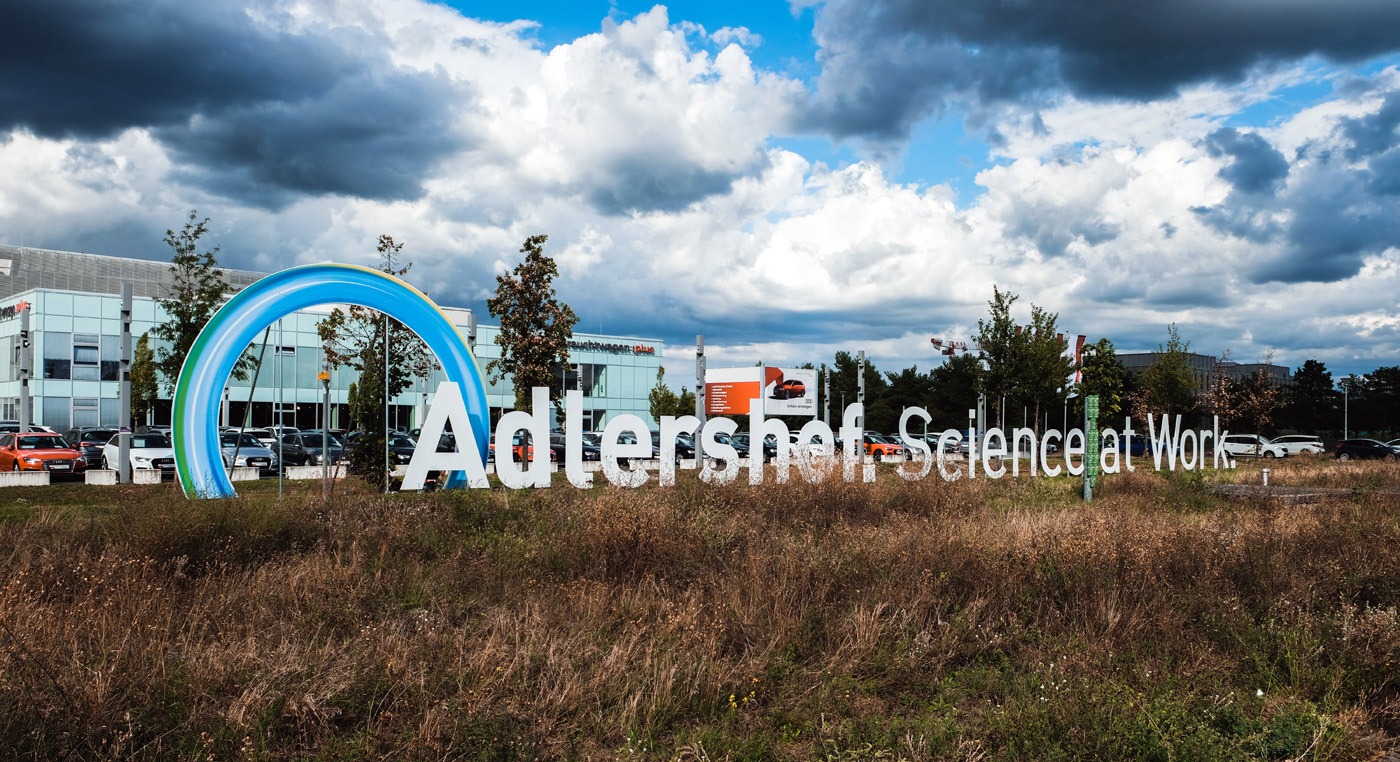
Berlin Adlershof is Germany’s largest and most successful Science and Technology Park as well as Berlin’s largest media location—embedded in an overall urban development concept. Spanning an area of 4.6 km², the park is home to 1,300 companies and 18 scientific institutions with around 29,600 employees. Adding to this are approx. 6,200 students.
The Science and Technology Park Adlershof is divided into three areas: the core area, the growth area, and Media City.
In the core area of the Science and Technology Park, which is shaped predominantly by high-technology companies, around 600 companies were able to grow their revenues and subsidies to 1.26 bn. euros in the past year. Around 9,500 people worked in the core area in 2025. This represents a slight increase.
The revenues and budget funds of the approximately 460 companies and research facilities in the growth area rose by 2%—amounting to 1.89 bn. euros in 2025. The number of employees also saw an increase—by 2% to 12,300 people.
At Media City, the number of companies fell slightly to 230, whilst the number of employees rose slightly to 3,600. Revenue increased by 4.3%, totalling 491 million euros. The number of so-called regular freelancers remained largely stable, with around 960 of them working on the site.
In the core area of the Science and Technology Park, the approximately 600 companies and non-university research institutes focus on the following technology fields:
- photonics and optics,
- photovoltaics and renewable energies,
- microsystems and materials,
- information technology (IT) and media,
- biotechnology and environmental technologies.
Adding to this are the institutes of Humboldt-Universität zu Berlin (chemistry, geography, computer science, mathematics, physics, and psychology).
In the immediate neighbourhood (growth area) and in addition to Media City with its 230 companies, an ensemble of now approximately 460 local businesses, shops, hotels and restaurants has developed. The Science and Technology Park as well as the 45-ha area of the former rail yard in Schöneweide (“Gleislinse”) have additional lots at their disposal, providing companies with ideal conditions for further growth.
Adlershof is not just a place to work, but has also developed into a vibrant place to live. Next to a local service infrastructure (daycare centres, doctors, etc.) as well as retail and gastronomy, the importance of Adlershof as a place to live has been growing. More and more single family homes, condominiums, rental apartments, townhouses, and managed apartments have been built. At the end of 2025, there were around 3,900 residential units across Adlershof’s development area. More housing will be added in the years to come.
Science City Adlershof in figures
Last updated: 31.12.2025
Area: 4.6 km²
Staff: 29,600
Companies: 1,300
Scientific facilities: 18
Core area of the Science and Technology Park
Companies
Number: 600
Staff: 9,500
Revenues (total): 1.26 billion euros (incl. subsidies)
Scientific institutions
Non-university research institutions
Number: 11
Staff: 3,100
Core funding: 356 million euros
Subsidies and third-party funding: 103 million euros
Humboldt-Universität zu Berlin
Number of institutes: 7
(computer science, mathematics, chemistry, physics, geography, psychology, CSMB Adlershof)
Staff: 1,100
Students: 6,200
Core funding: 86 million euros
Third-party funding: 38 million euros
Media city
Companies: 230
Staff: 3,600 (incl. freelancers)
Revenues: 491 million euros (incl. subsidies)
Growth area (commerce and services)
Companies and facilities: 460
Staff: 12,300
Revenues and budget funds: 1.89 billion euros (incl. subsidies)
Contact:
WISTA Management GmbH
Rudower Chaussee 17, 12489 Berlin
+49 30 6392-2191
presse(at)wista.de
www.wista.de
Downloads