• Skip to Page content
  • Skip to Management
  • Skip to Main menu
Adlershof - science at work
  • WISTA
  • WISTA.Plan
  • WISTA.Service
  • WISTA direkt
  • Search
    • de
    • en
  • Adlershof - science at work
  • Technology Park
    • Companies / Institutes
    • Science City in numbers
    • Direction / Maps
      • Bus / Train
      • By Car
      • Bicycle
      • Orientation / Maps
      • Trail of Thoughts
  • Newsroom
    • Overview
    • News
      • Social Media Stream
      • Success Stories
    • Events / Calendar
      • Adlershof Winter Magic
      • Adlershof Research Forum
      • Long Night of Sciences Berlin
    • Adlershof Journal
    • Hot Topics
      • Grand Challenges
      • Circular Economy
      • Climate change mitigation
      • Digital infra­structure / 5G campus network
    • Photos / Flyer / Downloads
      • Magazine archive
    • WISTA-Editorial Staff
  • Science / Technology
    • Overview
    • Technology Centres
      • Photonics / Optics
      • Biotech­nology / Envi­ron­ment
      • Micro­systems / Materi­als
      • IT / Media
      • Renewable Energy / Photovoltaics
    • Non-university Research
    • Universities / Colleges
      • Humboldt-Universität zu Berlin
      • Services for Students
    • Young Talents / STEM / School Labs
    • Start-Ups
      • Adlershof Start-Up Centre IGZ
      • Adlershof Startup Lab
    • Networks / Management
      • Campus Club Adlershof
      • workhier! Academics Career Programme
      • WISTA Academy
  • TV / Media
    • TV and Movie Production
    • Media Services / Companies
    • News and Events
    • Filming Locations
    • Costume Hire
    • GDR Film Archive
    • Tickets / Booking
  • Properties
    • Overview
    • Real Estate Rent
      • Office Space / Workspace / Laboratories
    • Real Estate Offers
      • Commercial Properties
    • ST3AM Working Environments / Coworking
    • Residential
    • Construction
      • Building Projects
      • Architecture
      • Time-lapse footage
  • Service
    • Overview
    • Gastronomy / Leisure / Shopping
    • Jobs / Market
    • Social and Healthcare Facilities
    • WISTA-Business Services
    • Event Services / Guided Tours / Hotels
    • Facility Management
    • Downloads / Photos / Videos
    • Jobs for Refugees
  • Hood
    • Overview
    • History
    • Nature Park
    • Culture
    • Technology Park
    • Digital Tours
  • WISTA
  • WISTA.Plan
  • WISTA.Service
WISTA direkt
  • Home Technology Park
  • Newsroom
  • News

News

  • Overview
  • News
  • Events / Calendar
  • Adlershof Journal
  • Hot Topics
  • Photos / Flyer / Downloads
  • WISTA-Editorial Staff
  • Home Technology Park
  • Newsroom
  • News
30. September 2026

Nanosilver as an electro­catalyst for CO₂ reduction

Simultaneous production of formic acid, hydrogen and CO further enhances the cost-effectiveness of electrolysis
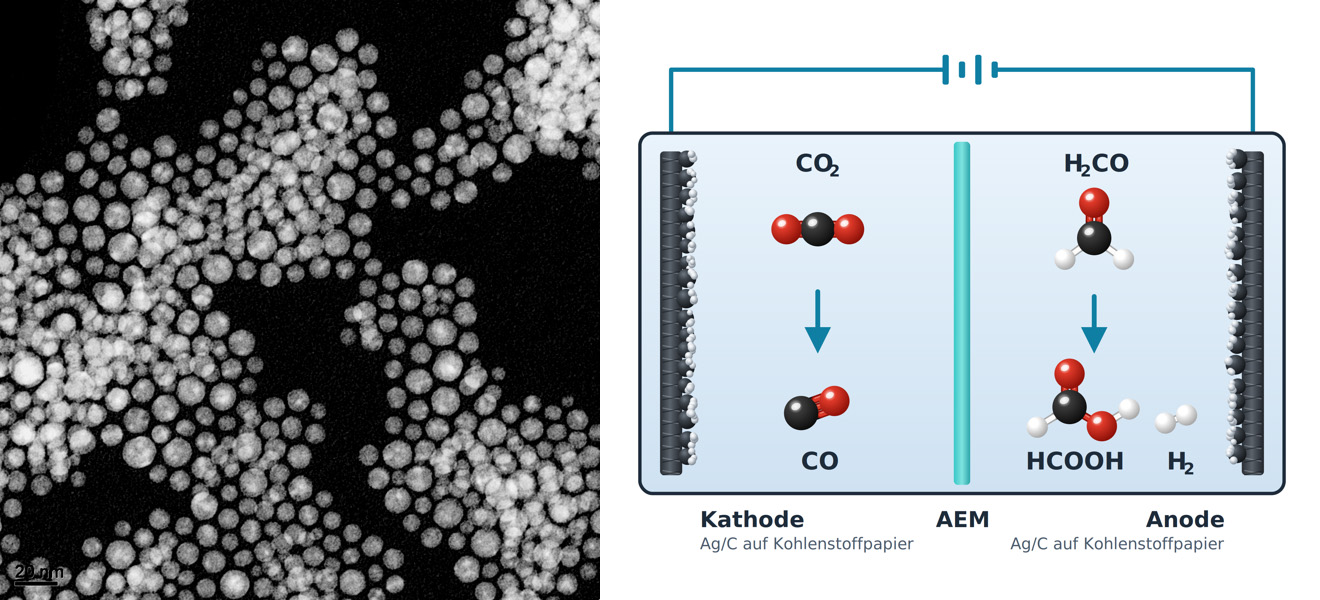
Left: white dots in clusters on a black background. Right: Schematic diagram of an electrochemical cell with a cathode and an anode and various molecules
Left: Silver nanoparticles with diameters of ~10 nm, combined with a conductive carbon powder in a ratio of 20:80, on an electrode (image taken using a transmission electron microscope, TEM). Right: Combined electrochemical cell with optimised electrocatalysts made with silver nanoparticles: on the left, at the cathode, carbon dioxide (CO₂) is reduced to carbon monoxide (CO). On the right, at the anode, formaldehyde (HCOH) is oxidised to formic acid (HCOOH). Hydrogen (H₂) is also produced. © HZB

Via electrolysis, CO2 can be reduced to CO, a raw material for further chemical products such as fuels. Within the GreenQuest Project, an internation team led by HZB chemist Prashanth Menezes has now systematically investigated catalyst layers made of silver nanoparticles, varying both the size of the particles and their density. The best yield was achieved with nanoparticles with diameters of around 10 nm, which were loosely distributed. Furthermore, they demonstrated how the economic efficiency of the electrochemical cell can be enhanced by integrating an additional chemical reaction at the anode, enabling the simultaneous production of a valuable formic acid, hydrogen, and CO in one device.

The greenhouse gas CO2 can be reduced electrolytically to carbon monoxide (CO) using electrical energy. In subsequent steps, the CO and H₂ generated through electrochemical processes form syngas, which is subsequently converted to DME and further catalytically transformed into green-LFG, primarily comprising propane (C₃H₈) and butane (C₄H₁₀). Provided that the electrical energy for electrolysis is generated from solar or wind power, this technology can be considered carbon neutral, since CO2 is, so to speak, recycled. Teams from HZB are collaborating with partner institutions in South Africa on this technology within the GreenQUEST project. Their goal is to develop an affordable and sustainable “green” cooking fuel (gLFG) as a cleaner alternative to traditional biomass-based cooking, particularly in rural regions of South Africa where firewood remains an important household energy source.

A team led by Dr Prashanth Menezes at HZB has now demonstrated a way to improve the efficiency and cost-effectiveness of the electrolytical reduction of CO2 to CO. They systematically investigated catalyst layers made of silver nanoparticles, varying both the size of the particles and their density on a carbon powder material that covers the carbon electrode.

“We already knew that too tiny nanoparticles promote hydrogen evolution, which reduces the carbon monoxide yield. Conversely, nanoparticles that are too large are catalytically less active. We wanted to identify the exact optimum,” says Dr Niklas Hausmann, co-author of the study. Their study shows: The best yield was achieved with nanoparticles with diameters of around 10 nm, which were loosely distributed over the carbon material (0.2 mg per square centimetre of electrode).

A second step brought a further improvement: whilst carbon dioxide is reduced to carbon monoxide at the cathode, an oxygen evolution reaction normally takes place at the anode. This oxygen evolution reaction consumes a great deal of energy, which must be supplied by electricity, and yields only oxygen, which has no economic value. The team has now demonstrated that by adding aldehydes to the electrolyte, the oxygen evolution reaction can be replaced by an aldehyde oxidation reaction. This reduces the energy consumption of the entire process by more than 30 %. In addition, instead of oxygen, useful hydrogen gas and valuable carboxylic acids such as formic acid are produced.

The optimised catalyst based on silver nanoparticles exhibited a Faradaic efficiency of almost 100 % for CO over the remarkably long period of 100 hours. Investigations using X-ray photoelectron spectroscopy confirmed that the electronic and chemical structure of the active silver particles remains largely stable during operation.

“If we combine the production of CO with hydrogen generation and the simultaneous formation of other value-added chemicals such as formic acid, we can improve the overall value of the electrochemical process. The CO and hydrogen can serve as building blocks for the subsequent production of sustainable fuels and chemicals,” says Menezes.

Note: This work was performed within the GreenQUEST project, a collaborative German–South African initiative funded by the BMFTR and led by HZB. The goal is advancing sustainable green liquefied fuel gas (gLFG) production pathways based on circular carbon utilisation.
https://www.greenquest.africa/

Publication:

Advanced Functional Materials (2026): Decoupling the Size and Loading Effects in Silver Nanoparticles for Efficient Paired Carbon Dioxide and Formaldehyde Electrolysis
Venkata S. R. K. Tandava, Clara Große, Debabrata Bagchi, Zhenye Zhu, Suptish Ghosh, J. Niklas Hausmann, Carsten Walter, Rosario Suarez Anzorena, Catalina Elena Jimenez, Yasmin Lucero Cobos-Becerra, Jack C. Q. Fletcher, Tobias Sontheimer, Michael Schwarze, Holger Dau, Matthias Driess, Marcus Bär, Prashanth W. Menezes
DOI: 10.1002/adfm.78365

Contact:

Helmholtz-Zentrum Berlin für Materialien und Energie
Department Materials Chemistry for Catalysis

Jan Niklas Hausmann
(030) 8062-15175
niklas.hausmann(at)helmholtz-berlin.de

Dr. Prashanth Menezes
(030) 8062-15174
prashanth.menezes(at)helmholtz-berlin.de

Press Officer
Dr. Antonia Rötger
(030) 8062-43733
antonia.roetger(at)helmholtz-berlin.de


HZB press release, 24 September 2026

Research Renewable Energies Microsystems / Materials Grand Challenges Biotechnology / Environment

Related News

Figure: methods and techniques of synthesis

Materials chemistry shapes the future of catalysis

Emerging developments in operando analytics, data-driven discovery and autonomous robotics are transforming synthesis into the central tool for the targeted development of smart and adaptive electrocatalysts
Nine illustrative figures visualising chemical reactions

Electrocatalysis with dual functionality – an overview

Synchrotron sources provide insights into complex reactions and can thus help in the development of hybrid electrolysers
Illustration of the material structure

A cage structured material transforms into a performant catalyst for producing green hydrogen

The promising material class of clathrates was investigated at BESSY II
Figure visualizing the added value of research and development so that research funds can be invested in promising and important projects. © 10.1016/j.joule.2024.07.005

Green hydrogen from direct seawater electrolysis

International experts compare different approaches and warn against hype

Related Institutions

  • Helmholtz-Zentrum Berlin für Materialien und Energie GmbH, Elektronenspeicherring BESSY II

Share this page

The development of the Science and Technology Park Berlin Adlershof was and is co-financed by the European Union namely by EFRE. This concerns infrastructure development like construction of technology centres. Furthermore EFRE is used for international projects.

  • © WISTA Management GmbH
  • Legal Notice
  • Privacy Policy
  • Digital Accessibility
  • Social Media Guide
  • FAQ
  • Contact
  • Press
  • Newsletter
  • RSS
  • International
Member of:
Zukunftsorte Berlin Logo, Standort Adlershof