• Skip to Page content
  • Skip to Management
  • Skip to Main menu
Adlershof - science at work
  • WISTA
  • WISTA.Plan
  • WISTA.Service
  • WISTA direkt
  • Search
    • de
    • en
  • Adlershof - science at work
  • Technology Park
    • Companies / Institutes
    • Science City in numbers
    • Direction / Maps
      • Bus / Train
      • By Car
      • Bicycle
      • Orientation / Maps
      • Trail of Thoughts
  • Newsroom
    • Overview
    • News
      • Social Media Stream
      • Success Stories
    • Events / Calendar
      • Adlershof Connect
      • Long Night of Sciences Berlin
      • Adlershof Research Forum
    • Adlershof Journal
    • Hot Topics
      • Grand Challenges
      • Circular Economy
      • Climate change mitigation
      • Digital infra­structure / 5G campus network
    • Photos / Flyer / Downloads
      • Magazine archive
    • WISTA-Editorial Staff
  • Science / Technology
    • Overview
    • Technology Centres
      • Photonics / Optics
      • Biotech­nology / Envi­ron­ment
      • Micro­systems / Materi­als
      • IT / Media
      • Renewable Energy / Photovoltaics
    • Non-university Research
    • Universities / Colleges
      • Humboldt-Universität zu Berlin
      • Services for Students
    • Young Talents / STEM / School Labs
    • Start-Ups
      • Adlershof Start-Up Centre IGZ
      • Adlershof Startup Lab
    • Networks / Management
      • Campus Club Adlershof
      • workhier! Academics Career Programme
      • WISTA Academy
  • TV / Media
    • TV and Movie Production
    • Media Services / Companies
    • News and Events
    • Filming Locations
    • Costume Hire
    • GDR Film Archive
    • Tickets / Booking
  • Properties
    • Overview
    • Real Estate Rent
      • Office Space / Workspace / Laboratories
    • Real Estate Offers
      • Commercial Properties
    • ST3AM Working Environments / Coworking
    • Residential
    • Construction
      • Building Projects
      • Architecture
      • Time-lapse footage
  • Service
    • Overview
    • Gastronomy / Leisure / Shopping
    • Jobs / Market
    • Social and Healthcare Facilities
    • WISTA-Business Services
    • Event Services / Guided Tours / Hotels
    • Facility Management
    • Downloads / Photos / Videos
    • Jobs for Refugees
  • Hood
    • Overview
    • History
    • Nature Park
    • Culture
    • Technology Park
    • Digital Tours
  • WISTA
  • WISTA.Plan
  • WISTA.Service
WISTA direkt
  • Home Technology Park
  • Newsroom
  • News

News

  • Overview
  • News
  • Events / Calendar
  • Adlershof Journal
  • Hot Topics
  • Photos / Flyer / Downloads
  • WISTA-Editorial Staff
  • Home Technology Park
  • Newsroom
  • News
15. July 2026

New atomic trap boosts quantum performance by utilising surface forces

Researchers at HU have developed a new method for trapping and controlling atoms
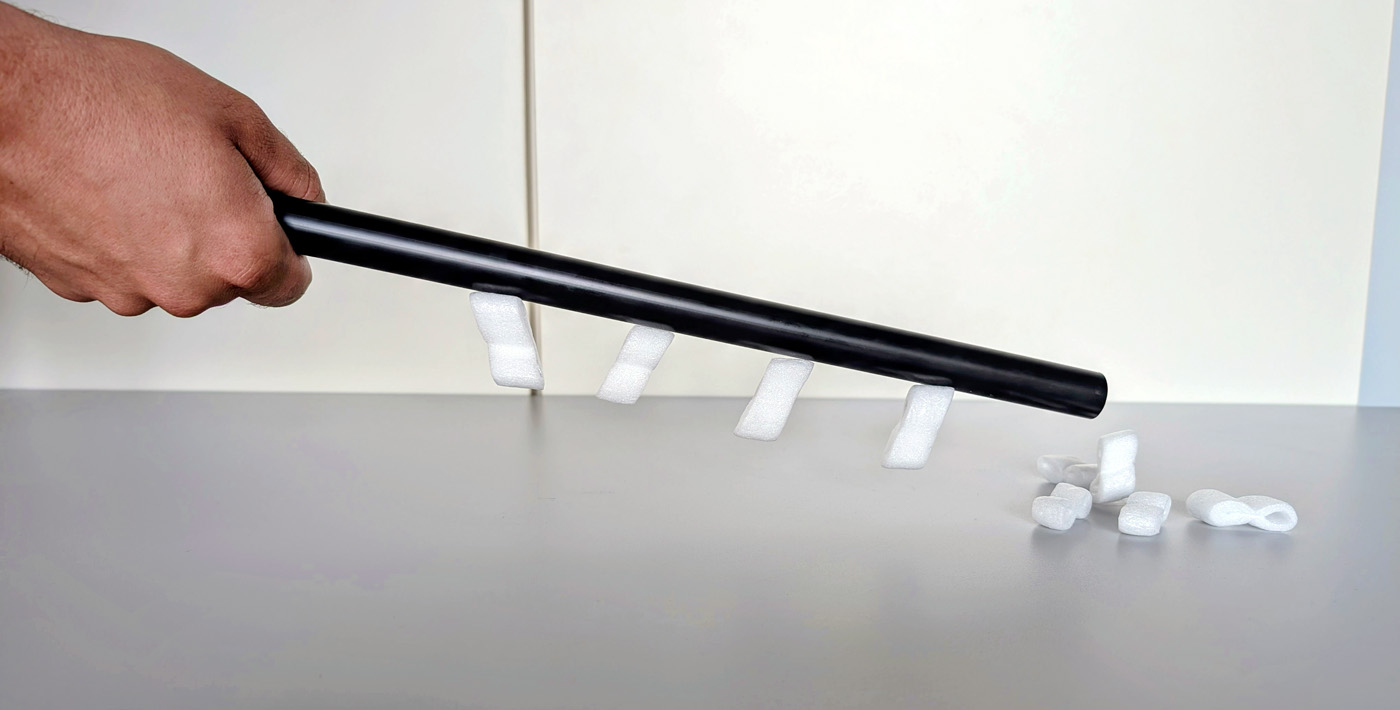
A hand holding a plastic stick with polystyrene flakes stuck to it
The same forces that the HU researchers use in their quantum physics experiment to trap atoms are also at work when polystyrene flakes are attracted to a plastic rod that has been electrostatically charged by friction. © Arno Rauschenbeutel/HU Berlin

Trapping and controlling atoms is one of the technical foundations for utilising their quantum mechanical properties – for example, for secure communication in quantum networks or in quantum computing. Many novel quantum devices rely on the interconnection of atoms using light: For example, atoms are trapped and held near tiny light-guiding structures to enable efficient communication between the quantum particles. Until now, multiple laser beams were required to keep the atoms in place within such nanophotonic systems.

New approach combines light and naturally occurring electrostatic forces

The research group ‘Fundamentals of Optics and Photonics’ led by Prof. Dr Arno Rauschenbeutel at the Institute of Physics, Humboldt-Universität zu Berlin (HU), has now developed a simpler and fundamentally different approach. The researchers trap laser-cooled atoms using a combination of light and naturally occurring electrostatic forces, and hold them near an ultra-thin glass fibre (100 times thinner than a single hair). Using this approach, they were able to significantly improve the stability and coherence of the trapped atoms compared to previous experiments: the atoms remained in the ‘trap’ for twice as long, and the quantum information could be stored ten times longer. The study, in which the researchers demonstrate the new experimental approach, was recently published in the renowned journal Nature Photonics.

Quantum information stored in atoms is preserved more effectively

For their approach, the quantum researchers do not rely on laser light to attract atoms to the ultra-thin glass fibre. Instead, their approach makes use of the electrostatic forces that occur naturally on the surface of the glass fibre. In their study, they demonstrate how the surface forces attract the atoms, whilst an additional laser field gently pushes them away from the surface – thereby creating a stable trapping region.

Although the resulting trap holds the atoms less tightly than conventional traps, the team succeeded in transferring atoms to it efficiently, with hardly any atoms being lost. Once inside the trap, the atoms remained ‘trapped’ for a surprisingly long period of time and preserved their quantum properties far better than in previous experiments with such nanophotonic systems. This improvement is due to the fact that the atoms are kept in regions with very low light for most of the time.  This reduces disturbances that can degrade delicate quantum states, allowing quantum information stored in the atoms to remain intact much longer.

“Powerful new tool for controlling quantum particles”

“This research opens up new possibilities for investigating the interactions between atoms and surfaces on extremely small scales, and introduces surface forces as a powerful new tool for controlling quantum particles. We believe that this technique could help to improve future quantum memories, quantum communication networks and other technologies based on long-lived quantum states,” explains Dr Riccardo Pennetta, lead author of the study and a postdoctoral researcher in the research group ‘Fundamentals of Optics and Photonics’ at the Department of Physics at HU. Prof. Dr Arno Rauschenbeutel, head of the research group, adds: “By showing that surface forces are not just a nuisance but that they can be useful, the study sets a new direction for the development of quantum devices. This will make optical quantum technologies both simpler and more robust in the future.” 

Further information:

Research article in *Nature Photonics*: “Hybrid Nanophotonic Trap for Cold Atoms Using Surface Forces and a Blue-Detuned Evanescent Field”

‘Fundamentals of Optics and Photonics’ Research Group at the Institute of Physics, Humboldt-Universität zu Berlin

Contact:

Prof. Dr. Arno Rauschenbeutel
Institute of Physics, Humboldt-Universität zu Berlin
+49 30 2093-82152
arno.rauschenbeutel(at)hu-berlin.de

Dr. Riccardo Pennetta
Institute of Physics, Humboldt-Universität zu Berlin
+49 30 2093-82160
riccardo.pennetta(at)physik.hu-berlin.de


Press release, HU Berlin, 15 July 2026

Universities Photonics / Optics IT / Media

Related News

nano-repeater, Grafic: ©HU Berlin

HU researchers develop a light amplifier for efficient fiber optic networks

The nano-repeater has succeeded in amplifying light in a glass fiber in just one direction

Related Institutions

  • Campus Adlershof der Humboldt-Universität zu Berlin
  • Humboldt-Universität zu Berlin | Institut für Physik

Share this page

The development of the Science and Technology Park Berlin Adlershof was and is co-financed by the European Union namely by EFRE. This concerns infrastructure development like construction of technology centres. Furthermore EFRE is used for international projects.

  • © WISTA Management GmbH
  • Legal Notice
  • Privacy Policy
  • Social Media Guide
  • FAQ
  • Contact
  • Press
  • Newsletter
  • RSS
  • International
Member of:
Zukunftsort Adlershof Logo