
New contact material boosts the efficiency of perovskite solar cells
The new carborane-based material improves efficiency and stability; it has since been patented and is already commercially available
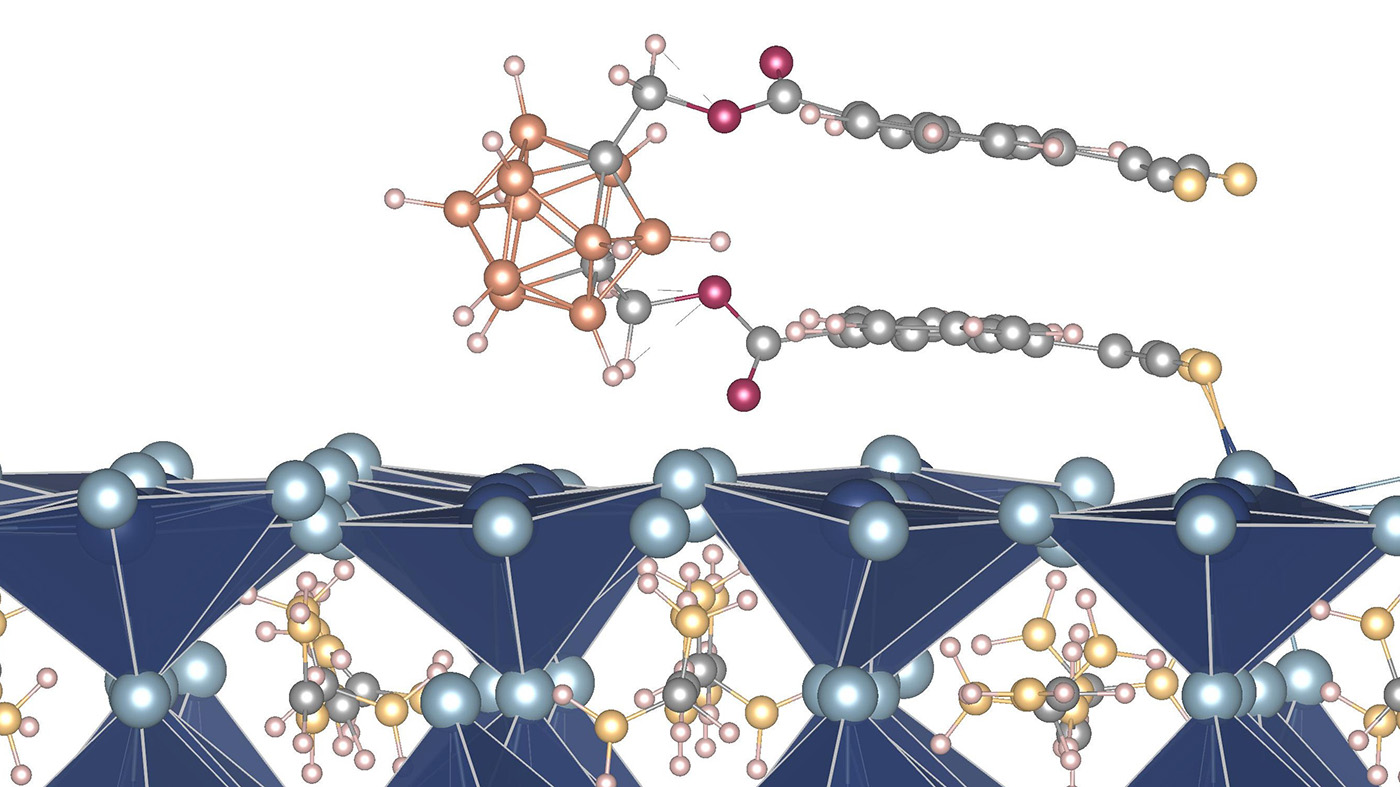
A newly developed material for the electron contact improves the efficiency of single perovskite solar cells and perovskite/silicon tandem solar cells. The new material is based on a carborane molecule. It offers several advantages over the standard material C60, as shown by the study led by Steve Albrecht’s team. The new material has since been patented and is already commercially available.
Perovskite solar cells are not only exceptionally inexpensive to manufacture but also achieve very high efficiency levels. Single-junction perovskite devices already can convert over 27 per cent of sunlight into electrical energy, while perovskite-silicon tandem cells have even achieved efficiencies of over 35 per cent. Until now, a layer of so-called ‘football molecules’ (C60) has been used to transport electrons away. However, a significant proportion of the charge carriers are lost at the interface between the C60 layer and the perovskite absorber. Furthermore, C60 materials are relatively expensive and tend to delaminate over time, compromising the cell’s stability.
Novel material developed
In collaboration with a group from Kaunas University of Technology (KTU) in Lithuania and other partners, the team led by Professor Steve Albrecht at HZB has now developed a novel carborane-based material. Not only can it replace C60 electron-transport materials, it is also superior in many respects. The material can be produced from commercially available reagents. The molecules consist of a meta-carborane core with two 9-fluorenylidene malononitrile functional groups (mCB-FMN).
Multiple advantages
Compared to C60, the thin film can be deposited from the vapour phase at lower temperatures. This means that the production of the layer requires less energy and places less thermal stress on the equipment. The evaporated mCB-FMN forms a uniform layer on the perovskite absorber. Measurements of transient surface photovoltage (trSPV) and photoluminescence (PL) reveal that this layer facilitates the transport of electrons very effectively with fewer losses at the interface than with C60. Investigations using He-I ultraviolet photoemission spectroscopy (He-UPS) showed that the mCB-FMN layer and the perovskite absorber layer are well matched energetically. Density functional theory (DFT) calculations suggest that surface defects are passivated, which could be a further reason for the lower losses. Electron microscopy and in-situ ellipsometry during deposition of the overlying SnOx buffer layer demonstrate that the new ETM even improves film growth. Mechanical tests confirm that the new material also enhances interfacial adhesion and, consequently, stability within the perovskite/ETM/SnOx layer stack.
Improved efficiency
As a result, the efficiency of a single p-i-n perovskite cell increases by 1.5% (in absolute terms) when the new ETM replaces C60. In perovskite-silicon tandem cells, the efficiency increases by as much as 2.4% (in absolute terms) compared to the reference cell. This is because the lower parasitic absorption also allows more light to reach the photoactive layers.
‘We have developed a very high-performance substitute material for fullerenes in perovskite solar cells, and we have demonstrated its benefits through different measurements,’ says Lea Zimmermann, first author of the study.
Already commercially available
The new material has already attracted considerable interest in both academic and industrial circles, and it was selected for the “Best Scientific Content Award” at the 2025 TandemPV International Workshop. A European patent application has been filed (EP 25175871.0) has been filed, covering mCB-FMN, its derivatives and their use in solar cells. ‘Dyenamo has now brought this material to market with the aim of enabling its widespread use,’ explains Steve Albrecht.
Novel materials for tandem solar cells
His team had already achieved a breakthrough with self-assembling monolayers (SAMs) for the hole-conducting contact layers on the other side of the solar cell, in collaboration with international partners. They are now aiming to achieve the same for the electron transport layer: ‘We are currently working flat out on developing further novel materials in this class and we believe that this class of materials could also revolutionise tandem solar cells,’ says Albrecht.
Publication:
Energy and Environmental Science (2026): A novel carborane-based electron transport material for high-performance perovskite/silicon tandem solar cells
Lea Zimmermann, Julius Petrulevicius, Dorothee Menzel, Wander Max Bernardes de Araujo, Kazuki Morita, Suresh Maniyarasu, Maxim Simmonds, Yasaman Salimi, Dong Kuk Kim, Florian Mathies, Florian Scheler, Sebastian Berwig, Woongmo Sung, Satoshi Nihonyanagi, Arman Mahboubi Soufiani, Angelika Harter, Vygintas Jankauskas, Jona Kurpiers, Tadas Malinauskas, Tahei Tahara, Mariadriana Creatore, Sebastian Wood, Rutger Schlatmann, Bernd Stannowski, Lars Korte, Eike Köhnen, Vytautas Getautis, Steve Albrecht
DOI: 10.1039/d6ee01246a
Contact:
Helmholtz-Zentrum Berlin für Materialien und Energie
Department Perovskite Tandem Solar Cells
Lea Zimmermann
(030) 8062-41322
lea.zimmermann(at)helmholtz-berlin.de
Dr. Eike Köhnen
(030) 8062-41390
eike.koehnen(at)helmholtz-berlin.de
Prof. Dr. Steve Albrecht
(030) 8062-41334
steve.albrecht(at)helmholtz-berlin.de
Press Officer:
Dr. Antonia Rötger
(030) 8062-43733
antonia.roetger(at)helmholtz-berlin.de
www.helmholtz-berlin.de
HZB press release, 16 July 2026