
New insights into sodium transport in sodium-ion batteries
Measurements reveal movements and chemical changes in the material
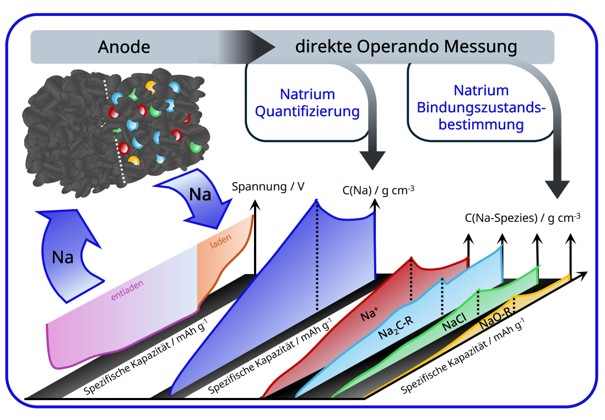
Sodium-ion batteries are regarded as a promising alternative to today’s lithium-ion batteries. Sodium is widely available and could play an important role, particularly in large-scale stationary energy storage systems. However, in order to develop high-performance, long-lasting sodium-ion batteries, it is essential to gain a better understanding of what actually happens inside the battery during charging and discharging.
In the research project 24GRD09 HyMetBat, quantitative spectroscopic measurements using X-ray fluorescence analysis and X-ray absorption spectroscopy were carried out whilst the battery was in operation, to clarify how much sodium is moving in and out of the anode of the battery cell during a charging and discharging process and in what chemical form it exists. These methods allow the absolute amount of sodium to be determined, traceable to the International System of Units (SI).
The measurements show that the sodium does not move uniformly within the electrode during the first charge and discharge cycle. Rather, different sodiation regions can be distinguished, each with characteristic rates of uptake and release. At the same time, the chemical form of the sodium changes: some sodium compounds are formed during discharge and are partially removed again during the subsequent charging, whilst other sodium components remain permanently within the electrode. This made it possible to directly and quantitatively determine the reason behind the battery's capacity loss. This information will enable targeted improvements to sodium battery anodes in the future.
Link to the publication: https://doi.org/10.1021/acsenergylett.6c01960
Contact:
Physikalisch-Technische Bundesanstalt (National Metrology Institute of Germany, PTB)
Working Group X-ray Spectrometry
Katja Frenzel
Katja.Frenzel(at)ptb.de
Burkhard Beckhoff
Burkhard.Beckhoff(at)ptb.de
PTB press release, 4 September 2026