
New PFHxA limits: BAM reference material enables reliable measurements
The certified reference material derived from outdoor textiles assists testing laboratories with their analytical work
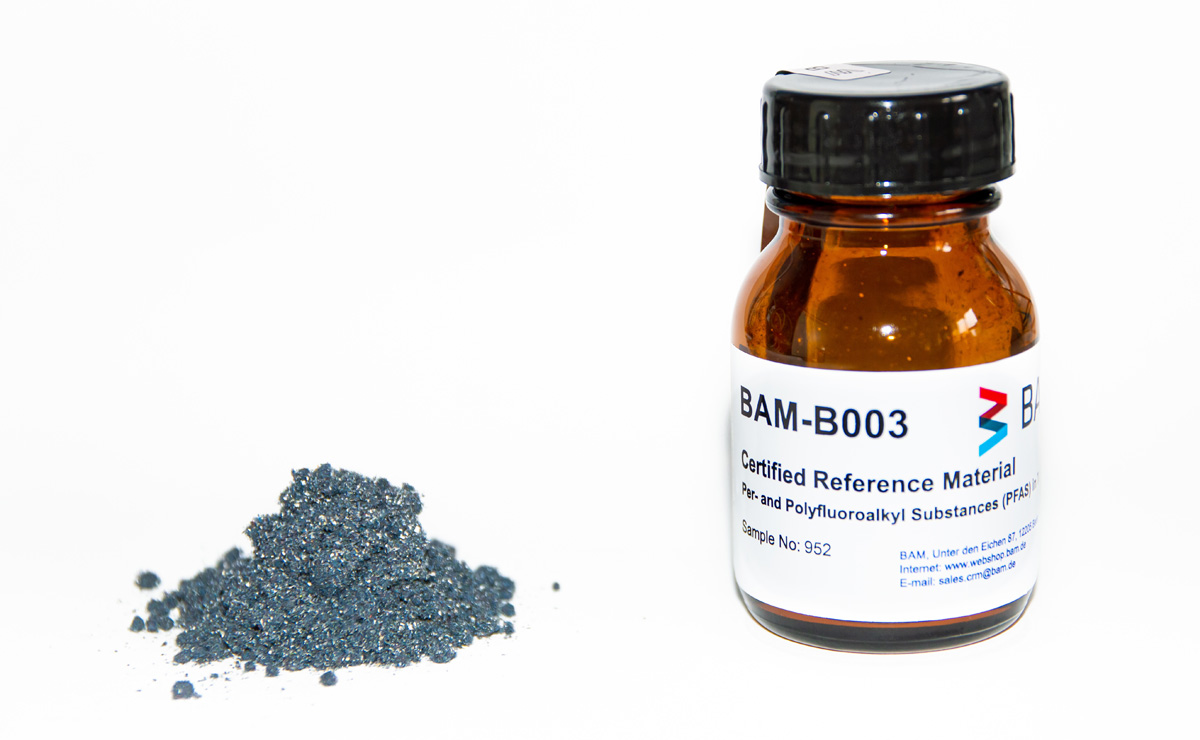
Since October 10, 2026, new restrictions have been in force in the EU to perfluorohexanoic acid (PFHxA), its salts, and related substances in clothing, footwear, and accessories. The Federal Institute for Materials Research and Testing (BAM) is supporting testing laboratories in their monitoring efforts with a certified reference material derived from outdoor textiles. This allows laboratories to verify whether their analytical methods can reliably detect selected PFAS, including PFHxA, even at very low concentrations.
Per- and polyfluoroalkyl substances (PFAS) are a large group of synthetic chemicals. Among other things, they are used to make textiles water-, grease-, or stain-repellent. Many PFAS are extremely persistent and degrade only very slowly in the environment.
Perfluorohexanoic acid (PFHxA), a single chemical compound within this group, is also water-soluble and can therefore spread widely—for example, during production or when washing. The European Union has therefore restricted PFHxA, its salts, and PFHxA-related substances as of 2024 under the European chemicals regulation REACH.
Starting October 10, 2026, outdoor clothing, footwear, and related accessories may contain only limited amounts of PFHxA and its salts. The EU regulation sets maximum limits of 25 micrograms per kilogram for PFHxA and its salts, and 1,000 micrograms per kilogram for PFHxA-related substances. Different transition periods apply in some cases to other textiles.
To ensure that such low concentrations can be reliably monitored, testing laboratories require suitable reference standards. This is where the reference material “BAM-B003” comes into play: It consists of shredded outdoor textiles and contains 18 precisely defined PFAS. This includes PFHxA with a certified concentration of 35 micrograms per kilogram. The material was developed specifically for PFAS analysis in outdoor textiles.
“With the new limit values, the demands on analytical methods are increasing,” explains Thomas Sommerfeld, project leader at BAM. “Our reference material provides laboratories with a reliable standard they can use to verify whether their measurement methods deliver accurate results even at very low PFAS concentrations.”
Reference materials serve as a benchmark, much like a calibrated reference weight: the concentrations of specific substances are certified, including their uncertainties. Laboratories compare their measurement results with these values to verify the accuracy of their analytical methods.
By developing and certifying such materials, BAM fulfills its mission of “Safety in Technology and Chemistry.” Reliable analyses support the monitoring of legal limit values and provide a basis for decisions aimed at protecting people and the environment.
The certified reference material BAM-B003, as well as other reference materials, are available through the BAM webshop.
Further information:
Contact:
Federal Institute for Materials Research and Testing (BAM)
Communications, Marketing
+49 30 8104-1013
presse(at)bam.de
www.bam.de
BAM press release, 9 October 2026