
Researchers Harness Nonlinear Optics to Achieve Quantum Light Thermalization
Bridging Classical Wave Physics and Quantum Many-Body Dynamics
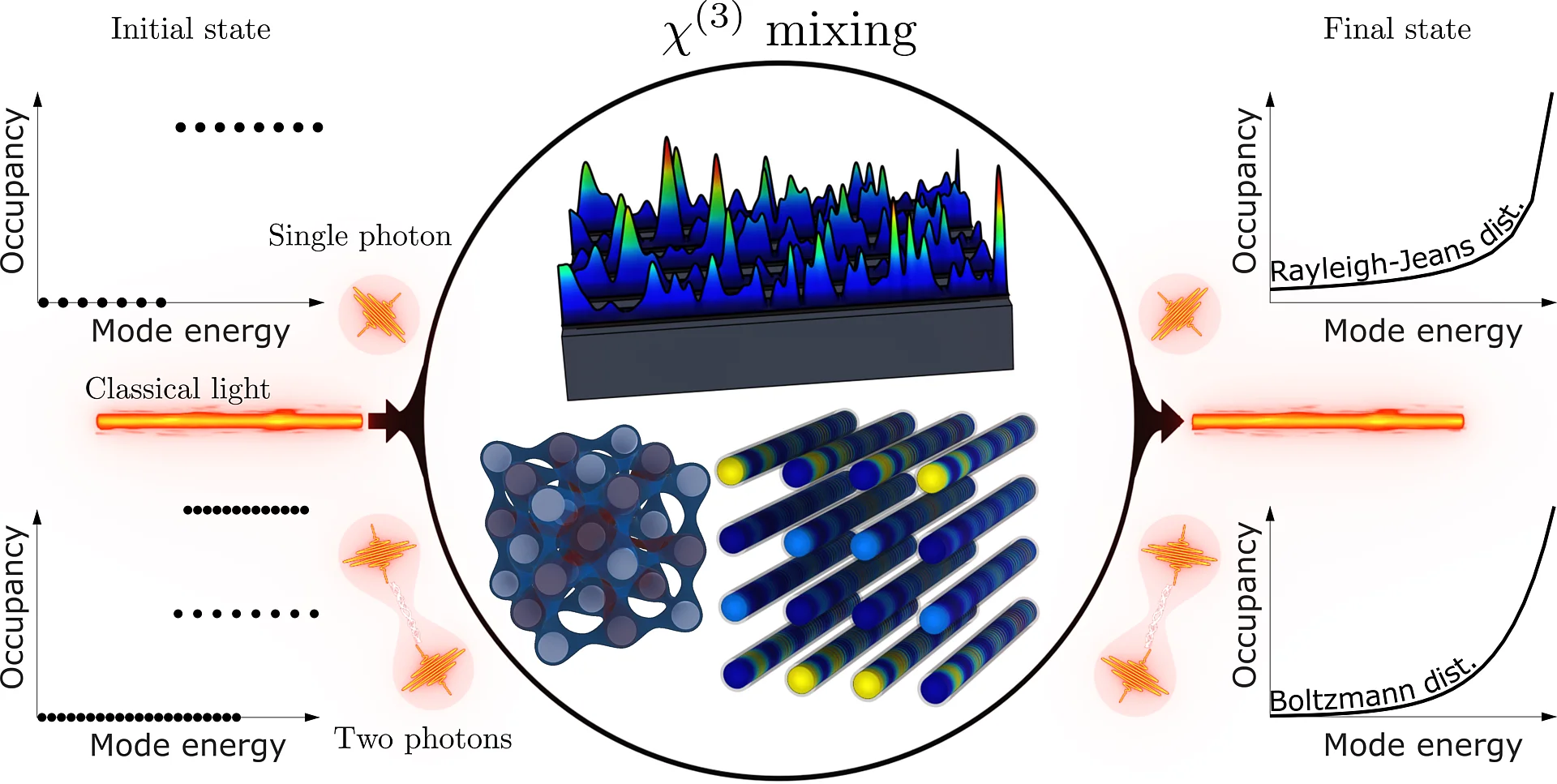
An international collaboration demonstrates that classical nonlinear dynamics can drive single- and two-photon states to thermalize, opening new avenues for simulating complex quantum many-body systems within accessible optical architectures.
In the modern landscape of quantum physics and optical sciences, photons stand out as the ultimate information carriers. Possessing exceptional coherence and traveling at the absolute upper physical speed limit, they form the backbone of high-speed data transmission and quantum-enhanced optical technologies. Yet, these advantages are coupled with a fundamental physical limitation: the absence of direct photon-photon interactions.
When high intensity classical light fields propagate through nonlinear optical materials, they undergo mutual and self-interactions, modifying their phase and amplitude via self-phase and cross-phase modulation. However, translating such multi-wave mixing behavior to the single-photon level is a prohibitively difficult task. Conventional optical media exhibit vanishingly small nonlinear responses at ultra-low light intensities, meaning individual photons typically pass right through one another without scattering or interacting. Consequently, generating direct, controllable photon-photon interactions for single- and few-photon states has remained eluisive, restricting the exploration of quantum many-body dynamics in optical systems.
Now, in a theoretical study detailed in the paper, “Thermalization of quantum light induced by classical nonlinear wave dynamics”, an international research team comprising scientists from Saint Louis University (USA), the Max Born Institute (Berlin), and Humboldt-Universität zu Berlin has demonstrated that the nonlinear dynamics of classical light can influence single and two-photon quantum states. Specifically, the team has shown that multimode nonlinear optical platforms can be harnessed to induce effective quantum interactions between photons, subsequently thermalizing them.
Overcoming the Quantum Nonlinearity Barrier
To circumvent the weak native nonlinearities of materials at the quantum limit, we investigated scenarios where quantum light propagates alongside relatively intense classical light fields within multimode nonlinear optical systems. Through rigorous numerical experiments, the team revealed that single- and two-photon states embedded in these configurations do not merely maintain their initial states or suffer unmitigated decoherence; instead, they thermalize.
This thermalization process is confirmed by the emergence of characteristic statistical distributions, specifically matching Rayleigh-Jeans and Boltzmann distributions. By leveraging the intense classical wave dynamics to mediate effective interactions, the system successfully bridges the gap between macroscopic nonlinear optics and microscopic quantum mechanics.
This approach provides a powerful framework for simulating quantum behaviors that were previously considered practically inaccessible in optical setups. Rather than requiring exotic, ultra-strong single-photon nonlinear materials – which are notoriously difficult to fabricate and scale – the team's method achieves effective quantum thermalization using standard, readily available classical optical structures.
Opening Doors to Complex Quantum Phenomena
The implications of this work extend far beyond foundational optics, reaching deep into statistical mechanics and condensed matter physics. By establishing that classical nonlinearities can effectively thermalize quantum states, the framework offers researchers a powerful, highly controllable testbed for investigating open quantum systems and many-body thermodynamics.
Furthermore, this platform paves the way for exploring a richer, broader spectrum of complex quantum phenomena—including aspects of quantum phase transitions—within standard laboratory optical settings. By lowering the experimental barriers required to study complex quantum photon interactions, the research opens fresh avenues for light dynamics and deepens our fundamental understanding of how statistical equilibrium emerges in quantum systems.
Authors include Fouad Chahrour, who received his MSc in Physics from the Humboldt University of Berlin (Master thesis at Max Born Institute), Şahin K. Özdemir and Ramy El-Ganainy, both professors of electrical and computer engineering at Saint Louis University, as well as Kurt Busch, Physics professor at the Institute of Physics in the Humboldt University of Berlin and the Max Born Institute; and Armando Perez-Leija, research scientist at Saint Louis University.
Publication:
Thermalization of quantum light induced by classical nonlinear wave dynamics
Fouad Chahrour, Şahin K. Özdemir, Kurt Busch, Ramy El-Ganainy, Armando Perez-Leija
Science Advances, 4 Nov 2026, Vol 12, Issue 45. URL, DOI oder PDF
Contact:
Prof. Dr. Kurt Busch
Max Born Institute for Nonlinear Optics and Short Pulse Spectroscopy, Leibniz Institute in Forschungsverbund Berlin e.V.
Theoretical Optics & Photonics
+49 30 6392 1261
kurt.busch(at)mbi-berlin.de
mbi-berlin.de
MBI press release, 9 November 2026