• Skip to Page content
  • Skip to Management
  • Skip to Main menu
Adlershof - science at work
  • WISTA
  • WISTA.Plan
  • WISTA.Service
  • WISTA direkt
  • Search
    • de
    • en
  • Adlershof - science at work
  • Technology Park
    • Companies / Institutes
    • Science City in numbers
    • Direction / Maps
      • Bus / Train
      • By Car
      • Bicycle
      • Orientation / Maps
      • Trail of Thoughts
  • Newsroom
    • Overview
    • News
      • Social Media Stream
      • Success Stories
    • Events / Calendar
      • Adlershof Connect
      • Long Night of Sciences Berlin
      • Adlershof Research Forum
    • Adlershof Journal
    • Hot Topics
      • Grand Challenges
      • Circular Economy
      • Climate change mitigation
      • Digital infra­structure / 5G campus network
    • Photos / Flyer / Downloads
      • Magazine archive
    • WISTA-Editorial Staff
  • Science / Technology
    • Overview
    • Technology Centres
      • Photonics / Optics
      • Biotech­nology / Envi­ron­ment
      • Micro­systems / Materi­als
      • IT / Media
      • Renewable Energy / Photovoltaics
    • Non-university Research
    • Universities / Colleges
      • Humboldt-Universität zu Berlin
      • Services for Students
    • Young Talents / STEM / School Labs
    • Start-Ups
      • Adlershof Start-Up Centre IGZ
      • Adlershof Startup Lab
    • Networks / Management
      • Campus Club Adlershof
      • workhier! Academics Career Programme
      • WISTA Academy
  • TV / Media
    • TV and Movie Production
    • Media Services / Companies
    • News and Events
    • Filming Locations
    • Costume Hire
    • GDR Film Archive
    • Tickets / Booking
  • Properties
    • Overview
    • Real Estate Rent
      • Office Space / Workspace / Laboratories
    • Real Estate Offers
      • Commercial Properties
    • ST3AM Working Environments / Coworking
    • Residential
    • Construction
      • Building Projects
      • Architecture
      • Time-lapse footage
  • Service
    • Overview
    • Gastronomy / Leisure / Shopping
    • Jobs / Market
    • Social and Healthcare Facilities
    • WISTA-Business Services
    • Event Services / Guided Tours / Hotels
    • Facility Management
    • Downloads / Photos / Videos
    • Jobs for Refugees
  • Hood
    • Overview
    • History
    • Nature Park
    • Culture
    • Technology Park
    • Digital Tours
  • WISTA
  • WISTA.Plan
  • WISTA.Service
WISTA direkt
  • Home Technology Park
  • Newsroom
  • News

News

  • Overview
  • News
  • Events / Calendar
  • Adlershof Journal
  • Hot Topics
  • Photos / Flyer / Downloads
  • WISTA-Editorial Staff
  • Home Technology Park
  • Newsroom
  • News
29. July 2026

Two attosecond flashes capture electrons in motion

Researchers at the Max Born Institute have developed a table-top technique in which attosecond pulses both initiate and probe electronic motion
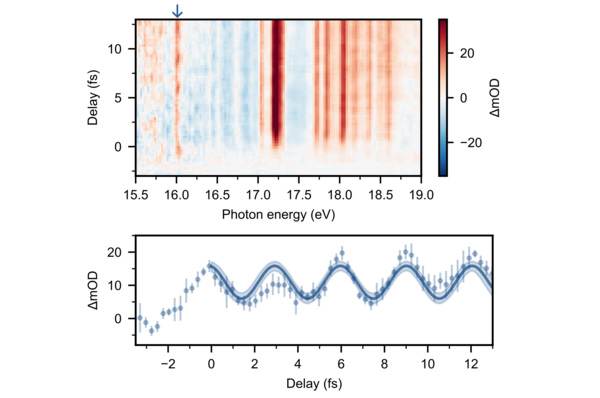
Graph showing a colour-coded spectrogram at the top and a line graph with a periodic curve at the bottom
Observation of hole motion in Xe⁺ ions. The upper panel shows the delay-dependent change in XUV absorption; the arrow marks an oscillatory feature near 16 eV. The lower panel shows a lineout of this feature, revealing a period of about 3 fs. © MBI

Using all-attosecond transient absorption spectroscopy, the team resolved the oscillatory motion of an electron vacancy (an electronic “hole”) in xenon ions with a period of about three femtoseconds. The results have now been published in Nature Communications.

Electronic motion sets the stage for virtually every light-induced process in nature, from the first step of a chemical reaction to the flow of charge in a solid. Yet these processes unfold so rapidly that they can only be observed with flashes of light lasting a few hundred attoseconds—billionths of a billionth of a second. Most previous attosecond experiments combined an attosecond pulse in the extreme ultraviolet (XUV) with a longer and often intense near-infrared pulse. Such fields can disturb the system under investigation and obscure its intrinsic electronic response. In the new approach, both the pump and the probe are attosecond extreme-ultraviolet pulses, providing a potentially much cleaner view of the underlying dynamics.

The researchers generated pulses with a duration of approximately 270 attoseconds using a laboratory-based high-harmonic source. A precision split-and-delay system produced two pulse replicas with an independently adjustable delay. The first pulse removed an electron from a xenon atom and created the ion in a coherent superposition of two closely spaced electronic states. The resulting electron vacancy, or “hole”, did not remain stationary but oscillated periodically within the ion.

The second attosecond pulse recorded this motion through changes in the extreme-ultraviolet absorption spectrum. The observed period of about three femtoseconds is consistent with the beating expected from the energy separation of the two spin-orbit states. “Using attosecond pulses in both steps allows us to initiate electronic motion and observe it without applying an additional strong infrared field,” explains Bernd Schütte, who led the study. “This brings us closer to watching electronic processes as they unfold, without significantly perturbing them.”

The experiment marks an important step toward a new generation of attosecond spectroscopy that can be carried out using table-top light sources. By combining extreme temporal resolution with the ability to distinguish individual electronic states, the method could make it possible to follow how charge moves through molecules, how electronic energy is redistributed, and how the first decisive steps of a photochemical reaction emerge from the coupled motion of electrons and nuclei.

The potential impact extends far beyond atoms and molecules. Applied to solids, the technique could reveal how electronic screening, scattering, carrier multiplication, exciton formation and charge transfer across interfaces develop on attosecond to femtosecond timescales. Such measurements could provide a new microscopic view of the processes that determine the performance of semiconductors, quantum materials, two-dimensional systems and future optoelectronic devices. In the long term, all-attosecond spectroscopy may offer a route towards observing - and ultimately controlling - the fastest electronic processes that govern how matter responds to light.

Publication:

Table-top all-attosecond transient absorption spectroscopy
Mikhail Volkov, Evaldas Svirplys, Stefanos Carlström, Serguei Patchkovskii, Misha Yu. Ivanov, Marc J. J. Vrakking & Bernd Schütte
Nature Communications 17, 7572 (2026). URL, DOI oder PDF

Contact:

Max Born Institute for Nonlinear Optics and Short Pulse Spectroscopy (MBI)
https://mbi-berlin.de/

Prof. Dr. Mikhail Ivanov
+49 30 6392-1210
Mikhail.Ivanov(at)mbi-berlin.de

Dr. Bernd Schuette
+49 30 6392-1295
Bernd.Schuette(at)mbi-berlin.de

Prof. Dr. Marc Vrakking
+49 30 6392-1200
Marc.Vrakking(at)mbi-berlin.de


MBI press release, 29.07.2026

Research Microsystems / Materials Photonics / Optics

Related News

a) Illustration of a lens with a laser beam projected through it; b) Diagram with measured values

Breakthrough in attosecond science

Research team from MBI and DESY develops a plasma lens that can focus attosecond pulses, thereby overcoming significant limitations
Figure: metal-insulator phase transition © MBI/Smirnova

Ultrafast excitations in correlated systems

Team of researchers presented new ideas for ultrafast multi-dimensional spectroscopy of strongly correlated solids
Visualisation of the experiment © MBI

Insights into fundamental processes in non-linear optics

At MBI, a pump-probe experiment was demonstrated to study non-linear multi-photon ionization processes on attosecond timescales

Related Institutions

  • Max-Born-Institut für Nichtlineare Optik und Kurzzeitspektroskopie im Forschungsverbund Berlin e.V. (MBI)
  • Forschungsverbund Berlin e.V.

Share this page

The development of the Science and Technology Park Berlin Adlershof was and is co-financed by the European Union namely by EFRE. This concerns infrastructure development like construction of technology centres. Furthermore EFRE is used for international projects.

  • © WISTA Management GmbH
  • Legal Notice
  • Privacy Policy
  • Social Media Guide
  • FAQ
  • Contact
  • Press
  • Newsletter
  • RSS
  • International
Member of:
Zukunftsort Adlershof Logo