• Skip to Page content
  • Skip to Management
  • Skip to Main menu
Adlershof - science at work
  • WISTA
  • WISTA.Plan
  • WISTA.Service
  • WISTA direkt
  • Search
    • de
    • en
  • Adlershof - science at work
  • Technology Park
    • Companies / Institutes
    • Science City in numbers
    • Direction / Maps
      • Bus / Train
      • By Car
      • Bicycle
      • Orientation / Maps
      • Trail of Thoughts
  • Newsroom
    • Overview
    • News
      • Social Media Stream
      • Success Stories
    • Events / Calendar
      • Adlershof Winter Magic
      • Adlershof Research Forum
      • Adlershof Dissertation Award
    • Adlershof Journal
    • Hot Topics
      • Climate change mitigation
      • Grand Challenges
      • Digital infra­structure / 5G campus network
      • Circular Economy
    • Photos / Flyer / Downloads
      • Magazine archive
    • WISTA-Editorial Staff
  • Science / Technology
    • Overview
    • Technology Centres
      • Photonics / Optics
      • Biotech­nology / Envi­ron­ment
      • Micro­systems / Materi­als
      • IT / Media
      • Renewable Energy / Photovoltaics
    • Non-university Research
    • Universities / Colleges
      • Humboldt-Universität zu Berlin
      • Services for Students
    • Young Talents / STEM / School Labs
    • Start-Ups
      • Adlershof Start-Up Centre IGZ
      • Adlershof Startup Lab
    • Networks / Management
      • Campus Club Adlershof
      • workhier! Academics Career Programme
      • WISTA Academy
  • TV / Media
    • TV and Movie Production
    • Media Services / Companies
    • News and Events
    • Filming Locations
    • Costume Hire
    • GDR Film Archive
    • Tickets / Booking
  • Properties
    • Overview
    • Real Estate Rent
      • Office Space / Workspace / Laboratories
    • Real Estate Offers
      • Commercial Properties
    • ST3AM Working Environments / Coworking
    • Residential
    • Construction
      • Building Projects
      • Architecture
      • Time-lapse footage
  • Service
    • Overview
    • Gastronomy / Leisure / Shopping
    • Jobs / Market
    • Social and Healthcare Facilities
    • WISTA-Business Services
    • Event Services / Guided Tours / Hotels
    • Facility Management
    • Downloads / Photos / Videos
    • Jobs for Refugees
  • Hood
    • Overview
    • History
    • Nature Park
    • Culture
    • Technology Park
    • Digital Tours
  • WISTA
  • WISTA.Plan
  • WISTA.Service
WISTA direkt
  • Home Technology Park
  • Newsroom
  • News

News

  • Overview
  • News
  • Events / Calendar
  • Adlershof Journal
  • Hot Topics
  • Photos / Flyer / Downloads
  • WISTA-Editorial Staff
  • Home Technology Park
  • Newsroom
  • News
25. November 2026

X-ray Spectroscopy Sheds New Light on Push-Pull Chromophores

Key process of light-triggered intramolecular charge transfer of the DMABN prototype elucidated
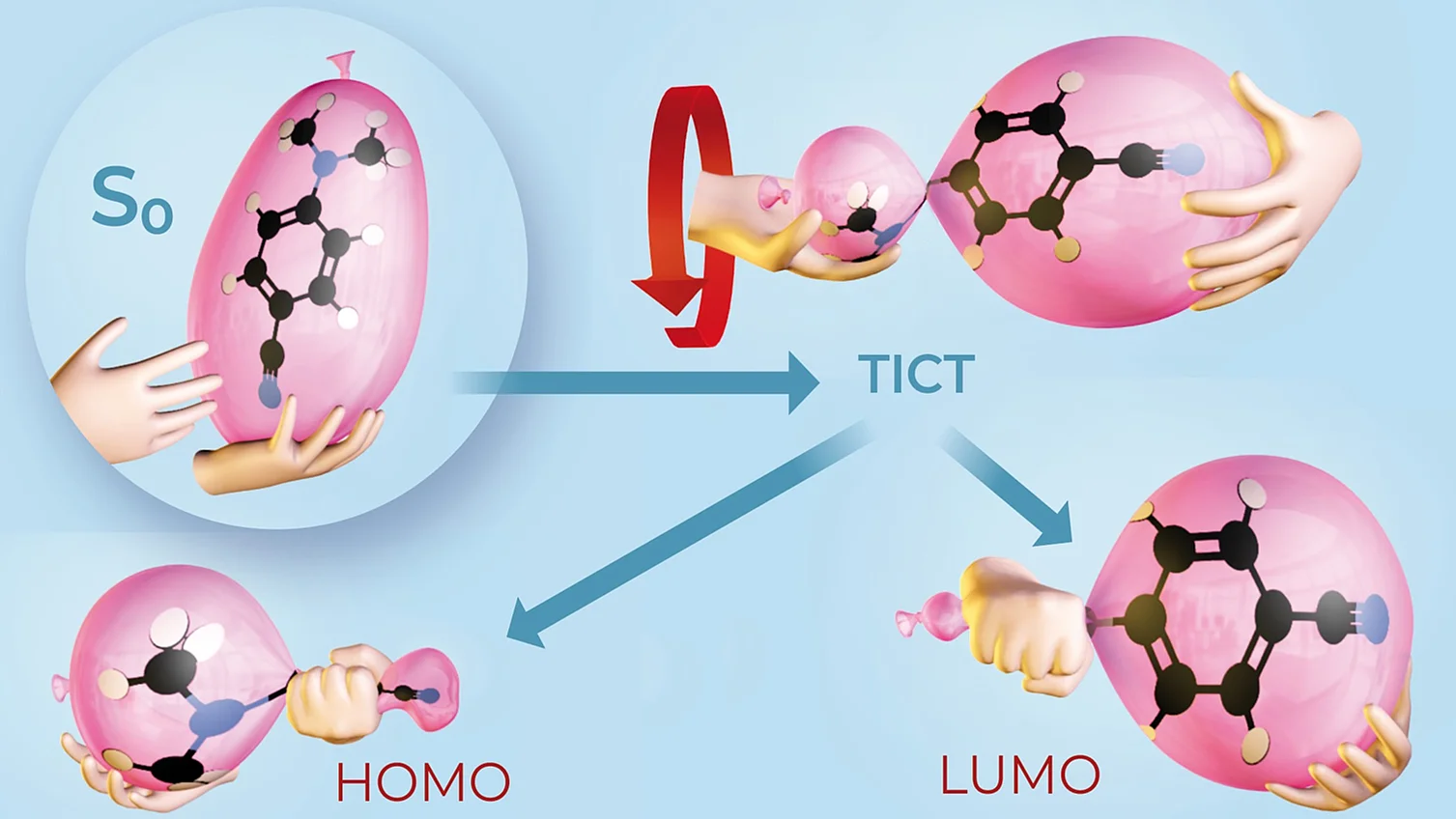
Four pink balloons with chemical molecular structures, held by hands and connected by arrows to the terms ‘S₀’, ‘TICT’, ‘HOMO’ and ‘LUMO’.
By mapping frontier molecular orbitals of 4-(dimethylamino)benzonitrile, a prototype push–pull chromophore, with time-resolved soft X-ray absorption spectroscopy, it is shown how the transient electronic structure underlies the mechanism of charge flow. © MBI

Push–pull chromophores typically have a D–π–A molecular architecture with an electron-rich donor group D and an electron-poor acceptor group A, linked by aromatic π units. The wide variety of donor and acceptor groups enable targeted design of push-pull chromophores that are crucial in molecular design and applications such as solar energy conversion, organic electronics and optoelectronics. Scientists of the Max Born Institute of Nonlinear Optics and Short Pulse Spectroscopy have, in a collaboration with University of Ottawa (Canada), Uppsala University (Sweden) and Helmholtz-Zentrum Berlin, now have shed light on the underlying key process of light-triggered intramolecular charge transfer of the prototype 4-dimethylaminobenzonitrile DMABN. The results have been published in Chemical Science.

The results put a definitive mark to the decades-old debate of the cause of dual emission by this model push-pull chromophore DMABN, a molecule that has puzzled chemists for over 50 years. In the combined experimental and theoretical study it is shown how crucial information can be obtained with soft-X-ray spectroscopy on the electronic structure and how this changes upon absorption of light. For DMABN conclusive evidence is delivered on molecular twisting upon charge transfer as the driving mechanism in this archetypal donor-bridge-acceptor system.

Using pioneering transient X-ray absorption spectroscopy, it is possible able to directly access the core question of photochemistry of the DMABN molecule, by resolving the local electronic structures of the donor and acceptor moieties separately. Supported by state-of-the-art CVS-DFT/MRCI calculations, not only the twisting mechanism is validated but also a quantification of the orbital and charge distributions in the DMABN excited states. This is illustrated using a balloon diagram, with which conveniently a visualization can be made of the relocation of electronic charge distributions in DMABN—i.e., what the locally excited (LE) and twisted intramolecular charge transfer (TICT) states actually represent.

These scientific results redefine how the impact of charge transfer and charge flow can be understood, and provide a new methodology that will be transformative for the field of photochemistry, and can be extended towards molecular systems ranging from photochromic switches, molecular machines, organic light-emitting diodes, organic photovoltaic cells and light-harvesting systems.

Publication:

A core–shell spectroscopic perspective on solution phase charge transfer in photoexcited push–pull chromophores
Mate Kurucz, Marc-Oliver Winghart, Debkumar Rana, Victoria Kabanova, Jibrael Rolston, Martha Yaghoubi Jouybari, Mattis Fondell, Sebastian Eckert, Philippe Wernet, Albert Stolow, Arnaud Rouzée, Michael S. Schuurman and Erik T. J. Nibbering
Chem. Sci. (2026) 17 (44): 21344–21351. URL, DOI or PDF


Credit: MBI, 20 November 2026

Research Microsystems / Materials Photonics / Optics

Related News

Quantum state mixing in photobiology

New insight from ultrafast terahertz Stark spectroscopy

Related Institutions

  • Max-Born-Institut für Nichtlineare Optik und Kurzzeitspektroskopie im Forschungsverbund Berlin e.V. (MBI)
  • Helmholtz-Zentrum Berlin für Materialien und Energie GmbH, Elektronenspeicherring BESSY II

Share this page

The development of the Science and Technology Park Berlin Adlershof was and is co-financed by the European Union namely by EFRE. This concerns infrastructure development like construction of technology centres. Furthermore EFRE is used for international projects.

  • © WISTA Management GmbH
  • Legal Notice
  • Privacy Policy
  • Digital Accessibility
  • Social Media Guide
  • FAQ
  • Contact
  • Press
  • Newsletter
  • International
Member of:
Zukunftsorte Berlin Logo, Standort Adlershof