• Skip to Page content
  • Skip to Management
  • Skip to Main menu
Adlershof - science at work
  • WISTA
  • WISTA.Plan
  • WISTA.Service
  • WISTA direkt
  • Search
    • de
    • en
  • Adlershof - science at work
  • Technology Park
    • Companies / Institutes
    • Science City in numbers
    • Direction / Maps
      • Bus / Train
      • By Car
      • Bicycle
      • Orientation / Maps
      • Trail of Thoughts
  • Newsroom
    • Overview
    • News
      • Social Media Stream
      • Success Stories
    • Events / Calendar
      • Adlershof Connect
      • Long Night of Sciences Berlin
      • Adlershof Research Forum
    • Adlershof Journal
    • Hot Topics
      • Grand Challenges
      • Circular Economy
      • Climate change mitigation
      • Digital infra­structure / 5G campus network
    • Photos / Flyer / Downloads
      • Magazine archive
    • WISTA-Editorial Staff
  • Science / Technology
    • Overview
    • Technology Centres
      • Photonics / Optics
      • Biotech­nology / Envi­ron­ment
      • Micro­systems / Materi­als
      • IT / Media
      • Renewable Energy / Photovoltaics
    • Non-university Research
    • Universities / Colleges
      • Humboldt-Universität zu Berlin
      • Services for Students
    • Young Talents / STEM / School Labs
    • Start-Ups
      • Adlershof Start-Up Centre IGZ
      • Adlershof Startup Lab
    • Networks / Management
      • Campus Club Adlershof
      • workhier! Academics Career Programme
      • WISTA Academy
  • TV / Media
    • TV and Movie Production
    • Media Services / Companies
    • News and Events
    • Filming Locations
    • Costume Hire
    • GDR Film Archive
    • Tickets / Booking
  • Properties
    • Overview
    • Real Estate Rent
      • Office Space / Workspace / Laboratories
    • Real Estate Offers
      • Commercial Properties
    • ST3AM Working Environments / Coworking
    • Residential
    • Construction
      • Building Projects
      • Architecture
      • Time-lapse footage
  • Service
    • Overview
    • Gastronomy / Leisure / Shopping
    • Jobs / Market
    • Social and Healthcare Facilities
    • WISTA-Business Services
    • Event Services / Guided Tours / Hotels
    • Facility Management
    • Downloads / Photos / Videos
    • Jobs for Refugees
  • Hood
    • Overview
    • History
    • Nature Park
    • Culture
    • Technology Park
    • Digital Tours
  • WISTA
  • WISTA.Plan
  • WISTA.Service
WISTA direkt
  • Home Technology Park
  • Newsroom
  • News

News

  • Overview
  • News
  • Events / Calendar
  • Adlershof Journal
  • Hot Topics
  • Photos / Flyer / Downloads
  • WISTA-Editorial Staff
  • Home Technology Park
  • Newsroom
  • News
25. February 2022

Good prospects for the commercialisation of perovskite tandem solar cells

Research teams from HZB and ISFH have combined PERC/POLO silicon cells, which are widely used on the market, with perovskite cells for the first time and estimate the efficienciy at 29.5%
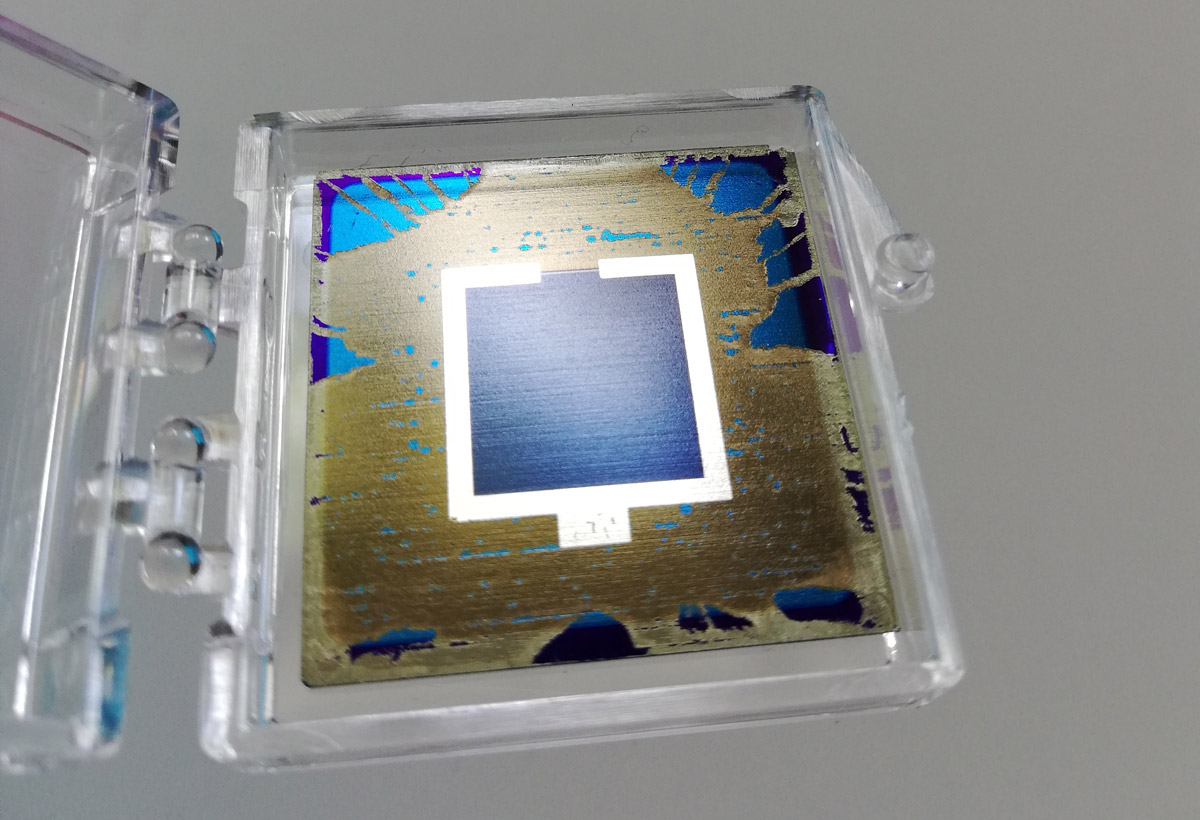
Tandem solar cell © Silvia Mariotti / HZB
A standard silicon solar cell is combined with a perovskite top cell. This tandem solar cell could reach high efficiencies. © Silvia Mariotti / HZB

So-called PERC cells are used in mass production of silicon solar cells, they are considered the workhorses of photovoltaics, dominating the market. Now two teams from HZB and the Institute for Solar Energy Research in Hamelin (ISFH) have shown that such standard silicon cells are also suitable as a basis for tandem cells with perovskite top cells. Currently, the efficiency of the tandem cell is still below that of optimised PERC cells alone, but could be increased to up to 29.5% through targeted optimisation. The research was funded by the German Federal Ministry of Economics as part of a joint project.

Tandem cells made of silicon and perovskite are able to convert the broad energy spectrum of sunlight into electrical energy more efficiently than the respective single cells. Now, for the first time, two teams from HZB and ISFH Hameln have succeeded in combining a perovskite top cell with a so-called PERC/POLO silicon cell to form a tandem device. This is an important achievement, since PERC silicon cells on p-type silicon are the "workhorse" of photovoltaics, with a market share of about 50% of all solar cells produced worldwide. They are largely optimised, long-term stable and temperature stable. Therefore, it is particularly interesting for the commercialisation of a perovskite-silicon tandem technology to develop a "perovskite tandem upgrade" for PERC cells. The cooperation took place within the framework of the joint project P3T, which is funded by the Federal Ministry of Economics and coordinated by HZB.

The team at ISFH used an industry-compatible PERC process for the backside contact of the silicon bottom cells. On the front side of the wafer, another industrialisable technology was used, the so-called POLO contact, which was adapted here for the small-area proof of concept cells.

Perovskite expertise at HZB

The following process steps took place at HZB: A tin-doped indium oxide recombination layer was applied as a contact between the two subcells. On top of this, a perovskite cell was processed with a layer sequence similar to that in the current world record tandem cell on n-type silicon heterojunction cells, made by HZB. The first perovskite PERC/POLO tandem cells produced in this way achieve an efficiency of 21.3% on an active cell area of about 1 cm². This efficiency is thus still below the efficiency of optimised PERC cells in this feasibility study. "However, initial experimental results and optical simulations indicate that we can significantly improve the performance through process and layer optimisation," explains Dr. Lars Korte, the corresponding author of the study.

PCE estimated at 29,5 %

The experts estimate the Power Conversion Efficiency (PCE) of these perovskite/silicon tandem solar cells with PERC-like sub-cell technology at 29.5 %. The next steps for further efficiency increases are already clear: Dr. Silvia Mariotti from the HZB team had identified the coverage of the silicon surface by the perovskite as potential for improvement: "For this purpose, one could adapt the surface of the silicon wafers and thus quickly increase the efficiency to about 25%," says Mariotti. This is then already significantly higher than the efficiency of PERC single cells.

Publication:

Monolithic Perovskite/Silicon Tandem Solar Cells fabricated using industrial p-type POLO/PERC Silicon Bottom Cell Technology
Silvia Mariotti, Klaus Jäger, Marvin Diederich, Marlene Sophie Härtel, Bor Li, Kari Sveinbjörnsson, Sarah Kajari-Schröder, Robby Peibst, Steve Albrecht, Lars Korte, Tobias Wietler
Solar RRL (2022). DOI: 10.1002/solr.202101066

Further information:

  • P3T-research project
     

Contact:

Helmholtz-Zentrum Berlin für Materialien und Energie
Young Investigator Group Perowskite Tandem Solar Cells

Dr. Lars Korte
Phone +49 30 8062-41351
Email korte(at)helmholtz-berlin.de

Prof. Dr. Steve Albrecht
Phone +49 30 8062-41334
Email steve.albrecht(at)helmholtz-berlin.de

Press Officer:
Dr. Antonia Rötger
Phone +49 30 8062-43733
Email antonia.roetger(at)helmholtz-berlin.de


Press release HZB, 24 February 2022

Research Grand Challenges Renewable Energies Microsystems / Materials

Related News

Portrait Silvia Mariotti

New Helmholtz Young Investigator Group at HZB on perovskite solar cells

Silvia Mariotti aims to advance the development of multi-junction solar cells made from different perovskite layers

Optical innovations for solar modules – which are the most promising?

Experts provide a comprehensive overview of the state of solar research
Tandem solar cell HySPRINT Lab © Amran Al-Ashouri/HZB

From Lab to Fab: World Record Solar Cell Goes from Lab to Industry

Q CELLS and Helmholtz-Zentrum Berlin achieve record efficiency of 28.7% for 2-terminal perovskite-silicon tandem solar cell
Tag cloud Perovskite research © HZB

A Wiki for Perovskite Solar Cell Research

An international team of experts has designed an open source database to systematically record findings on perovskite semiconductors
world record cell HZB. © Amran Al-Ashouri /HZB

Another world record for HZB perovskite silicon tandem solar cells

Almost 30 % efficiency for next-generation tandem solar cells
perovskite layer, HZB Adlershof Berlin, © M. Künsting/HZB

HZB researchers provide new insights into lead-free perovskite solar cells

How fluoride additives improve quality
MAPI perovskite © HZB

Perovskite solar cells: Hydrogen bonds measured

Research results provide important information for perovskites materials research for solar cells
crystal structure © HZB

New insights into the structure of organic-inorganic hybrid perovskites

Team at HZB has analysed structural data of photovoltaic materials with a novel model
Schematic: Coating with material ink © Jinzhao Li / HZB

The perfect recipe for efficient perovskite solar cells

HZB team improved the composition of material inks for the simple and cost-effective production of solar cells
Tandem solar cell © Eike Köhnen/HZB

Perovskite/silicon tandem solar cells on the threshold of 30% efficiency

HZB team was able to improve the charge carrier transport and the stability of the solar cells
Structure of FASnI3:PEACl films © Meng Li/HZB

On the road to non-toxic and stable perovskite solar cells

International cooperation led by HZB has developed new materials with tin instead of lead

Share this page

The development of the Science and Technology Park Berlin Adlershof was and is co-financed by the European Union namely by EFRE. This concerns infrastructure development like construction of technology centres. Furthermore EFRE is used for international projects.

  • © WISTA Management GmbH
  • Legal Notice
  • Privacy Policy
  • Social Media Guide
  • FAQ
  • Contact
  • Press
  • Newsletter
  • RSS
  • International
Member of:
Zukunftsort Adlershof Logo