
Modular concept brings rail and road transport closer together
The EU project Pods4Rails has developed new approaches to connected mobility
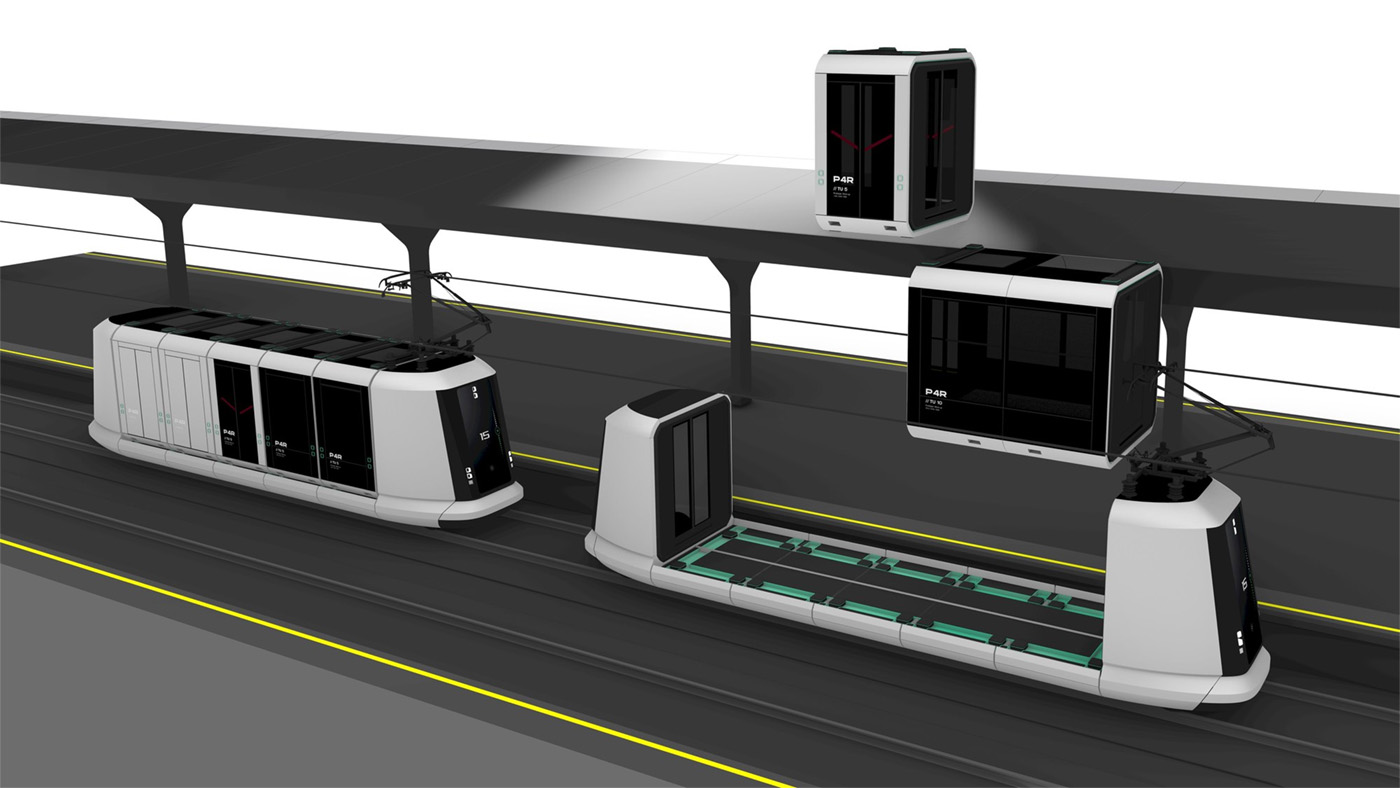
As part of the EU Pods4Rail project, the German Aerospace Center (Deutsches Zentrum für Luft- und Raumfahrt; DLR) has developed an innovative, automated mobility concept together with collaborators from research and industry. The aim is to integrate rail transport more closely with road transport and cable cars. The Pods4Rail approach is modular: capsules for transporting people and goods – known as 'pods' – are combined with mobile carrier units designed for different modes of transport. The carrier units include the necessary components for each mode, such as the chassis, drive system, power supply and other technical systems.
Siemens Mobility coordinated the project, which involved 15 participants from seven European countries. It received approximately three million euros in funding from the EU as part of the Europe's Rail Joint Undertaking and the Horizon Europe research programme. DLR was the largest research organisation involved in the project, with five DLR institutes contributing expertise across the entire development chain for rail and road vehicles.
'Supermodality' – seamless use of multiple modes of transport
"The aim of Pods4Rail is to provide seamless end-to-end mobility across different modes of transport. Passengers and freight remain in the same capsule throughout a journey, being transferred to another carrier unit as required," says Manuel Osebek, DLR researcher who led the project at the DLR Institute of Vehicle Concepts, explaining 'supermodality' as the central concept behind Pods4Rail.
For example, a pod may set off on a road carrier unit in a rural area. At a hub, it is automatically transferred to a rail carrier unit, allowing it to cover most of the journey energy-efficiently by rail, together with other pods. The concept is designed around the needs of users, be they passengers or logistics companies. This requires a high degree of flexibility, speed, innovation and comfort – combined with the high safety standards of rail transport.
Many cities around the world are considering cable cars as a complement to their local public transport systems. Pods4Rail has therefore also examined the extent to which cable cars can be integrated into the concept. Rail forms the backbone of Pods4Rail due to its high capacity, efficiency, as well as its climate and environmental sustainability.
"For the study, we did not just look at the vehicles required for such a concept. Other key aspects included how pods and carrier units could be connected to one another, as well as issues relating to automation. Analyses of the necessary infrastructure and ideas for digital operating concepts rounded off the work," summarises Osebek. The EU project benefited from the diverse expertise of its participants.
Focus on user requirements
At the outset, the project team analysed existing intermodal mobility systems and potential areas of application, assessing technical performance data alongside user acceptance, comfort, accessibility, environmental impact and economic viability. DLR conducted surveys with potential user groups and evaluated existing vehicle and mobility concepts as technological benchmarks.
The team identified more than 20 potential applications and developed eight business scenarios. These applications range from on-demand passenger transport on underused branch lines to parcel and express logistics and mobile medical facilities. The results informed technical requirements for pods, carrier units, automated handling systems and mobility management.
Systematically investigating technical feasibility
One of DLR's key focus areas was how these requirements could be translated into technically feasible vehicle concepts. This included investigating modular and lightweight vehicle structures, energy requirements, climate control of pods and the interfaces between pods and chassis. In addition, DLR examined requirements for communication between vehicles, infrastructure and traffic management.
DLR also contributed its expertise on standards, approval procedures and safety requirements for road and rail transport. This resulted in overarching functional requirements for the overall system, which then guided the design of transport cabins, carrier units and locking and transfer systems.
Foundations for the next stage of development
Pods4Rail demonstrates how transport infrastructure can be used more flexibly and how different modes of transport can be more closely integrated. The concept can enable new, demand-responsive services, particularly on branch lines and in regions with fluctuating demand. At the same time, larger sections of a transport chain can be shifted onto energy-efficient rail transport without sacrificing the benefits of a direct road connection.
The results provide a basis for the further development of individual components and larger-scale testing, allowing issues such as regulatory approval, cost-effectiveness and integration into existing transport networks to be addressed in the next phase. To this end, the DLR-led follow-up project, PREFER (Pods and Regional Flexible Efficient Rolling Stock), is expected to launch later this year.
Related information:
- EU Pods4Rail project
- Europe's Rail
- Featured topic – The future of rail transport
- DLR Institute of Vehicle Concepts
- DLR Institute of Transport Research
- DLR Institute of Transportation Systems
- DLR Institute of Systems Engineering for Future Mobility
- DLR Institute of Communications and Navigation
- Siemens Mobility
Pods4Rail project participants (in alphabetical order):
Delft University of Technology, European Rail Research Network of Excellence (EURNEX), German Aerospace Center (DLR), Gustave Eiffel University, Hacon, moodley, Netherlands Organisation for Applied Scientific Research (TNO), ProRail, Railenium, Royal Institute of Technology (KTH), Siemens Mobility, Siemens Mobility Austria, Trafikverket (Swedish Transport Administration), Universidad Politécnica de Madrid (UPM) and University of West Bohemia in Pilsen (UWB)
Contact:
German Aerospace Center (DLR)
Denise Nüssle
Corporate Communications
Pfaffenwaldring 38-40, 70569 Stuttgart
+49 711 6862-8086
www.dlr.de
DLR press release, 6 August 2026