
PLATO space telescope – electronics ready for space
Telescope has passed all the necessary tests ahead of its planned launch in March 2027
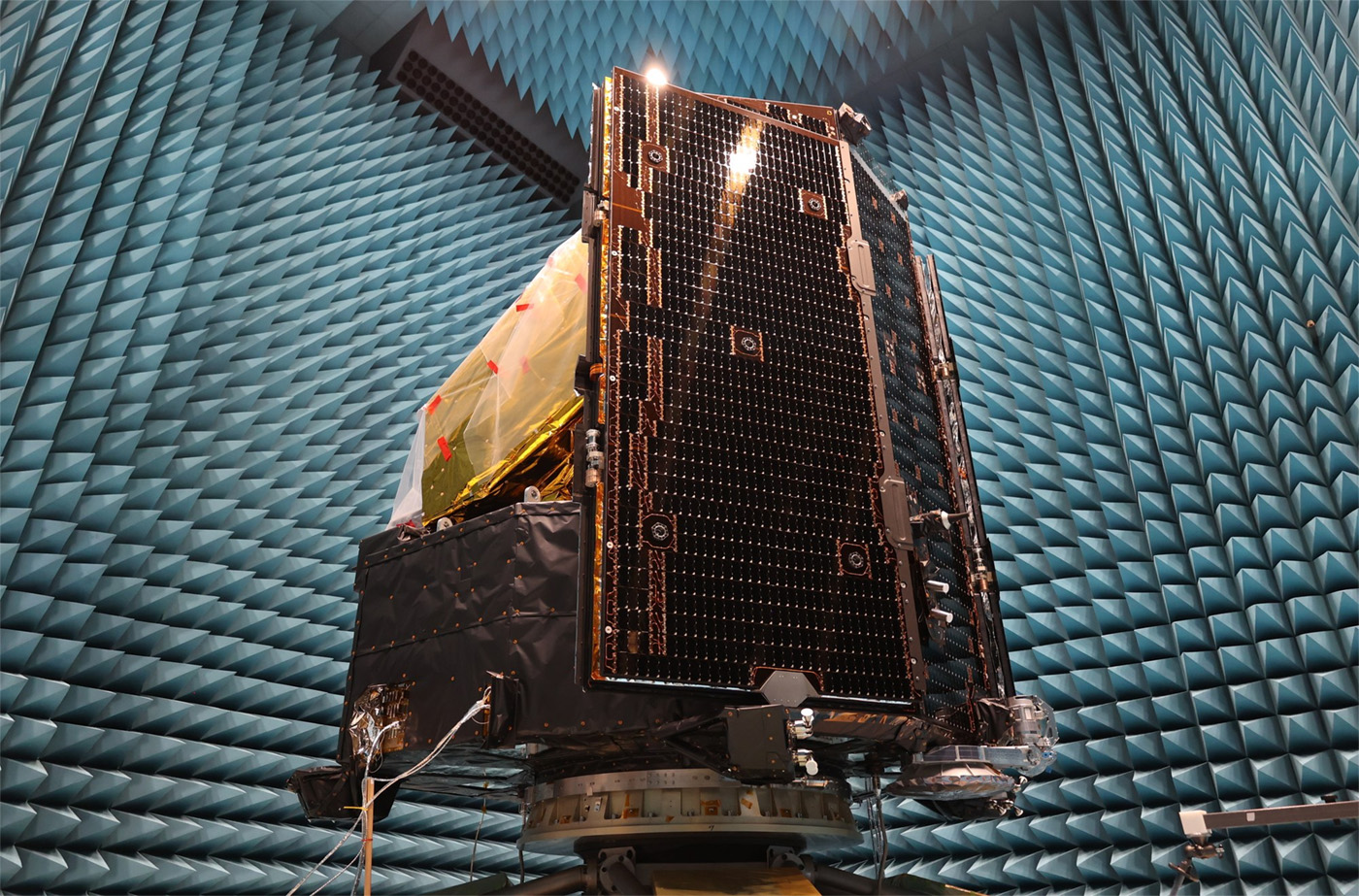
The PLATO (PLAnetary Transits and Oscillations of stars) mission from the European Space Agency (ESA) has successfully completed its electromagnetic compatibility tests – and the German Aerospace Center (Deutsches Zentrum für Luft- und Raumfahrt; DLR) is playing a key role in the mission. At the Maxwell facility at ESA's European Space Research and Technology Centre (ESTEC) in Noordwijk, the Netherlands, the team verified that the space telescope’s numerous electronic systems work together without interference. With the successful completion of this test, PLATO has now passed the final major hurdle required for the spacecraft to be cleared for launch.
The nine-metre-high test chamber is completely enclosed by conductive metal walls. Together, these form a Faraday cage that shields the chamber from external electromagnetic signals. Foam panels on the walls and ceiling also absorb electrical signals and prevent disruptive reflections within the chamber.
Once the chamber had been sealed, the test team switched on PLATO’s electronic systems and carried out various functional tests. Among other things, they investigated whether individual instruments, electronic modules or communication systems interfered with one another. Such unwanted interactions are referred to as electromagnetic 'crosstalk'.
On a satellite system such as PLATO, numerous sensitive systems operate together in a very confined space. Crosstalk could, for example, distort scientific measurements, disrupt communications with Earth or interfere with the satellite’s control systems. The tests have now confirmed that all electronic systems on PLATO function as intended, even when operating together.
Final major test for the space probe ahead of its planned launch in spring 2027
With the electromagnetic compatibility tests, PLATO has completed the final major test of its qualification campaign. This campaign began in January 2026 with vibration and acoustic tests at ESTEC, which simulated the vibrations and noise loads experienced during a rocket launch.
PLATO was then put through its paces in ESA's Large Space Simulator – Europe’s largest space simulation chamber – where spacecraft are exposed to a vacuum as well as extreme heat and cold. The tests on PLATO showed that its cameras, electronics and temperature control system function correctly even under space-like conditions.
PLATO's launch is currently scheduled for March 2027. An Ariane 6 launch vehicle is set to carry the space telescope from Europe's Spaceport in Kourou, French Guiana, to the L2 Lagrange point. This point lies approximately 1.5 million kilometres from Earth, on the opposite side of the Sun. In this position, the gravitational forces of the Earth and Sun combine to balance the centrifugal force acting on the spacecraft. This means the spacecraft can maintain a stable position with minimal energy expenditure, while carrying out scientific observations with uninterrupted communication with Earth.
Searching for planets with 26 cameras
PLATO stands for PLAnetary Transits and Oscillations of stars. The space telescope will use 26 cameras to simultaneously observe hundreds of thousands of stars over long periods of time. The principal objective is to detect Earth-sized planets orbiting Sun-like stars.
The cameras will, for example, measure minute, regular fluctuations in a star's apparent brightness. These can occur when, as seen from Earth, a planet passes in front of its star. Together with observations from ground-based telescopes, this will enable measurements including the size, mass and age of newly discovered planets.
The scientific instruments are provided by ESA and the international PLATO mission consortium. The spacecraft was built and assembled by the PLATO core industrial team, led by OHB SE, in collaboration with Thales Alenia Space and Beyond Gravity.
Key DLR contributions and other German involvement in PLATO
The sophisticated readout electronics and data processing systems for PLATO's fast cameras, including the software for the precise orientation of the satellite, were developed at the DLR Institute of Space Research in Berlin. The institute supports the calibration and operation of the readout electronics, as well as the payload computer and parts of the data processing on board the space telescope. DLR also leads the international PLATO mission consortium and plays a major role in the scientific evaluation of PLATO data.
Further German contributions are funded by the German Space Agency at DLR using federal funds. The development and coordination of the PLATO scientific data centre – including the implementation of the data processing and data analysis pipelines – is led by the Max Planck Institute for Solar System Research in Göttingen. At the Freie Universität Berlin, support is provided for both the leadership and management of the scientific consortium, as well as contributions to the data-processing pipelines, payload operations and the scientific analysis of mission data.
Performance analysis of the payload, as well as contributions to raw data analysis, is being carried out at FH Aachen University of Applied Sciences. Support for the camera test campaigns was provided by the Rhenish Institute of Environmental Research (RIU) at the University of Cologne. German contributions to the programme of ground-based follow-up observations of planet candidates also come from the University of Göttingen, Heidelberg University and the Thuringian State Observatory in Tautenburg.
Related links
- DLR news: PLATO exoplanet telescope passes vibration test
- DLR news: ESA's PLATO space telescope completed and ready for final tests
- DLR mission page: PLATO – the space telescope searching for Earthlike planets in the Milky Way
- DLR Institute of Space Researh
- ESA special: PLATO – Terrestrial planet hunter
- ESA info: The ESTEC Maxwell Test Chamber
- ESA info: ESTEC – European Space Research and Technology Centre
Contact:
German Aerospace Center (DLR)
Philipp Burtscheidt
DLR media relations
Linder Höhe, 51147 Köln
+49 2203 601-2323
www.dlr.de
DLR press release, 20 July 2026