
Superconducting TES array X-ray spectrometer goes into operation at BESSY II
The instrument is around 100 to 1,000 times more efficient at detecting photons than conventional devices
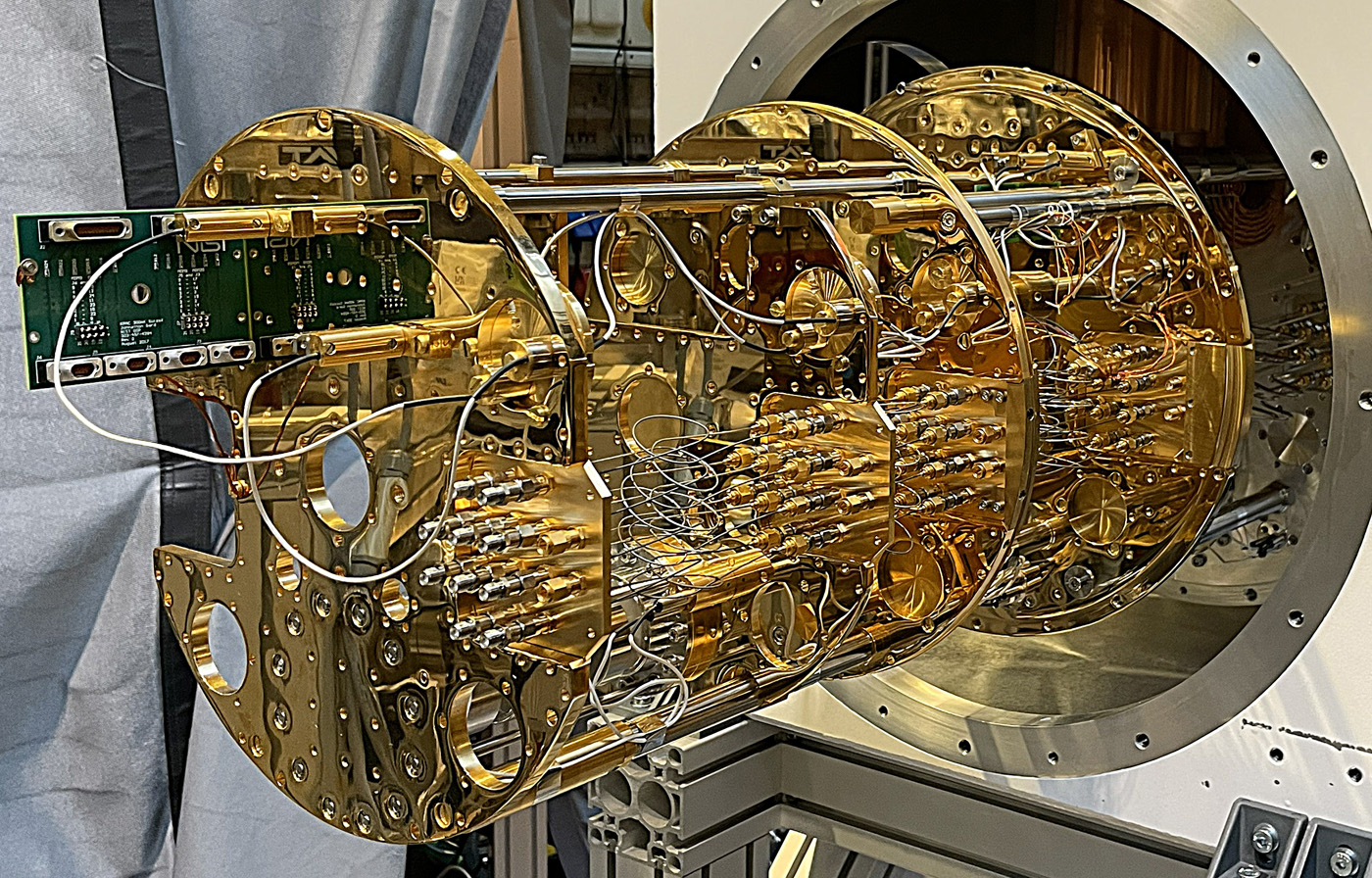
The TES-Spectrometer was developed within a collaboration between the HZB, the MPI-CEC (Mühlheim-an-der-Ruhr, Germany) and the NIST (Boulder CO, USA) and is now in operation at BESSY II, as the only TES-Spectrometer at a synchrotron source in Europe. The photon detection efficiency of the new instrument exceeds that of wavelength-dispersive X-ray emission spectrometers by a factor of 100 to 1000. It will be used to investigate the electronic properties of atomically thin layers, nanostructures and highly diluted atomic and molecular samples. The team is looking forward to receiving exciting research proposals from the user community.
Synchrotron radiation sources such as BESSY II provide intense, highly brilliant X-ray light that can be used to examine a wide variety of samples. However, X-ray emission spectroscopy (XES) and Resonant Inelastic X-ray Scattering (RIXS), where the photons emitted from the sample are detected, are extremely photon-hungry techniques. Therefore, XES and RIXS have been so far largely limited to high concentration and bulk samples.
Huge sensitivity
‘The superconducting Transition Edge Sensor (TES) array photon detector that we have now put into operation at BESSY II is around 100 to 1000 times more efficient to detect photons than conventional XES and RIXS spectrometers’ says Régis Decker, HZB, responsible scientist of the new instrument.
Low-dimensional systems
‘This can provide new insights into molecular chemistry or molecular biology, but also into the quantum properties of systems in reduced dimension such as atomic monolayers, nanostructures and impurities. The TES spectrometer complements methods such as ARPES, which scans the electronic band structures of such systems,’ says Régis Decker. In addition, some XES and RIXS measurements that would otherwise take hours can be completed in a matter of minutes using this instrument.
248 superconducting sensors
The TES array spectrometer contains 248 sensors that are superconducting when cooled at 25 milli-Kelvin. Such a low temperature is reached using a He4-He3 dilution refrigerator, similar to those used for quantum computers. When a sample is examined with X-rays, it reacts by emitting photons itself. These photons then strike individual sensors in the array, causing an abrupt rise in temperature that briefly destroys the superconducting state leading to an increase of the resistance of the sensor, detected through a circuit based on an array of Superconducting Quantum Interference Devices (SQUIDs).
The spectrometer is attached to a custom ultra-high vacuum sample chamber, which enables the transfer, preparation and measurements of samples with precise temperature control from 10 K to room temperature. The ensemble of spectrometer and sample chamber is installed at the BESSY II UE52-SGM beamline, which allows full polarisation control. Future developments include improvements of the sample preparation capabilities and measurements of samples in magnetic field for X-ray Magnetic Circular Dichroism in absorption (XMCD) and emission (RIXS-MCD).
Europe's only TES-spectrometer
TES spectrometers were originally developed for astrophysical measurements to enable even the weakest photon fluxes to be evaluated. Until now, only five TES spectrometers worldwide existed at X-ray sources, four of them in the USA and one in Japan. BESSY II hosts now the only synchrotron TES spectrometer in Europe. ‘We are looking forward to receiving exciting research proposals from our user community,’ says Decker.
Publication:
Review of Scientific Instruments (2026): A next-generation superconducting transition edge sensor array for soft x-ray emission spectroscopies of low-dimensional and trace-level concentration systems
Régis Decker, Kelsey Morgan, Sergey Peredkov, Charles Titus, Axel Knop-Gericke, Alexander Dillmann, Dmitry Tikhonov, Raoul Blume, Detre Techner, Zechao Jin, Christian Weniger, Thomas Blume, Joseph Fowler, Nathan Nakamura, Nathan Ortiz, Torsten Kachel, Utkarsh Prakash, Gallen O’Neil, Douglas Bennett, Ben Mates, Dan Schmidt, Jozsef Imrek, Joel Weber, John Gard, Leila Vale, Abigail Wessels, Minmin Chen, Bastian Klemke, Sebastian Gerischer, Mattis Fondell, Sebastian Eckert, Joel Ullom, Dan S. Swetz, Serena DeBeer, and Alexander Föhlisch
DOI: 10.1063/5.0332443
Contact:
Dr. Régis Decker
Helmholtz-Zentrum Berlin für Materialien und Energie
Institute Methods and Instrumentation for Synchrotron Radiation Research
(030) 8062-14641
regis.decker(at)helmholtz-berlin.de
HZB press release, 15 June 2026