• Skip to Page content
  • Skip to Management
  • Skip to Main menu
Adlershof - science at work
  • WISTA
  • WISTA.Plan
  • WISTA.Service
  • WISTA direkt
  • Search
    • de
    • en
  • Adlershof - science at work
  • Technology Park
    • Companies / Institutes
    • Science City in numbers
    • Direction / Maps
      • Bus / Train
      • By Car
      • Bicycle
      • Orientation / Maps
      • Trail of Thoughts
  • Newsroom
    • Overview
    • News
      • Social Media Stream
      • Success Stories
    • Events / Calendar
      • Adlershof Connect
      • Long Night of Sciences Berlin
      • Adlershof Research Forum
    • Adlershof Journal
    • Hot Topics
      • Grand Challenges
      • Circular Economy
      • Climate change mitigation
      • Digital infra­structure / 5G campus network
    • Photos / Flyer / Downloads
      • Magazine archive
    • WISTA-Editorial Staff
  • Science / Technology
    • Overview
    • Technology Centres
      • Photonics / Optics
      • Biotech­nology / Envi­ron­ment
      • Micro­systems / Materi­als
      • IT / Media
      • Renewable Energy / Photovoltaics
    • Non-university Research
    • Universities / Colleges
      • Humboldt-Universität zu Berlin
      • Services for Students
    • Young Talents / STEM / School Labs
    • Start-Ups
      • Adlershof Start-Up Centre IGZ
      • Adlershof Startup Lab
    • Networks / Management
      • Campus Club Adlershof
      • workhier! Academics Career Programme
      • WISTA Academy
  • TV / Media
    • TV and Movie Production
    • Media Services / Companies
    • News and Events
    • Filming Locations
    • Costume Hire
    • GDR Film Archive
    • Tickets / Booking
  • Properties
    • Overview
    • Real Estate Rent
      • Office Space / Workspace / Laboratories
    • Real Estate Offers
      • Commercial Properties
    • ST3AM Working Environments / Coworking
    • Residential
    • Construction
      • Building Projects
      • Architecture
      • Time-lapse footage
  • Service
    • Overview
    • Gastronomy / Leisure / Shopping
    • Jobs / Market
    • Social and Healthcare Facilities
    • WISTA-Business Services
    • Event Services / Guided Tours / Hotels
    • Facility Management
    • Downloads / Photos / Videos
    • Jobs for Refugees
  • Hood
    • Overview
    • History
    • Nature Park
    • Culture
    • Technology Park
    • Digital Tours
  • WISTA
  • WISTA.Plan
  • WISTA.Service
WISTA direkt
  • Home Technology Park
  • Newsroom
  • News

News

  • Overview
  • News
  • Events / Calendar
  • Adlershof Journal
  • Hot Topics
  • Photos / Flyer / Downloads
  • WISTA-Editorial Staff
  • Home Technology Park
  • Newsroom
  • News
13. January 2025

The molecule splitter

Michelle Brown is working on producing green hydrogen
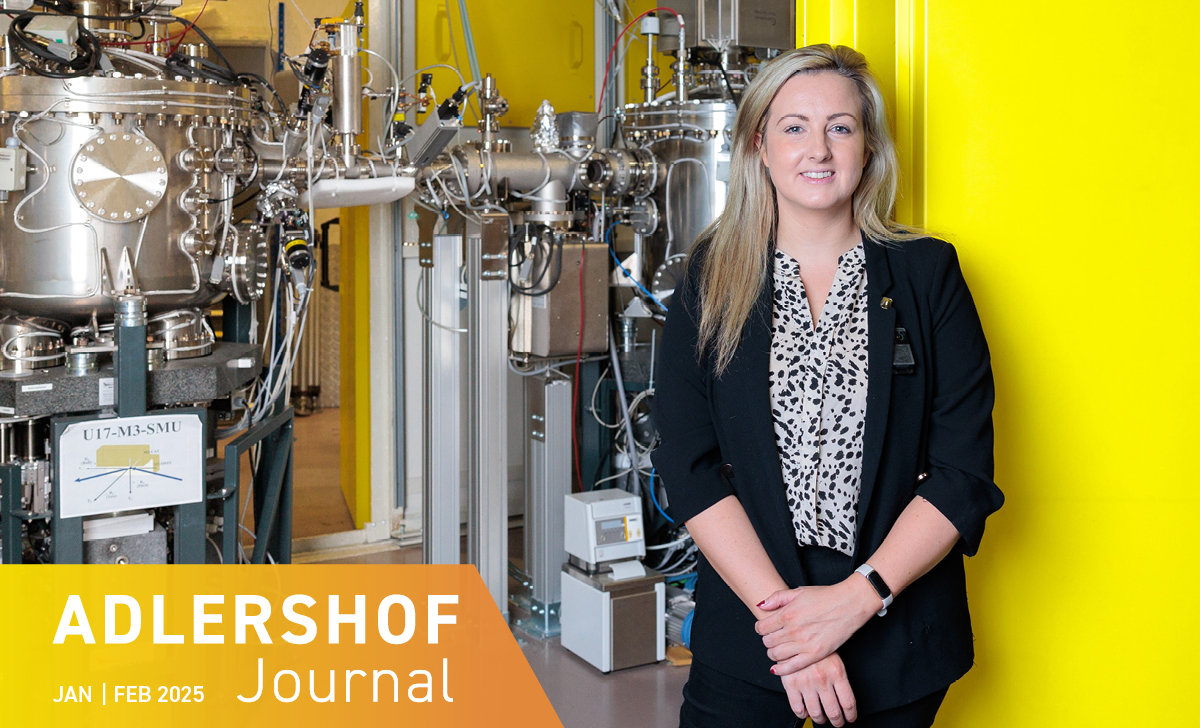
Portrait of the HZB junior research group leader Michelle Browne
Likes Berlin and what it offers to researchers: HZB junior research group leader Michelle Browne © HZB/Kevin Fuchs

Splitting water—using electrical energy to break the H₂O molecule into its gaseous components, hydrogen and oxygen, to be exact. Could this process be made cheaper, simpler, and more efficient? This question has guided Michelle Browne’s career, taking her from her native Dublin through Belfast and Prague to Adlershof.

Much depends on her research. It is one of the things set to determine whether the global effort against climate change will be successful. Produced using renewable electricity, green hydrogen is heralded as a key energy carrier for a carbon-neutral future. On the path to industrial-scale production of this climate-friendly gas, Browne’s award-winning research has taken major steps forward.

In 2021, she developed a hydrogen generator using a 3D printer and shared the blueprint online, making it accessible to researchers in labs all over the globe. According to Browne, the device costs just 500 euros to produce—a fraction of the market price, which can reach up to 20,000 euros for conventional equipment. Browne has now been leading a team of young scientists at Helmholtz Centre Berlin for Materials and Energy (HZB) since 2022.

Her team focuses on the electrodes that supply current during water splitting, particularly the anode, where the separated oxygen is produced. One research question is how to reduce the significant energy input currently required for this process. Browne’s group experiments with novel materials, applying them as ultra-thin coatings to electrodes to enhance their efficiency. ‘They do the research,’ Browne says about her team. Her role is to oversee the bigger picture—finances, public relations, and project management.

Browne’s journey to her life’s work was not straightforward. At one point, she worked as a physiotherapist, before delving into chemical methods for forensic science during her studies. It wasn’t until her dissertation that she chose a topic from electrochemistry. All this was driven by her curiosity to understand the world through science. And her desire to share that understanding with others. As a young doctoral candidate, she developed a groundbreaking science curriculum for children aged four to twelve in Ireland. Later, she designed an introductory course on electrochemistry for high school students aged 12–18.

After earning her PhD in Dublin, Browne embarked on a nomadic scientific journey, always seeking out the state of the art in hydrogen production. She spent two years at the prestigious Trinity College Dublin before facing a pivotal decision: What next? Browne turned down an offer from the venerable Royal Society, choosing instead to move to Adlershof. To her, Germany is nothing short of a ‘promised land’ of environmental research: ‘The expertise, funding, and infrastructure here are far superior to anywhere else.’

The now 34-year-old Irish scientist and her three-year-old daughter have found a home in Berlin. Browne has integrated well with her colleagues at Adlershof—who she notes are ‘very good at organising events’—while her daughter thrives in a kindergarten in Charlottenburg. Funding for her research from the Helmholtz Association extends until 2027. And after that? Michelle Browne has a dream: a professorship in Germany. She hopes to stay.

Dr. Winfried Dolderer for Adlershof Journal


Website of the HZB junior research group ‘Electrocatalysis: Synthesis to Devices’

Adlershof Journal Portrait Research Renewable Energies Microsystems / Materials Grand Challenges Talents

Related News

Group picture

ASCEND – A New Era in Catalysis

Federal Research Minister Dorothee Bär launches €30 million project in Berlin
Graphic: Hexagonal shapes with the names of the participating institutions and their partnerships

AI-driven Catalyst Development: €30 Million Funding for German Consortium

The ASCEND project to accelerate material development launches on April 1
Michelle Browne

Dr. Michelle Browne receives Daimler and Benz Foundation Fellowship

At HZB, she is developing better catalysts for the production of green hydrogen
Cover Adlershof Journal

Adlershof Journal January/February 2025

Boosting STEM: Play your way to growth
Surface of a Vanadium carbide MXene © B. Schmiedecke/HZB

MXenes show talent as catalyst for the production of green hydrogen

This class of materials is more stable and efficient than the best metal oxide catalysts currently available

Share this page

The development of the Science and Technology Park Berlin Adlershof was and is co-financed by the European Union namely by EFRE. This concerns infrastructure development like construction of technology centres. Furthermore EFRE is used for international projects.

  • © WISTA Management GmbH
  • Legal Notice
  • Privacy Policy
  • Social Media Guide
  • FAQ
  • Contact
  • Press
  • Newsletter
  • RSS
  • International
Member of:
Zukunftsort Adlershof Logo