
The protein maker
Bernd Haase’s company supplies molecular diagnostics with highly purified enzymes
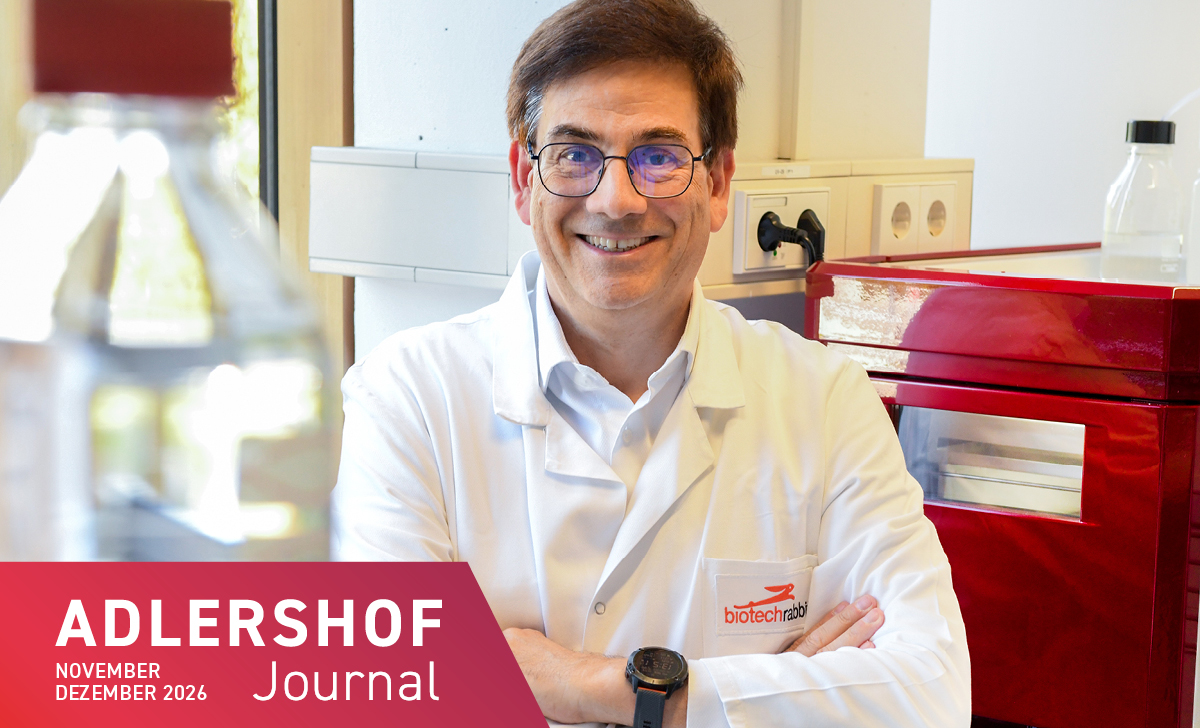
Bernd Haase has the simplest possible formula for what value creation means: “Creating something new.” That’s what drives him. Water, sugar, salt and yeast extract go in; highly purified proteins come out. This is the everyday production process that is the foundation of Haase’s Adlershof-based company: “The starting materials are simple; the technology behind them is extremely complex.”
Specially selected laboratory strains of E. coli grow in a carefully formulated nutrient medium. Through controlled fermentation, these bacteria produce complex proteins, which are then isolated and purified using complex and labour-intensive processes. Every bacterial cell contains thousands of proteins. Being able to extract a specific enzyme, separate it from the other cellular components and produce it to a consistently high standard: “Few companies in the world can do that,” says Haase.
For the past 15 years, his company, biotechrabbit GmbH, has been supplying pharmaceutical companies and medical laboratories with specialist proteins of the kind needed for molecular diagnostic and genetic tests. Its portfolio now comprises 350 products. Fifteen years ago, molecular biology tests accounted for just six percent of the global diagnostics market, even though this method delivers the most accurate results. This observation gave rise to the original business idea. Haase saw untapped opportunities for growth.
Originally from Lower Saxony, the 45-year-old could already look back on a managerial career when he launched biotechrabbit in 2011. He had studied biochemistry and completed a PhD and then made the transition into the industry in early 1996. Five years later, by then in a senior position, he completed an Executive MBA at a private university in Indiana, USA.
That meant flying across the Atlantic six times in 20 months for two-week seminars followed by exams. In between came plenty of homework, including up to 300 pages of reading a week. “It was no walk in the park.” But years spent in senior positions at leading international companies in the biotech industry had failed to satisfy Haase’s entrepreneurial drive in the long run: “I wanted to start my own business. I jumped in at the deep end.”
The company began modestly, with a three-person team, a laboratory and a small office in Hennigsdorf. Four years after its founding, it moved to Adlershof, where, in Haase’s words, it found “better opportunities for growth”.
At the Biotechnology Centre, the company now occupies around 2,000 square metres across two floors, with laboratories, offices and a workforce of 45. It also set up shop in Shanghai in 2022. A branch in the USA is also a real possibility.
Berlin’s Southeast has now also become the centre of his personal life. He lives in Köpenick and, as a watersports enthusiast, appreciates the area’s abundance of lakes and woods. He also loves cycling through these parts: past Müggelsee lake, the Dahme river, the ferry and the lido is a fantastic route, he says.
One question remains: What do biotech and rabbits have in common? It’s quite simple if you know your German. The founder’s name is Haase—German for rabbit. The company logo has a particularly majestic specimen jumping over the letters. The customers like it. “People come up and ask us about it at trade fairs.” Besides, as he points out: “If you can name a very successful company Apple...”
Dr. Winfried Dolderer for Adlershof Journal