
Tim Schröder receives first Doctoral Supervision Award
HU physics professor honoured for outstanding doctoral supervision
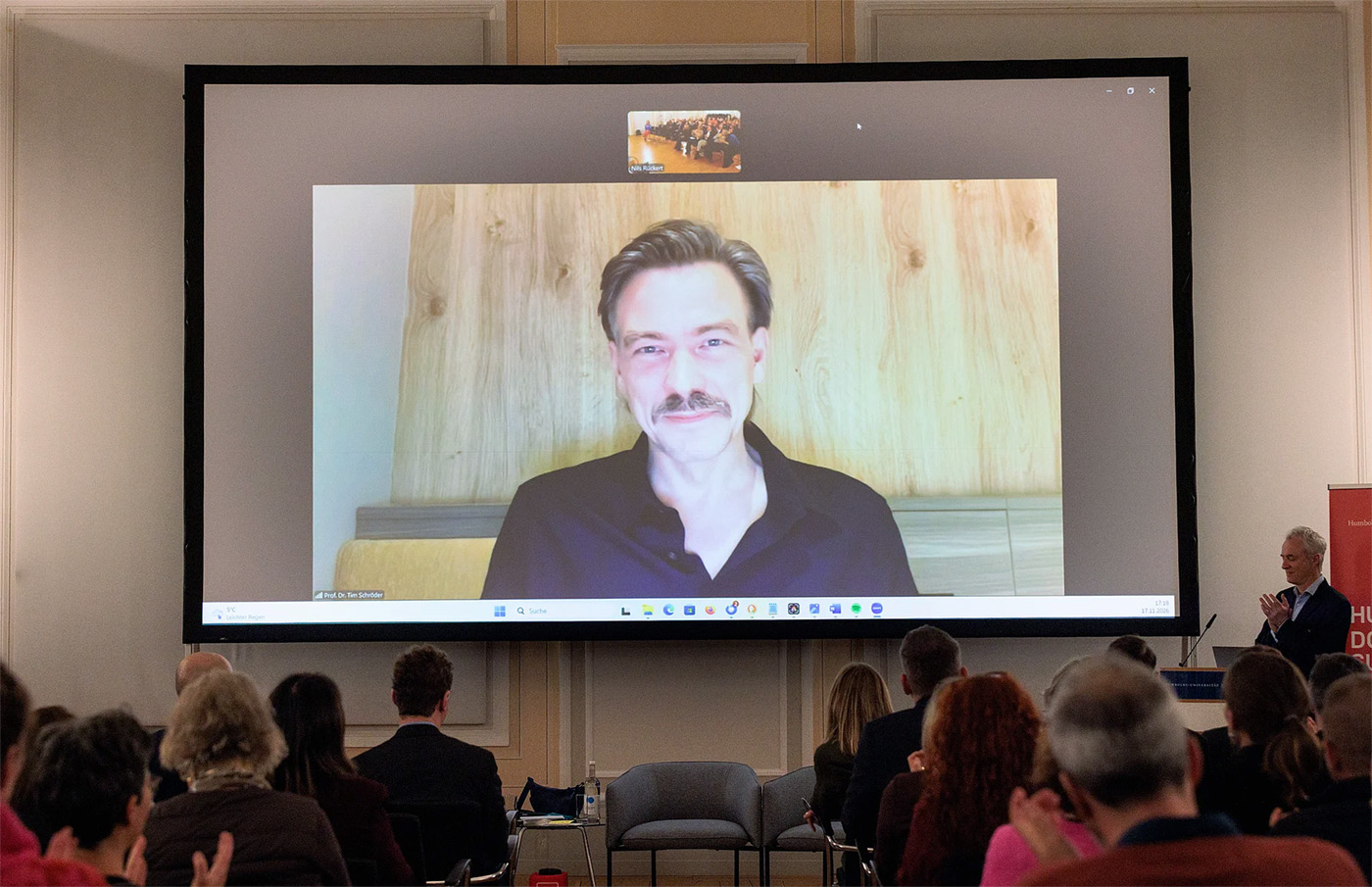
What does good supervision during a doctorate look like? For physics professor Tim Schröder, it involves regular dialogue, mutual trust and personalised support. He has now been awarded the Doctoral Supervision Award.
The prize was awarded on 17 November as part of the celebrations marking the 20th anniversary of the Humboldt Graduate School. Dr Ina Czyborra, Senator for Science, Health and Care, also attended the ceremony. With this new prize, Humboldt-Universität honours outstanding achievements in the supervision of doctoral researchers.
Dr Tim Schröder, Professor of Integrated Quantum Photonics and head of an internationally successful research group at the Department of Physics at Humboldt-Universität zu Berlin, was nominated for the prize by two of his doctoral researchers: Dr Laura Orphal-Kobin and Dr Julian Bopp. The anonymised nominations were assessed by the Council of the Humboldt Graduate School. The quantitative evaluations served as an initial guide. For the final assessment, the qualitative assessments and the personal letters from the nominators were the decisive factors.
Three pillars of good supervision
In his laudatory speech, Dr Bopp – now a researcher at the Fraunhofer Heinrich Hertz Institute – highlighted three pillars of Schröder’s supervision approach: continuous support in the day-to-day work of a PhD student, a respectful manner, and targeted support for professional development. With regard to the first point, Bopp highlighted regular communication in particular. “We held weekly discussions on general issues relating to the doctorate. He was also available at short notice for urgent queries,” said Bopp. Equally important, he added, was the trust that Schröder placed in his doctoral researchers. For example, they had the freedom to establish their own research collaborations. The third pillar was career support. Schröder gave his doctoral researchers an insight into the academic system and showed them various career prospects – including opportunities beyond an academic career, such as in industry.
Making time for people is important
The award winner himself joined the event online from Japan and, visibly delighted, expressed his gratitude for the honour. “One thing is absolutely crucial: as a supervisor, you must be constructively critical and work together to find solutions when progress is stalled, both academically and on a personal level,” he emphasised. Clear communication about the research project is also important. “Then the doctoral researcher can flourish within it and act independently.” Everyone needs a different level of attention in this regard. Some want to be left alone and simply get on with their work. Others need daily support.”
And how does that fit in with the professor’s own time management? “It’s really difficult, but very important to make time for people. However, I’m observing a shift in academic culture: compared to the past, collaborative development and working together are playing an increasingly important role.”
The award thus not only recognises Schröder’s commitment, but also highlights a key prerequisite for successful doctorates: supervision that enables academic independence whilst supporting doctoral researchers on their individual paths.
About the recipient
Prof. Dr Tim Schröder is Professor of Integrated Quantum Photonics at HU and heads the Joint Lab Diamond Nanophotonics at the Ferdinand Braun Institute of the Leibniz Association. Together with his international team, he researches nanophotonic structures in diamond and semiconductor materials for quantum communication and information processing – the key building blocks of a future quantum internet. In addition to numerous other research projects, he has secured the prestigious Starting and Consolidator Grants from the European Research Council (ERC). Alongside his research and teaching, he is strongly committed to science communication and shares insights into quantum photonics.
Video interview
In a video interview on the Humboldt Graduate School’s website to mark the award ceremony, the prize-winner shares his views on what constitutes good doctoral supervision: how have his own experiences as a doctoral researcher and postdoc shaped him? How does one manage to combine challenging research with dedicated supervision? And what is needed to ensure that good supervision is strengthened not only on an individual basis but also structurally within the academic system and at HU?
Contact:
Kathrin Klementz
Humboldt Graduate School
Officer / Advisor
+49 30 2093-89707
kathrin.klementz(at)hu-berlin.de
www.hu-berlin.de/en/humboldt-graduate-school
HU press release, 23 November 2026