
Turning waste into resources
MycoWerk focuses on regional fungi
Chitosan is a versatile biopolymer. This biodegradable, antimicrobial substance is used as a flocculant in water treatment, as a plant-strengthening agent in agriculture, and as a raw material for coatings and composite materials, among other things. Chitosan is derived from chitin, which not only forms the exoskeleton of insects but also the shells of crabs, prawns and lobsters. This makes the fishing industry one of its most important sources. Particularly in Asia, shellfish shells are processed into chitosan, which then reaches Europe through global supply chains. However, the animal kingdom is not the only source of chitin. It is also found in the cell walls of fungi. This is precisely where MycoWerk comes into play.
“Seeing as conventional supply chains are fragile and volatile, we sought to create a regional alternative,” says Juan F. Dueñas. The mycologist is one of the three founders of the MycoWerk start-up. “We use organic waste materials as a substrate for fungi and produce chitosan as locally as possible.” Instead of relying on centralised production and long transport routes, the team is pursuing a modular, decentralised biorefinery model.
Over the course of evolution, fungi have colonised a huge variety of habitats. They grow not only in forests, meadows and jam jars but also on waste from food production, such as brewer’s spent grain, coffee grounds, cereal bran and even residues from commercial mushroom cultivation. “They colonise their substrate and, in a sense, eat with their entire body,” explains Dueñas. “In the process, they incorporate chitin into their cell walls.” MycoWerk extracts it from there and processes it further into chitosan through several chemical steps.
The biopolymer is intended to be just the beginning. The team is already considering other substances that can be produced using fungi or extracted from them. In the long term, MycoWerk could thus create a platform for a range of fungus-based materials and chemical feedstocks.
For now, the start-up is still very much in the development stage. The fact that chitosan can be obtained from fungi has been known for some time. The questions Dueñas and his co-founders are investigating are therefore more practical ones: Which regional waste streams are best suited to which end products? When does it make sense to cultivate fungi in-house? How can chitin from fungal biomass be converted into chitosan even more efficiently? They are seeking answers through initial studies using waste materials from mushroom cultivation in Berlin and Brandenburg.
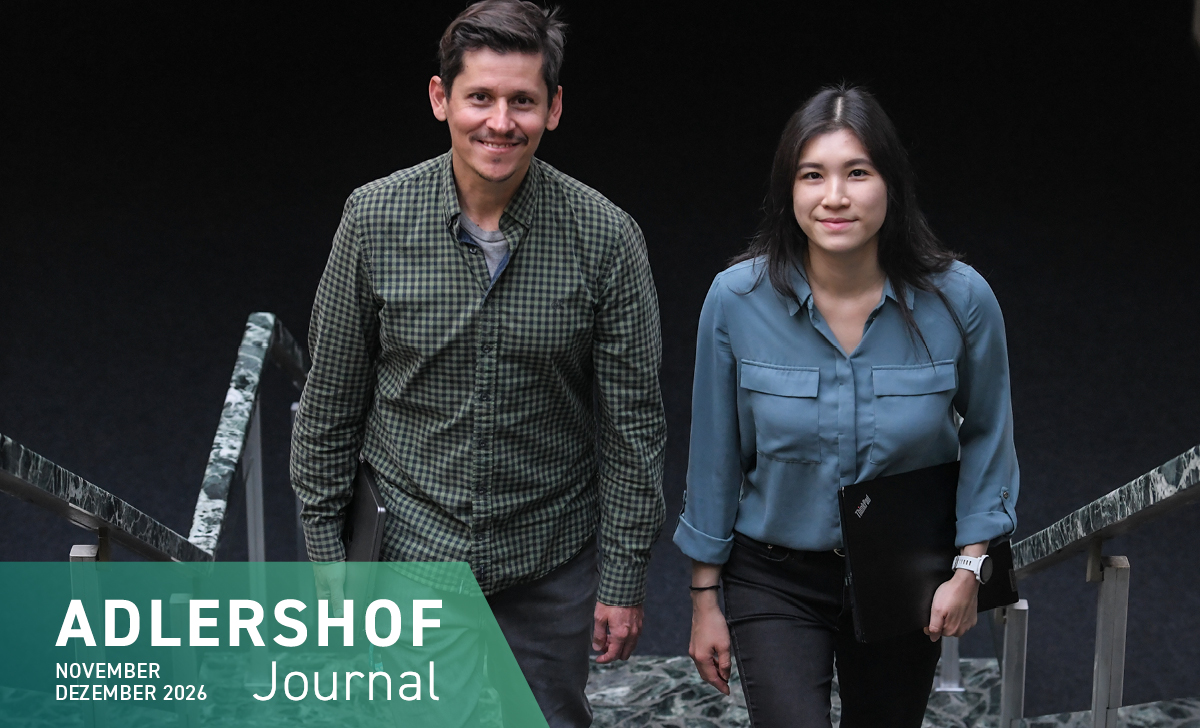
Dueñas has been working with fungi for many years at Freie Universität Berlin, where he also met Peter Meidl. Together, they developed the idea of launching their own start-up. “I’ve always been more interested in practical applications than in pure basic research,” says Dueñas. Meidl adds: “I also find it more rewarding to make a tangible difference than to spend my time chasing the next research grant.” They found the right addition to their team in Emily Y. Fung. She brings not only expertise in chemistry and some initial start-up experience to the table, but shares their enthusiasm for taking the step into the business world. “Researching and publishing papers is important,” she says. “But the results also need to find their way into the real world.”
It is precisely this transition from the laboratory to the market that the team is now working on at the Adlershof Startup Lab. What the four founders are dealing with now goes beyond fungi and chemistry. It includes financing, go-to-market strategy, setting up a company and finding customers. For Dueñas, it has been a steep learning curve. “The network and workshops help us tackle subjects that, as researchers, we have had very little exposure to until now.”
There are still some key questions to address. MycoWerk needs to decide which production route makes economic sense, whether to sell chitosan as a raw material or process it further for its own applications, and whether there will be enough customers for what it has to offer. At the same time, the team is exploring various funding opportunities and looking for academic partners to support further development. “Building a company from scratch is a demanding process,” says Dueñas. “But it’s also a very creative one.”
Kai Dürfeld for Adlershof Journal