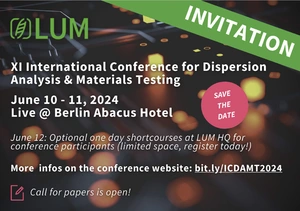
In June 2024, LUM GmbH hosts the next International Conference for Dispersion Analysis & Materials Testing:
In June 2024, LUM GmbH hosts the next, now traditional International Conference for Dispersion Analysis & Materials Testing (ICDAMT 2024). Due to popular demand the conference will again take place at the ABACUS…
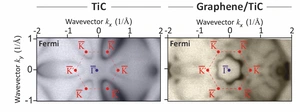
HZB team discovers a way for controlling and manipulating the electronic properties of materials by coating them with graphene:
Researchers have discovered a Lifshitz-transition in TiC, driven by a graphene overlayer, at the photon source BESSY II. Their study sheds light on the exciting potential of 2D materials such as graphene and the…
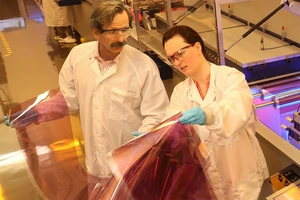
Innovation platform Solar TAP develops innovative solutions for photovoltaic applications and intends to bring them into use quickly:
Lighter, more flexible and adaptable – the innovation platform Solar TAP develops innovative solutions for photovoltaic applications. The aim is to make surfaces already used in agriculture, the building sector and…
A cornerstone for 1000-fold improved communication rates to bridge long distances:
Diamond material is of great importance for future technologies such as the quantum internet. Special defect centers can be used as quantum bits (qubits) and emit single light particles that are referred to as single…
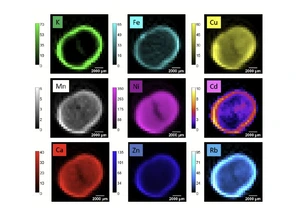
Team at BESSY II investigated heavy metal contamination of cocoa beans by combining different X-ray fluorescence techniques:
Cocoa beans can absorb toxic heavy metals such as cadmium from the soil. Some cultivation areas, especially in South America, are polluted with these heavy metals, in some cases considerably. In combining different…
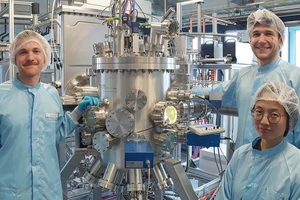
The equipment was commissioned to push the limits of material properties for quantum technologies:
Silicon (Si) and germanium (Ge) are the workhorses of modern semiconductor technology, where decades of science and technology development yielded advanced device fabrication of extremely pure materials. This…
European Research Council funds he work of quantum physicist Jens Eisert and materials scientist Catherine Dubourdieu:
Prof. Dr. Jens Eisert receives the ERC Advanced Grant of 1,8 million euros over five years for his project DebuQC. The quantum physicist conducts research at the Dahlem Center for Complex Quantum Systems at Freie…
Positive development despite interlocking crises/ Remarkable increase particularly in employment:
Despite various interlocking crises, the Science and Technology Park in Berlin Adlershof was able to grow significantly in 2022. Revenues and budgetary resources increased to €3.63 billion (2021: €3.21 billion),…
Helmholtz Association funds innovation platforms on accelerator technologies and photovoltaics research with 4.2 million euros:
The Helmholtz Association has selected three new innovation platforms that will now be funded. HZB is involved in two of them: The Innovation Platform on Accelerator Technologies HI-ACTS is intended to open up modern…
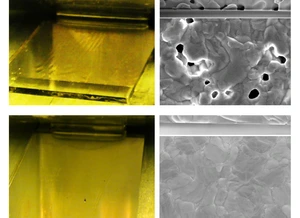
HZB team optimises metal halide perovskites for the slot die coater – a step towards industrial production:
Solar cells made from metal halide perovskites achieve high efficiencies and their production from liquid inks requires only a small amount of energy. A team led by Prof. Dr. Eva Unger at Helmholtz-Zentrum Berlin is…
The research at Helmholtz-Zentrum has reached the pinnacle of its field:
“No other sandwich will give you this amount of energy” – although this is putting it quite crudely, the sentence contains a highly scientific truth. After all, it was included in the presentation of Amran Al-Ashouri,…
Xolo’s novel technology enables the production of intricate components in mere seconds:
The DeepTech & Climate Fonds (DTCF) has successfully closed its first investment in a series A financing round. Together with the HZG Group, Onsight Ventures and the current investor SquareOne, DTCF is investing eight…
In his HyPerGreen project, the researcher aims to improve the efficiency of lead-free perovskite solar cells:
Dr. Artem Musiienko has earned a prestigious Maria Skłodowska Curie Postdoctoral Fellowship for his research project HyPerGreen. In the group of Prof. Antonio Abate, HZB, Musiienko will explore and improve lead-free…
IKZ joins hands with HU and DLR to reveal new physical properties at the quantum limit and to develop a technological base for new generation single-electron devices:
Germanium (Ge) has been demonstrated as the purest material that human beings could prepare among all semiconductor materials. Ultra-high purity germanium (u-HPGe) crystalline material with a net charge carrier…
With an improved material structure, a team from HZB achieves efficiencies of up to 24.6%:
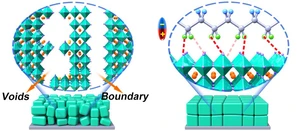
Perovskite semiconductors promise highly efficient and low-cost solar cells. However, the semi-organic material is very sensitive to temperature differences, which can quickly lead to fatigue damage in normal outdoor…
New method delivers high-resolution real-time video from the microcosm:
A team of scientists, led by researchers from the Max Born Institute in Berlin and Helmholtz-Zentrum Berlin in Germany and from Brookhaven National Laboratory and the Massachusetts Institute of Technology in the…
Researchers are investigating hybrid materials at the new Center for the Science of Materials Berlin (CSMB):
A place of innovation: Researchers of Humboldt-Universität zu Berlin and other Berlin-based research institutes are investigating new materials as part of the new Center for the Science of Materials Berlin (CSMB).…
An innovative project for sustainable kerosine has been launched at Helmholtz-Zentrum Berlin:
The transition to clean energy, or Energiewende, in transportation has begun. We are moving away from fuels that are damaging to the climate like petrol or diesel and towards carbon-neutral energy sources, including…
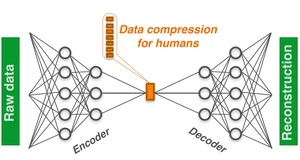
HZB-Team entwickelt Software, um die Datenauswertung von Experimenten deutlich zu verbessern:
Experimental data is often not only highly dimensional, but also noisy and full of artefacts. This makes it difficult to interpret the data. Now a team at HZB has designed software that uses self-learning neural…
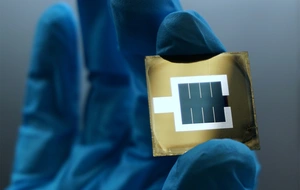
Tandem solar cell achieves 32.5 percent efficiency:
The current world record of tandem solar cells consisting of a silicon bottom cell and a perovskite top cell is once again at HZB. The new tandem solar cell converts 32.5 % of the incident solar radiation into…