
News Archive
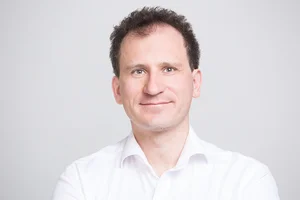
HU astroparticle physics group led by Prof. Kowalski made a significant contribution to the Nobel Prize win
Adlershof-based research team has been involved in neutrino research for more than 25 years:
The Royal Swedish Academy of Sciences has awarded the Belgian-American researcher Francis Halzen with the 2026 Nobel Prize in Physics for his “pioneering contributions to the IceCube neutrino observatory and the…
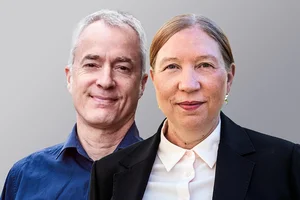
New Vice-Presidents at Humboldt-Universität zu Berlin
Professor Dr Ulf Leser and Professor Dr Beate Lütke took up their new posts on 1 October 2026:
Prof. Ulf Leser is responsible for the Research portfolio, whilst Prof. Beate Lütke is responsible for the Teaching and Student Affairs portfolio. The HU Council elected both of them on 28 April 2026. They succeed…
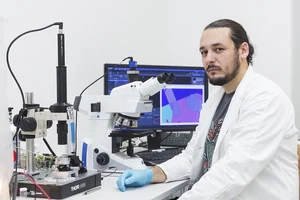
Internationally recognized materials scientist joins BTU and IKZ
Aleksandar Matkovic, expert in complex material structures and ERC Starting Grant recipient, conducts research at the interface of materials and devices:
Internationally recognized materials scientist Prof. Dr. Aleksandar Matkovic will take over as head of the “Nanostructures & Thin Films” department at the Leibniz-Institut für Kristallzüchtung (IKZ) on October 1,…

Far-UVC LEDs transmit data at record speed
Wireless optical communication using UVC light expands the possibilities of radio-frequency technologies:
Researchers at Ferdinand-Braun-Institut (FBH) in Berlin, the Institute of Photonics at University of Strathclyde, and the LiFi Research and Development Centre at University of Cambridge have transmitted data at up to…
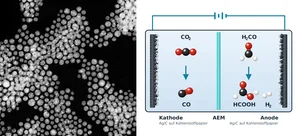
Nanosilver as an electrocatalyst for CO₂ reduction
Simultaneous production of formic acid, hydrogen and CO further enhances the cost-effectiveness of electrolysis:
Via electrolysis, CO2 can be reduced to CO, a raw material for further chemical products such as fuels. Within the GreenQuest Project, an internation team led by HZB chemist Prashanth Menezes has now systematically…
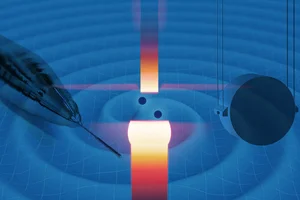
Record levels of purity: IKZ silicon for the mirrors of the Einstein Telescope
The institute is contributing to the preparation for the next-generation gravitational-wave detector:
The IKZ is developing the material for one of the most ambitious scientific instruments of the coming decades: high-purity crystalline silicon for the mirrors of the planned Einstein Telescope (ET). Through two…
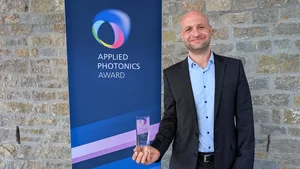
Applied Photonics Award 2026 for FBH researcher
Marc Christ was honoured for his dissertation on compact atomic quantum sensors:
The Applied Photonics Award recognizes outstanding scientific achievements in applied photonics. In his doctoral thesis, Marc Christ developed a technology platform that makes key components of atomic quantum sensors…
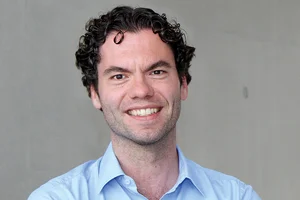
Christian Hackenberger receives the UNIPRENEURS Award for outstanding commitment to entrepreneurship
The HU professor, researcher and entrepreneur has been honoured for his commitment to spin-offs and entrepreneurship:
Every three years, UNIPRENEURS awards Germany’s highest honour for outstanding achievements in promoting entrepreneurship, technology transfer and spin-offs at universities and non-university research institutions.…
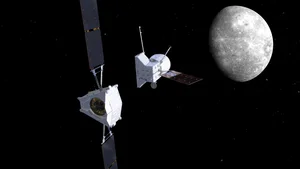
Cruise Complete, Mercury Ahead
A new chapter for the MERTIS and BELA scientific instruments onboard the BepiColombo planetary mission:
After an eight-year journey through the inner Solar System, BepiColombo mission is entering a decisive phase on its way to uncovering the mysteries of Mercury, the innermost planet. A joint mission of the European…
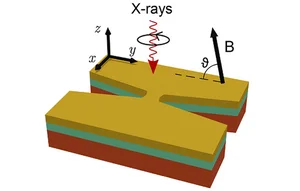
Spin waves inside a nano-oscillator imaged for the first time
The scanning transmission X-ray microscope MAXYMUS at BESSY II reveals magnetisation processes in spintronic devices:
For the first time, researchers have directly imaged the magnetisation dynamics inside a spin Hall nano-oscillator — a nanoscale device that converts direct current into tunable microwave signals and is a promising…
Watching a Carbon-Carbon Double Bond Respond to Light
Research team investigates the molecular response following the photoexcitation of ethylene:
Ethylene contains a carbon–carbon double bond, one of the most important structural motifs in organic chemistry. Carbon–carbon double bonds are present in countless molecules, and their response to light plays a…
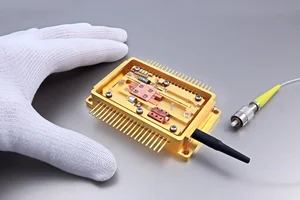
FBH at Photonics Days: from high-power diode lasers to quantum technologies
Ferdinand-Braun-Institut will present the latest developments on 7 and 8 October 2026 in Adlershof:
Ferdinand-Braun-Institut (FBH) will contribute numerous scientific presentations at Photonics Days Berlin Brandenburg on October 7 and 8, 2026. The focus will be on current developments in diode lasers and UV light…
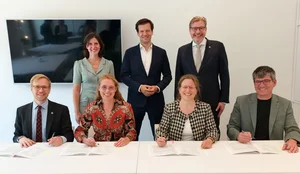
Joint power instead of duplicate structures
The research community in Berlin is pooling its computing power for AI and data research:
Berlin’s research community is further advancing its research excellence by establishing a high-performance, cross-institutional infrastructure for data and AI. With a joint agreement signed on 18 September 2026, the…
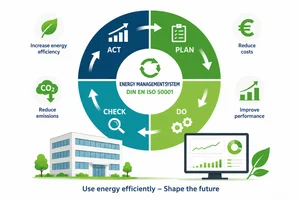
New greenhouse gas report identifies main sources of emissions at HZB
Research institute presents greenhouse gas inventory and certification for its energy management system:
For many years, the Helmholtz-Zentrum Berlin (HZB) has been committed to resource-efficient research and working practices. The centre has set itself the goal of becoming greenhouse gas neutral by 2035. To this end,…

Cooperation agreement signed between Humboldt-Universität and the Berlin Chamber of Industry and Commerce
Working together for talent and innovation ‘Made in Berlin’:
The HU and the Berlin Chamber of Commerce and Industry (IHK) aim to forge even closer links between academia and industry. The President of Humboldt-Universität zu Berlin (HU), Prof. Dr Julia von Blumenthal, and IHK…
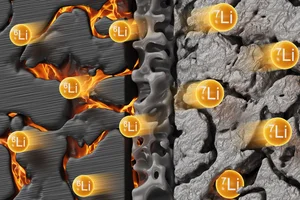
New findings on the lifespan of lithium-ion batteries
Distribution of lithium isotopes serves as a ‘fingerprint’ for aging processes:
The service life of lithium-ion batteries is limited by complex aging processes, the causes of which are often difficult to distinguish from one another. Researchers at the Federal Institute for Materials Research and…
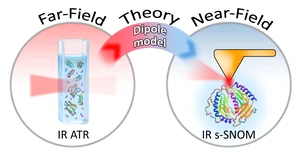
High-resolution insights into individual biomolecules and catalysts
Nanoscale infrared spectroscopy improves the ability to study biological and chemical processes at BESSY II:
Very small biological samples and even individual biomolecules can now be examined under near-physiological conditions with high confidence at the BESSY II infrared beamline with a newly validated and improved…
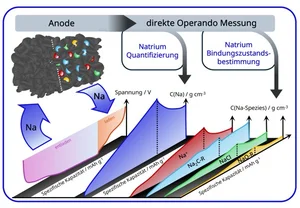
New insights into sodium transport in sodium-ion batteries
Measurements reveal movements and chemical changes in the material:
Sodium-ion batteries are regarded as a promising alternative to today’s lithium-ion batteries. Sodium is widely available and could play an important role, particularly in large-scale stationary energy storage…

From repair medicine to health medicine
Essay by David Matusiewicz, Professor of Healthcare Management at FOM University and Dean of Health & Social Care:
The medicine of the future will not simply become more digital—it will be more connected, preventive, personalised and humane. From my perspective, we are at a turning point where technological innovation and a…
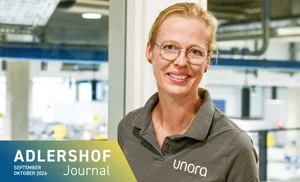
In conversation with Francoise Hesse, who advises customers on stoma care solutions
“Stoma care but stylish.” That is how Francoise Hesse describes UNORA's products, which are used to care for artificially created openings in the body, such as those involving the bowel, urinary tract or trachea.…