
Adlershof, acne and astronauts
JenLab technology offers countless potential applications and is used worldwide
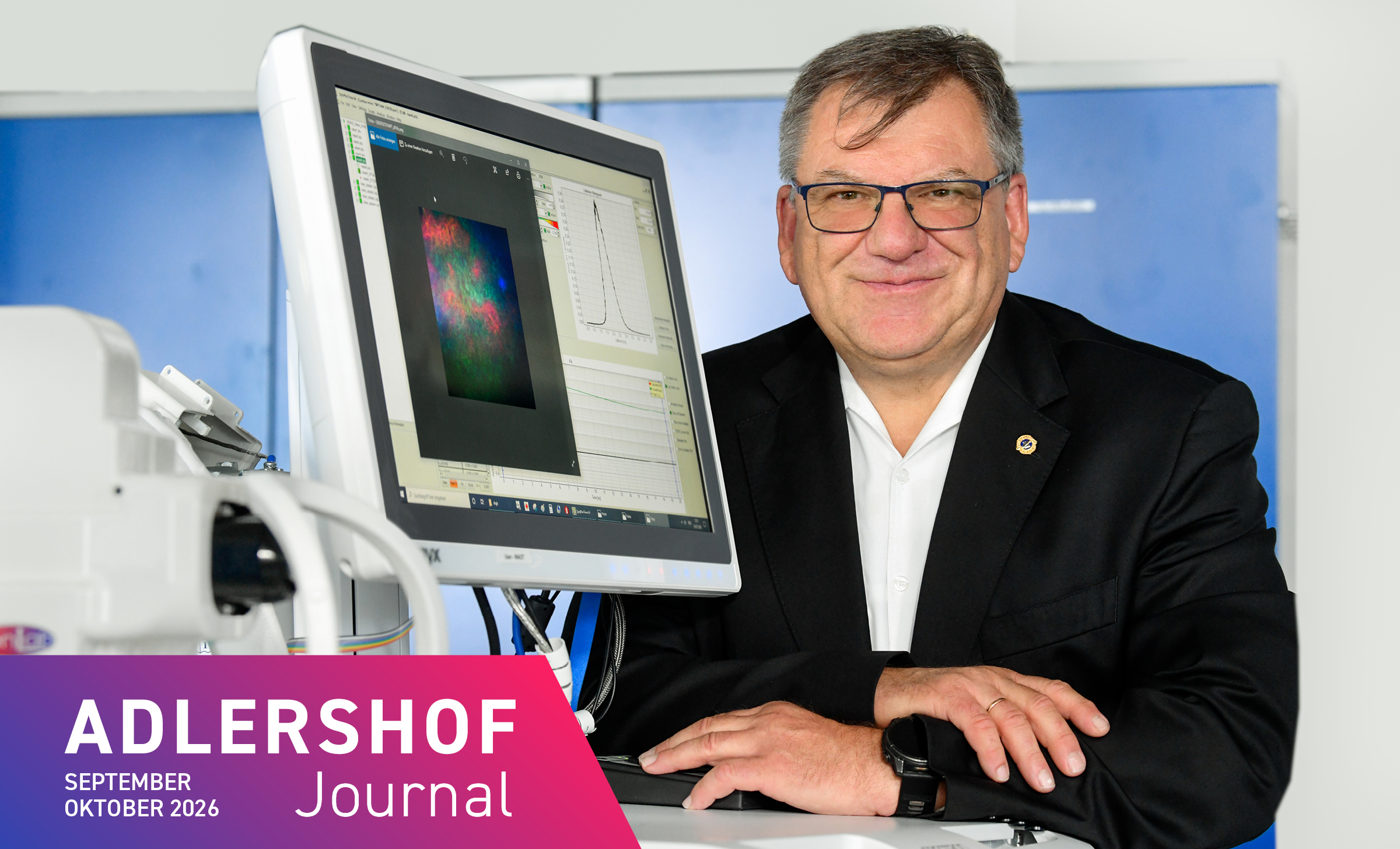
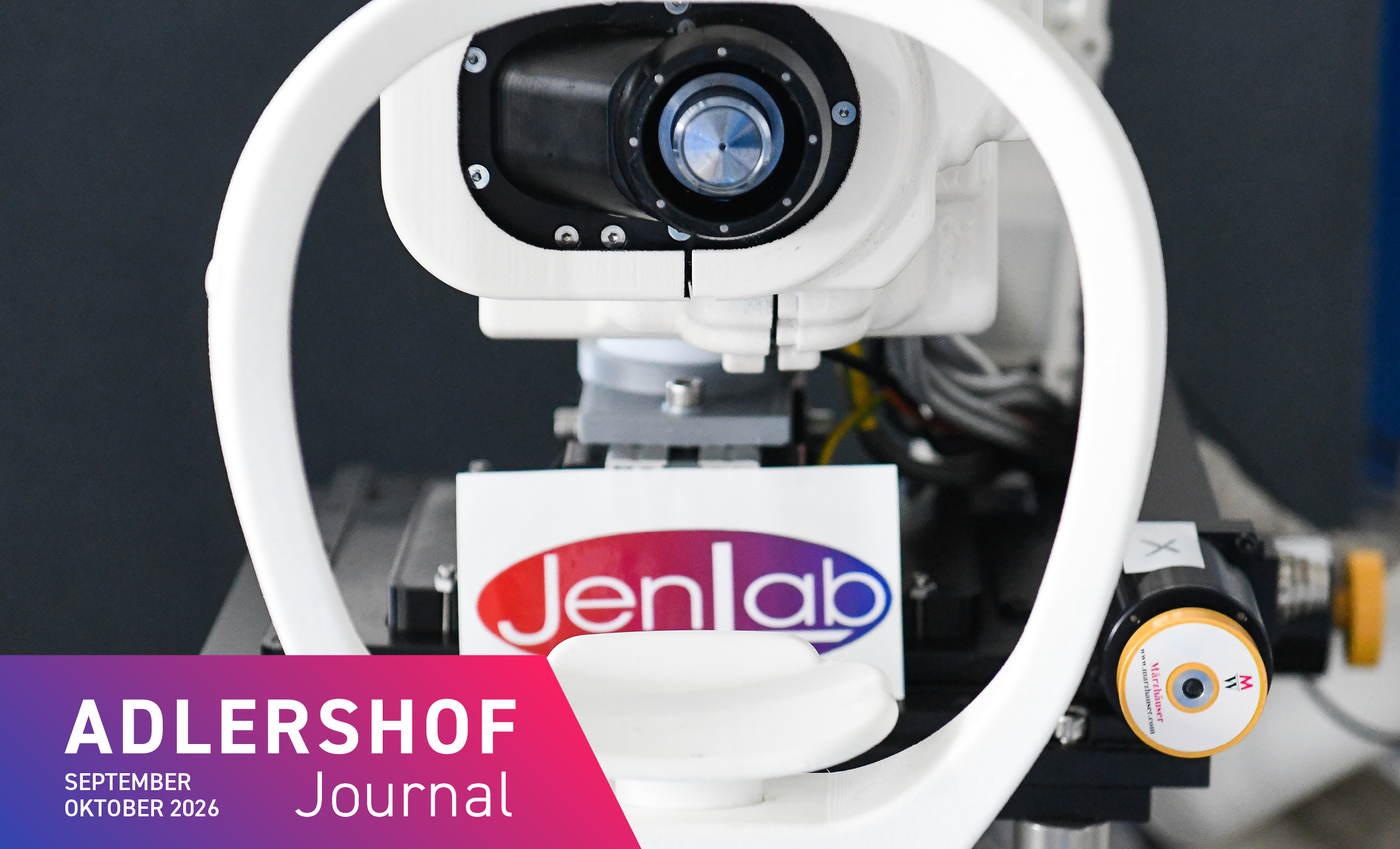
Its customers range from the European Space Agency (ESA) and global companies such as L’Oréal, Shiseido, Colgate-Palmolive and Procter & Gamble to leading clinics in Boston, Brisbane and Berlin. JenLab was named Innovator of the German Economy in 2023 and received the sought-after PRISM Award in 2024. Behind the success is an Adlershof native who returned to the campus: Karsten König grew up in Berlin’s smartest neighbourhood.
The infrared femtosecond laser in the multiphoton tomograph emits 80 million laser pulses per second. When these penetrate the skin, the detection of returning photons makes it possible to visualise the finest tissue structures as well as ageing and metabolic processes with very high spatial and temporal resolution. “With a spatial resolution of 0.3 micrometres, we achieve the highest spatial resolution of any clinical imaging technique and can detect fluorescent biomolecules in tissue with picosecond resolution,” says Karsten König, managing director and shareholder of JenLab GmbH. In 2024, his company received the PRISM Award for the best photonics product in the life sciences. It was also named Innovator of the German Economy in 2023 and has built up a select customer base in the US, Asia, Australia and Europe.
The European Space Agency uses JenLab’s technology to examine astronauts’ skin after extended stints in space. The findings showed that while their skin does not age more quickly, the volume of the protective epidermis decreases significantly. For those dreaming of flying to Mars, that is not good news. König has better news for teenagers and others affected by acne. In a research project with Charité – Universitätsmedizin Berlin, JenLab is working to measure the bacteria responsible for acne and their metabolism in the face at high resolution, investigate their metabolic activity and then finish them off using far-UVC laser diodes developed by Adlershof neighbours at the Ferdinand-Braun-Institut. “It looks as though the very shallow penetration depth allows us to inactivate bacteria on the surface without damaging living skin cells,” he explains. Multiphoton tomography will be used to verify the results. This purely photonic approach could offer an important alternative to the widespread use of antibiotics, which contributes to the problem of antibiotic resistance.
In another research project, JenLab is working with partners to establish femtosecond lasers in dental practices as an alternative to drills. This could put an end to the imprecise, noisy, vibrating and often painful treatment of tooth decay. The ultra-short laser pulses could precisely remove areas affected by decay. Gentle surgery is also the aim in skin cancer treatment, where high-resolution imaging during an operation enables non-contact biopsies that can clearly distinguish healthy from mutated tissue. Multiphoton tomography is also being used in US Food and Drug Administration (FDA) approval processes for new therapies, medicines and cosmetics. One Adlershof project is supporting the approval of a new form of radiotherapy for women with breast cancer. JenLab’s technology is being used to investigate whether the intense radiation damages their skin. Cosmetic manufacturers, meanwhile, use the technology to demonstrate that nanoparticles in sun creams do not penetrate into deeper, blood-supplied layers of the skin. They are also investigating the effects of anti-ageing products, medical skin creams, and pharmaceuticals directly on human volunteers, without the need for animal testing. This is made possible by an ultra-high-resolution, non-contact, in-vivo view into the first 200 micrometres of the human skin.
The future of healthcare lies in such gentle photonic techniques. But they naturally have their limits. Even in the long term, whole-body scans for the prevention of dermatitis, psoriasis or skin cancer will not be feasible with JenLab’s technology. “At a resolution of 0.3 micrometres, we can examine a few square millimetres of a suspicious area of skin. If we examine 20 layers at different depths and different areas of the skin, the process takes just under half an hour at an acquisition speed of around six seconds per image, including the initial patient briefing,” says König. The limitation lies in the procedure itself. The skin absorbs almost all photons, with only a very small number returning. Single-photon counters and extensive software are used to translate these extremely weak light signals into usable images.
Although König sees these technological limitations, he believes multiphoton tomography still has enormous potential. New projects and possible applications seem to flow constantly from him. “I am an entrepreneur, but I am still a professor and researcher,” he says emphatically. That is why he deliberately keeps the JenLab team small. His company only has ten employees, all highly qualified, because there would be too much bureaucracy otherwise. König wants to remain agile and innovative. He is increasingly marketing his technology in the US and Asia to avoid what he sees as excessive EU regulation. He has no doubts about Adlershof as a location. This is where he went to school, growing up among numerous personalities from science and world history. After spells in Jena, Ulm, Saarbrücken and Irvine, he returned to Adlershof to realise his dream of running his own company. Here, he has a network that provides support in turning his ideas, applications and projects into reality. An Adlershof native who returned as a professor—and who is getting under the skin of many people with his unique procedure. Whether they are astronauts or adolescents.
Peter Trechow for Adlershof Journal