
Autonomous rail transport: between optimism and scepticism
At the DLR Transport Research Institute, the acceptance conditions for automated rail transport were investigated

In future, autonomous vehicles could be used for both local and long-distance transport. The Acceptance GoA3+ project, which investigated the attitudes of passengers and staff towards this, has now been completed.
Areas of application for autonomous vehicles
In future, automated trains could be used in both local and long-distance services, as well as for passenger and freight transport. One promising development in this field is what is known as GoA3+. The term describes rail vehicles that operate without a train driver (Grade of Automation 3, GoA3). At the highest level, GoA4, on-board crew are also no longer required. At the second level, GoA2, the train driver remains on board primarily in a supervisory role, but would be supported by automation during the journey. This level of automation should be viewed with scepticism, as negative monotony effects on train drivers could have adverse consequences in the workplace.
The introduction of autonomous rail vehicles affects numerous stakeholders. Politicians, transport operators, associations, lobby groups and emergency services are just as concerned with the opportunities and challenges of the technology as railway staff and passengers themselves, who are directly affected by it. Successful implementation therefore depends not only on technical feasibility, but also on social acceptance.
Passenger acceptance
What do passengers think of autonomous trains? A study on acceptance involving more than 1,500 participants investigated this question.
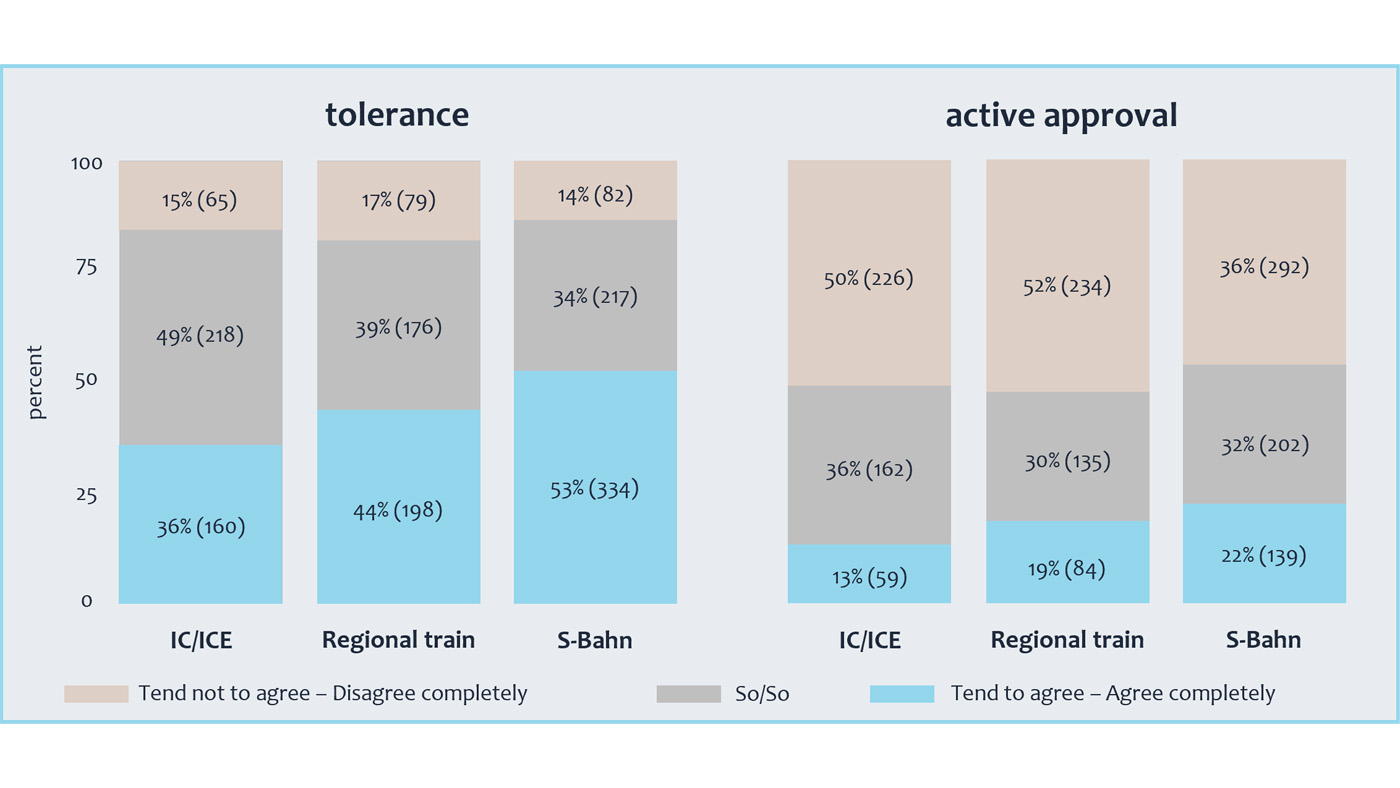
The results paint a generally positive picture: more than half of those surveyed would have no problem with self-driving commuter trains being introduced in their local area. More than one in five people would even expressly prefer such a service. However, approval ratings for regional trains and IC and ICE services are slightly lower than for suburban rail services.
Expectations regarding automation are high. Many respondents associate it with the hope of a better and more reliable transport service. At the same time, there are reservations: in particular, the question of who will provide on-site assistance in the event of technical faults or exceptional circumstances is a concern for many passengers.
Jobs in autonomous rail transport
The perspective of employees also plays a key role in the introduction of automated trains. As part of the research, more than 100 explicit and implicit tasks were identified that are currently carried out by train drivers and on-board staff. The explicit tasks are derived from official regulations, whilst the implicit tasks were identified on the basis of first-hand accounts.
Findings from interviews, workshops and an online survey show that the introduction of GoA3+ is associated with uncertainty among many employees. In addition to changes in work activities, aspects such as job satisfaction under GoA3+ were therefore also examined. Employees fear that their jobs could lose autonomy and variety. The acceptance of GoA3+ among the affected staff therefore depends largely on security, reliability and the human-centred design of new job roles and processes.
Recommendations from the GoA3+ study
Among other things, the researchers recommend the establishment of a national round table as a possible measure. Here, rail operators (EVU & EIU), trade unions, manufacturers, policymakers, academia and civil society could work together to find solutions, identify conflicting objectives at an early stage and develop consensus-based recommendations for action regarding the introduction of automated rail transport. Experience also shows that pilot projects, such as the autonomous S-Bahn in Nuremberg, increase acceptance.
The GoA3+ Acceptance Project has examined further stakeholder groups and plans to publish additional findings. Researchers at the Technical University of Braunschweig have also carried out fascinating analyses into the areas where automation is next expected to be introduced.
GoA3+ Acceptance Project
The absence of train drivers and accompanying staff (GoA3+) presents challenges for stakeholders in passenger and freight transport. In order to be successfully implemented, it must be clarified what requirements the different groups have for automated rail vehicles.
Project website Acceptance GoA3+
Contact:
German Aerospace Center (DLR)
Institute of Transport Research
Rudower Chaussee 7, 12489 Berlin
+49 30 67055 8079
www.dlr.de/vf
DLR press release, 6 July 2026