
Designing mobility for older people – DLR identifies need for action
A study from the DLR Transport Research reveals older people’s requirements for safe, understandable and accessible mobility services
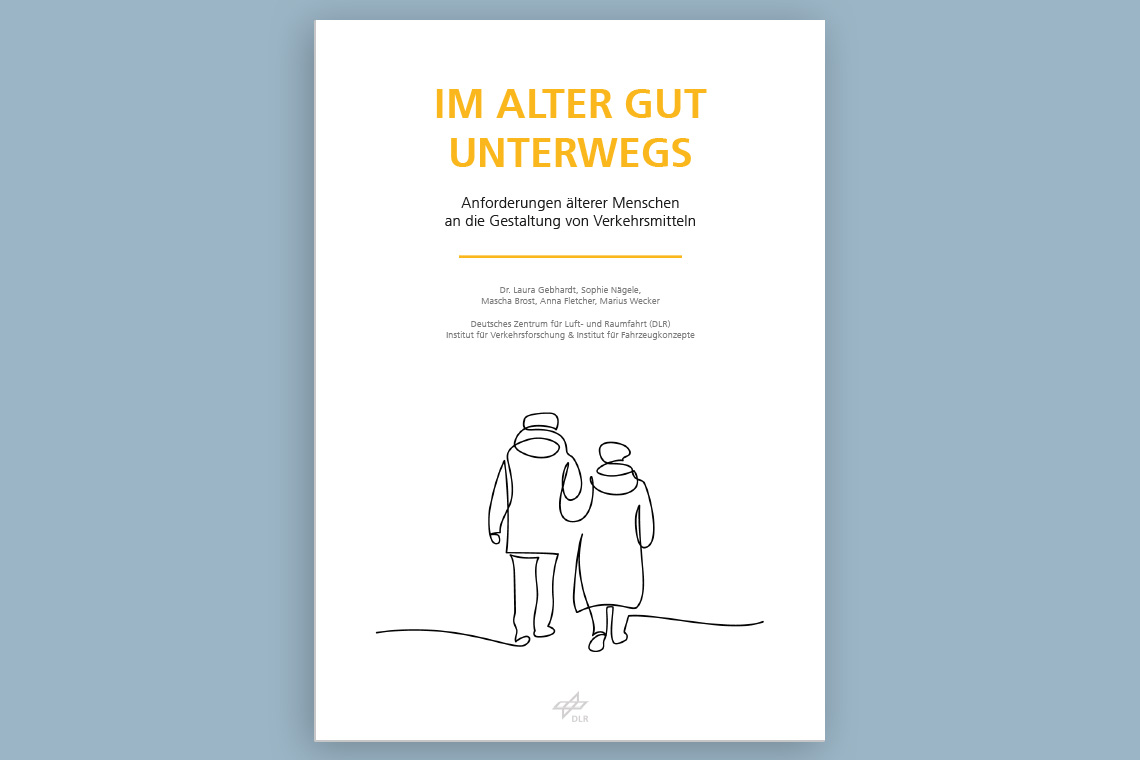
The German Aerospace Center (Deutsches Zentrum für Luft- und Raumfahrt; DLR) has conducted a study into the transport needs of people in their mid-60s and older. The study also analysed how current mobility services meet these needs. Critically, mobility options must be available and designed to meet actual requirements. The research team considered mobility in everyday life as well as in crisis situations, such as heatwaves or pandemics; examining mobility in crisis situations supported conclusions about the resilience of solutions.
The ‘Mobility Design Norm Gap’ excludes many people
“Our transport system and transport planning are still very clearly oriented towards a ‘reference person’, who is an average, healthy male – which does not adequately consider the needs of large sections of the population,” summarises Sophie Nägele from the DLR Institute of Transport Research, which produced the study together with the DLR Institute of Vehicle Concepts. “This includes older people, but also women, children and people of any age with permanent or temporary impairments. We have given this structural gap between needs and provision the name ‘Mobility Design Norm Gap’.”
Significant need for action for a growing target group
Due to demographic change, the proportion of older people is steadily growing. By 2040, almost 30 percent of people in Germany will be older than 67. A similar trend is taking place in many Western societies and in Asian countries such as Japan and South Korea. This affects how mobility offerings are perceived and used, since physical and cognitive impairments become more likely with increasing age. For example, reaction speed slows down, the field of vision narrows, hearing deteriorates. Complex processes can be overwhelming, and routines become more important. “Especially in old age, maintaining mobility is an important factor. It influences independence, participation in society and quality of life,” explains Nägele.
Potential for age-appropriate mobility – cars and e-bikes
Being able to get around by car is important for many older people. To better adapt vehicles to their needs, the study gives as one example ‘head-up displays’. These project important information into the driver's line of sight, allowing their attention to remain directed at the road. Voice control for navigation and comfort systems also helps maintain focus on the road. New functions work best when they build on familiar operating patterns, such as whether a button needs to be pressed or turned. Adjustable swivel seats are one option for making it easier to get in and out of a vehicle. “Another important aspect is age-appropriate crash-test dummies. They can make tests more realistic and better adapt safety systems to older people. This is important because, in old age, bones break more easily – for example, in an accident,” explains Nägele.
E-bikes are very popular among older people. Approximately 20 percent of users are between 60 and 70 years old, making them the second-largest user group. However, e-bikes are heavier than conventional bicycles. Lighter and more manoeuvrable models are therefore recommended for older people. Easily accessible training programmes can help practise the correct behaviour in dangerous situations and reduce the risk of accidents. Clear route guidance, good road surfaces and helmets also increase safety – not only for older people.
Walking and public transport – even in old age
For many older people, walking is the most common way of getting around. Sufficiently wide and well-lit paths and steps, functioning lifts and escalators, and seating for short breaks all make getting around easier. The same applies to route guidance that is as direct and simple as possible, especially when transferring to public transport.
Walking is the ‘first step’ in 95 percent of all journeys by bus and rail. For older people, this walk can represent a key hurdle to using public transport. “That is why it is so important not to look at individual means of transport in isolation, but always to consider the entire journey chain – that is, from front door to final destination,” explains Nägele. Older people also have particular requirements regarding public transport vehicles, starting with clear and large information boards and signs, and easily understandable announcements made at a moderate speaking rate. Digital tools for route planning and ticket booking should have simple user interfaces with large buttons and clear instructions. As for the vehicles, the study also lists several important considerations, from a low boarding height and handrails at different heights to sufficient space for walking aids and rollators.
Shared, automated vehicles – an attractive option for older people
Shared, automated vehicles could be a valuable option for older people in the future. They can enable mobility, independence and social participation when driving or walking are no longer options. “When designing such novel mobility services, the specific needs of this target group should be considered from the outset,” recommends Nägele. With automated mobility services, there will be no driver, so, for older people, interaction with fellow passengers will become important. Organising journeys with people of a similar age would also be conceivable. The design requirements here are similar to those described for public transport. It is important, for example, that booking apps here should also be as simple as possible.
Recommendations from the study
“Closing the Mobility Design Norm Gap will require coordination between everyone who plans and offers mobility services and vehicles. The government must specify binding framework conditions and requirements and, where necessary, issue sanctions to achieve the most comprehensive accessibility possible,” concludes Nägele. At the same time, the challenges of demographic change also represent an economic opportunity, since age-appropriate mobility offerings are needed by a growing target market with high purchasing power: “Providing a suitable offering for this group is not only about care and participation – it could develop into a genuine market advantage.”
Related links:
Contact:
German Aerospace Center (DLR)
Denise Nüssle
Corporate Communications
+49 711 6862-8086
www.dlr.de
DLR press release, 23 July 2026