
BAM takes a key role in major European research project
The EU project MaterialsCommons is establishing a networked data and AI infrastructure for materials research
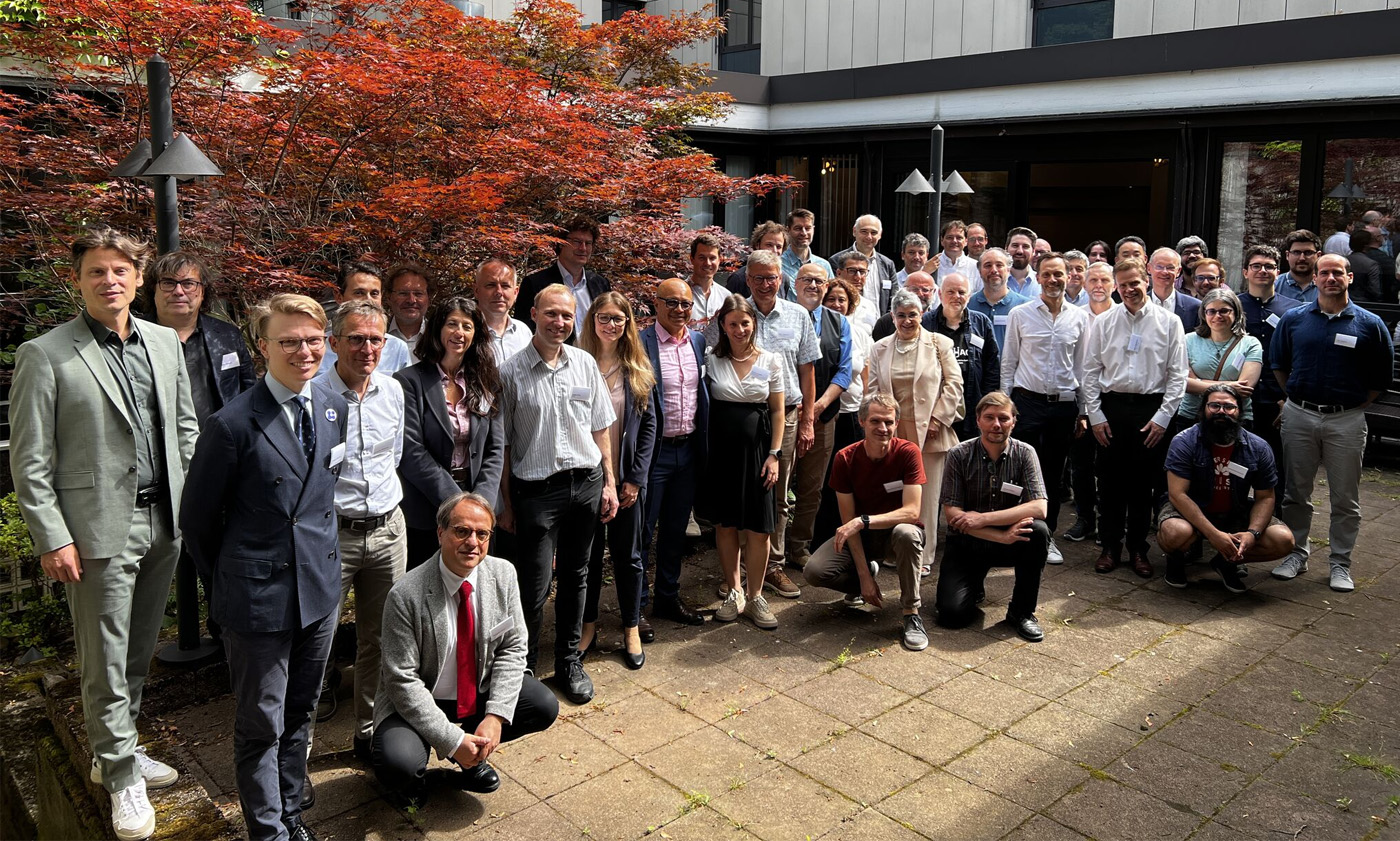
The Federal Institute for Materials Research and Testing (BAM) is taking on a central role in the major European project “MaterialsCommons”, which kicked off in June. Coordinated by Fraunhofer IWM, 26 research institutions from 14 EU member states are developing, for the first time, a transnational digital infrastructure for materials research and development. The goal is to significantly shorten the development path to new materials. The project is funded by the European Commission with 28 million euros as part of Horizon Europe.
From batteries and microelectronics to climate-friendly industrial production: About 70 percent of all technical innovations are based directly or indirectly on new materials. At the same time, it often still takes 10 to 20 years to develop new materials to market readiness, far too long in light of global challenges posed by climate change, the energy transition, and geopolitical crises.
A key reason for these long development times is the limited availability of materials data: research data is currently scattered across numerous platforms, databases, and national initiatives and is often incompatible with one another. As a result, it is often difficult for science and industry and especially for small and medium-sized enterprises to locate and utilize this data. Inefficient data searches and duplicate data collection result in estimated annual costs of over ten billion euros across Europe.
Against this backdrop, MaterialsCommons aims to enhance the interoperability of materials data, digital tools, and automated research workflows across Europe and to accelerate the development of new materials by a factor of at least four. At the same time, the initiative aims to empower materials research in Europe to better leverage the new opportunities offered by artificial intelligence. To this end, the initiative seeks to create shared access to distributed data repositories, simulations, and AI-supported analysis tools without the need for centralized data storage.
This means the infrastructure is based on a federated architecture: existing platforms can remain independent while still working together in an interoperable manner. Key technological components include shared ontologies, standardized metadata, and self-driving labs, in which experiments, computer simulations, and data analyses are automatically linked via workflows.
Within MaterialsCommons, BAM is taking a leading role in providing a development environment for such computer-aided workflows. The project’s goal is to make different digital tools and workflow languages interoperable. BAM is contributing its expertise in the areas of computer-aided materials research, machine learning, semantic pattern recognition, and digital research infrastructures.
In addition, BAM is participating in several industrial use cases within the project, particularly in quality assurance for additive manufacturing, as well as in work on self-driving labs and automated research processes. This work builds, among other things, on experience gained from initiatives such as the Platform MaterialDigital and QI-Digital.
The results from MaterialsCommons are intended to benefit European industry in particular. Associated partners include among others Siemens, Bosch, Infineon, Schaeffler, and ArcelorMittal.
Further links:
- Official website MaterialsCommons
- Materials design at BAM
- Digital materials research at BAM
- MaterialDigital innovation platform
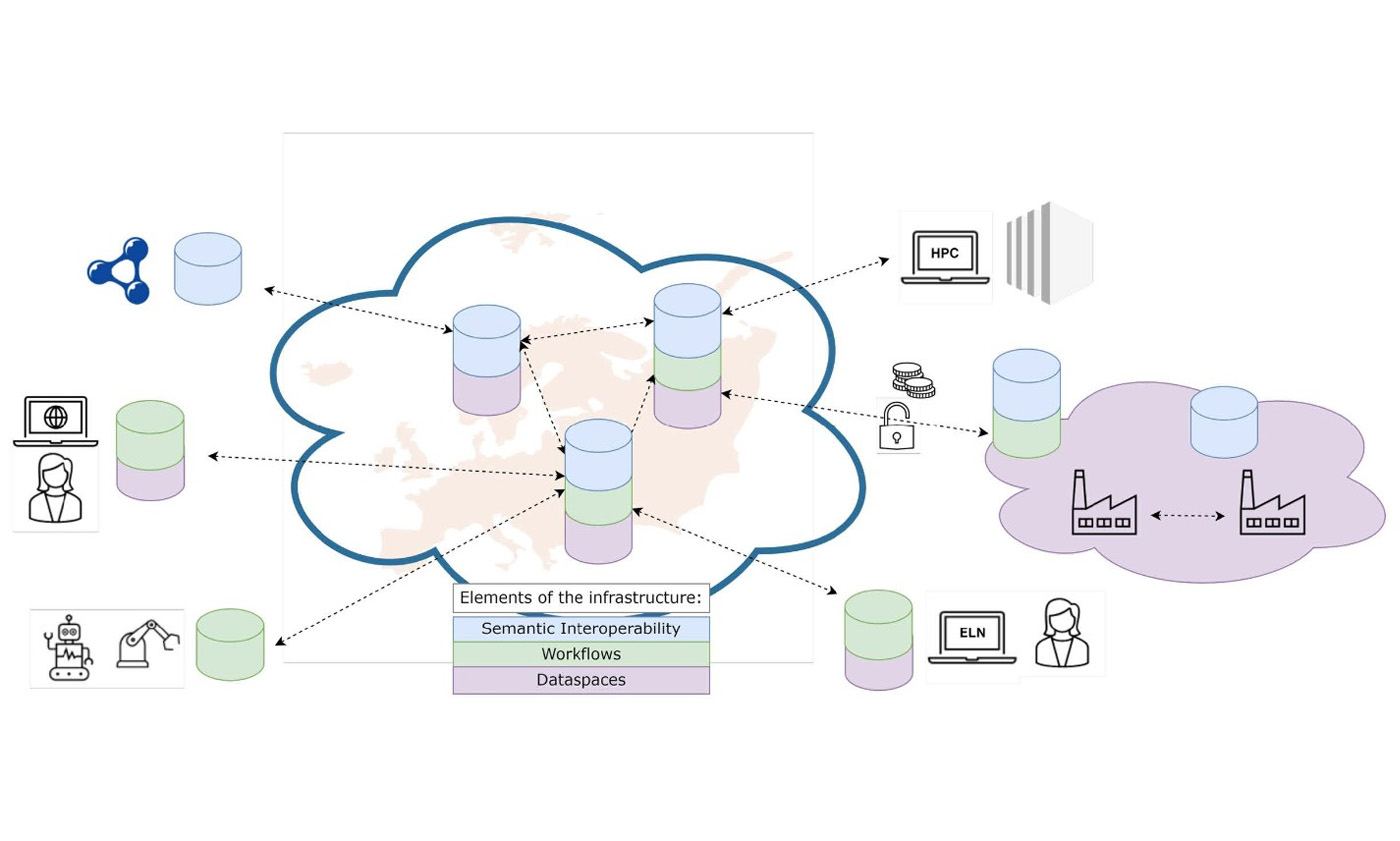
Explanation of the diagram (figure 2):
The Europe-spanning blue cloud represents the federated infrastructure that connects researchers from academia and industry while integrating previously isolated resources. The coloured building blocks symbolize the three technical elements of the infrastructure: Semantic interoperability (blue), workflows (green) and dataspaces (violet). Starting from the upper right and moving counterclockwise, the figure illustrates: (i) High-Performance Computing (HPC) facilities providing large-scale computational resources; (ii) semantically linked FAIR (Findable, Accessible, Interoperable, and Reusable) data enabling interoperability and machine-actionable data exchange; (iii) a user-friendly access layer that provides first-time users with an overview of available services; (iv) the orchestration of SDLs (self-driving laboratories), enabling automated synthesis and cycling experiments at partner laboratories while continuously streaming real-time data into a shared knowledge graph; (v) Electronic Lab Notebooks (ELNs) supporting digital experiment documentation and data management; and (vi) industrial vendors contributing data and services for commercial distribution. Together, these components form a digital ecosystem that supports collaborative, data-centric, and AI-enabled materials research and development across organizational and geographical boundaries. (Credit: Fraunhofer IWM)
Contact:
Bundesanstalt für Materialforschung und -prüfung (BAM)
Communications & Marketing
+49 30 8104-1013
presse(at)bam.de
www.bam.de
BAM press release, 18 June 2026