
Cruise Complete, Mercury Ahead
A new chapter for the MERTIS and BELA scientific instruments onboard the BepiColombo planetary mission
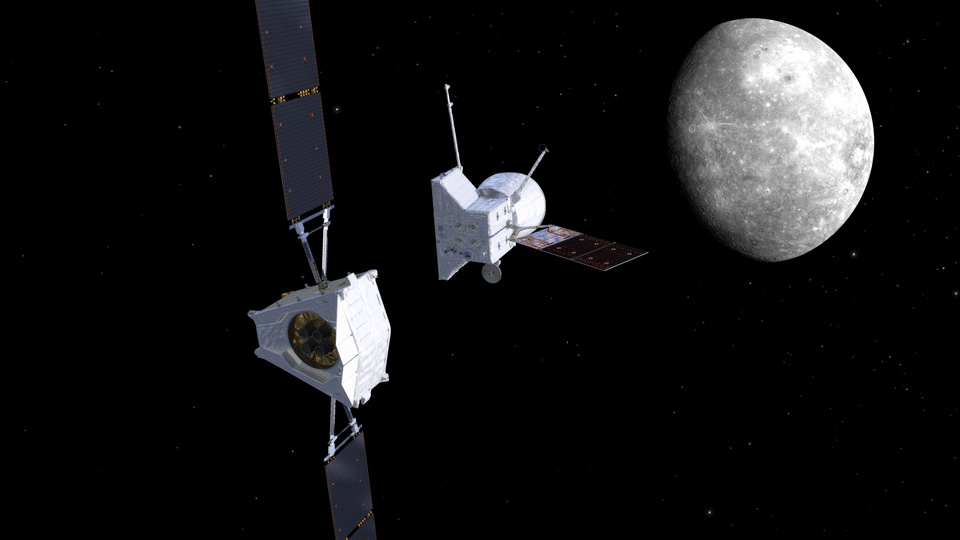
After an eight-year journey through the inner Solar System, BepiColombo mission is entering a decisive phase on its way to uncovering the mysteries of Mercury, the innermost planet. A joint mission of the European Space Agency (ESA) and the Japan Aerospace Exploration Agency (JAXA), BepiColombo carries two scientific orbiters designed to investigate Mercury’s surface, interior, magnetic field and interaction with the solar wind. On 3 September 2026 at 14:00 CEST, the Mercury Transfer Module (MTM), which powered the spacecraft through its journey, separated from the two scientific orbiters. This major milestone brings BepiColombo one step closer to its destination and marks the beginning of a new phase for the mission and its scientific instruments.
Mercury Radiometer and Thermal Infrared Imaging Spectrometer (MERTIS)
For the MERTIS instrument, led by the German Aerospace Center (DLR) and the University of Münster, the separation marked a significant transition: for the first time since launch in 2018, its nominal observation path is fully open. Until then, the port had been completely blocked by the MTM. MERTIS nevertheless demonstrated its capabilities during the journey, using its calibration space port to observe the Moon, Venus and even Mercury, already. With the MTM no longer obstructing its view, the instrument can now be tested in its intended configuration. The first deep-space measurements through the newly accessible optical path marked an important milestone for the MERTIS team and a key step towards its upcoming observations of Mercury.
On 15 September 2026 at 11:18 CEST, MERTIS received its first data through the nominal planet port. Around 1 gigabit of data was received as a result of a 22-hour science performance test, observing deep space simultaneously through the planet and calibration space ports. The measurements are being used to understand and quantify differences between the two ports of the instrument: the thermal-infrared spectrometer (TIS) and the radiometer (TIR). Observations were performed at different thermal states of the instrument, including shortly after switch-on and all the way to the thermal stability. This will help determine how the instrument’s own thermal state influences observations through the ports.
As part of the performance assessment, the team compared the inflight spectrometer (TIS) sensitivity, measured during the recent thermal test, with a low-temperature ground calibration carried out before launch in 2013. A first analysis shows little to no loss in sensitivity, well within the expected range considering the 13 years between the two measurements. Particularly reassuring is the very similar shape of the two images, indicating that the instrument’s response has remained remarkably consistent over time.
MERTIS will investigate Mercury’s surface composition, mineralogy and thermal properties. Its thermal-infrared spectrometer (TIS) covers wavelengths from 7 to 14 micrometers, while the radiometer (TIR) measures from 7 to 40 micrometers. Together, these measurements will provide information on the minerals present on Mercury’s surface as well as its temperature and thermal behavior.
The first observations of Mercury are expected in April 2027. During the initial global mapping phase, MERTIS will obtain high-resolution observations of the dayside, with spatial resolution of about 500 meters per pixel. Among the regions to be investigated are the Beethoven Basin, volcanic and intercrater plains, basins and vents in the Michelangelo and Shakespeare quadrangles, as well as permanently shadowed regions and hollows. These observations will allow scientists to investigate variations in Mercury’s surface composition and mineralogy and their relationship to the planet’s geological and thermal environment.
With its first light through the planet port successfully achieved, MERTIS is now ready for the next steps towards its first observations of Mercury.
BepiColombo Laser Altimeter (BELA)
The BELA instrument, which is led by the German Aerospace Center (DLR) and the University of Bern, was also activated for about 21.5 hours on 15 September. Without a reflecting surface in front of the instrument, the BELA laser emitted over 700 thousand pulses into open space without any hope of receiving a return. However, a small portion of the laser pulse was directed to the BELA receiver and allowed the team to assess the status of the laser after its 8 years long deactivation time. The obtained data revealed excellent health for the BELA laser and for the entire instrument - making it well prepared for the science phase at Mercury in April 2027.
Once at Mercury, BELA’s science objectives include the provision of high-resolution topographic data on a global scale and the determination of the tidal deformation of the surface. Together with the measurements of Mercury’s rotational state, to be also conducted by BELA, the tidal deformation provides key constraints for modelling Mercury’s deep interior and the evolution of the planet.
Contact:
German Aerospace Center
Institute of Space Research
Rutherfordstraße 2, 12489 Berlin
www.dlr.de/wr
DLR press release, 23 September 2026