
DFG funds research project into the material behaviour of piezoceramics under high-power ultrasound
HU researchers provide mathematical calculation and optimisation methods for model development
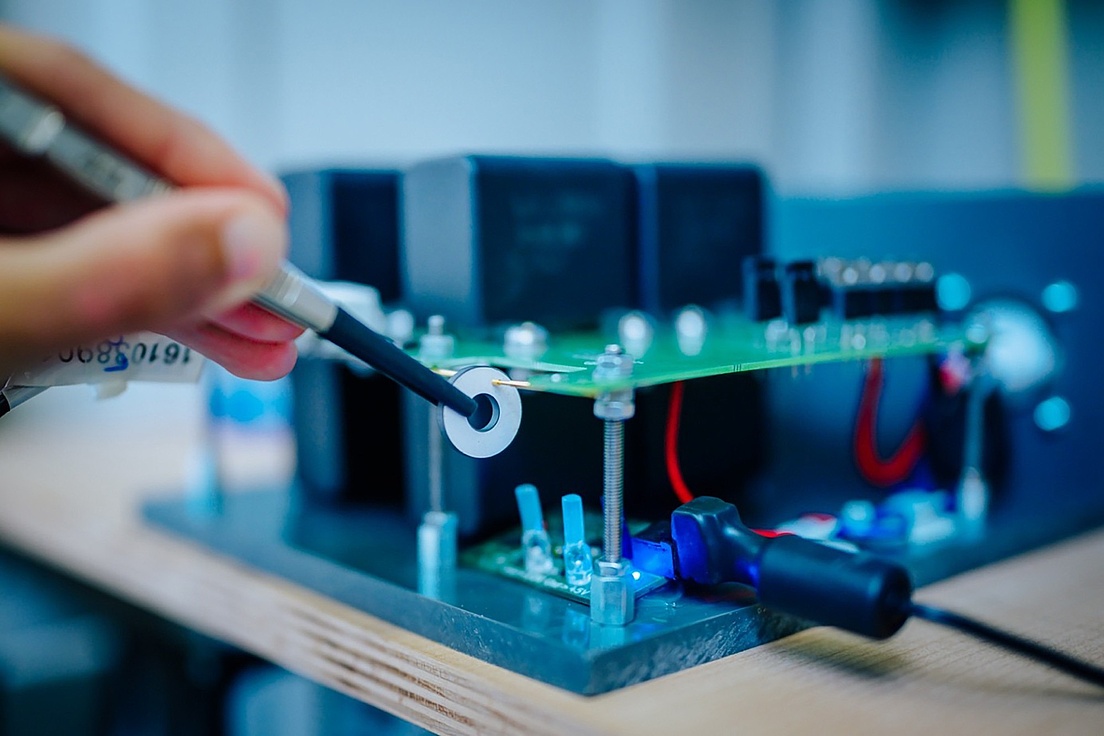
The DFG is funding the second phase of the research project NEPTUN II. The aim is to develop realistic models for technical applications that can mathematically predict the behaviour of piezoceramics.
Piezoelectric ceramics are used in the generation of ultrasound to convert electrical energy into mechanical vibrations. Ultrasound is used in a wide range of applications in science, technology and medicine, including sensory applications as well as in high-power ultrasound, for example in transducers in industry or in ultrasonic welding in electrical manufacturing. The research group ‘Model-based determination of non-linear properties of piezoceramics for high-power ultrasonic applications II’ (Neptun II) is investigating how piezoelectric ceramics behave under high-power ultrasonic conditions. The aim is to develop realistic models capable of mathematically predicting the behaviour of these transducers, thereby making development and analysis processes more efficient.
The results of the research project will contribute to the further development of piezoelectric materials and industrial manufacturing processes. In addition, the researchers are investigating alternative piezoceramics that can replace the existing lead-containing variants.
In the second phase of the project, Prof. Dr Andrea Walther from the Department of Mathematics at Humboldt-Universität zu Berlin will take over for coordination of the research group. This role was previously held by Prof. Dr-Ing Bernd Henning from the University of Paderborn. Scientists from Humboldt-Universität zu Berlin, the University of Paderborn and Johannes Kepler University Linz are involved in the six sub-projects. The HU researchers led by Andrea Walther are providing the mathematical calculation methods for comparison with the measurements and the mathematical optimisation required for the development of the models.
Piezo-ceramics – understanding material behaviour under high loads
Piezo ceramics are ceramic materials capable of converting mechanical energy into electrical energy – and vice versa. In sensor applications, such as those used in medical diagnostics or industrial sensor technology, the behaviour of piezoceramics is predictable and can be described approximately as linear. The situation is different in high-power ultrasonics.
High electrical excitation can cause the electrical, mechanical and thermal properties of piezoceramics to change. They may deform or change in length. These so-called non-linear effects make it difficult to reliably determine the behaviour of the materials.
Combining measurements and mathematical models
In the first funding phase, the research group initially investigated the behaviour of hard piezoceramic rings under conditions in which they were able to oscillate freely. In the second funding phase, the focus is now on a holistic description of the material properties in acoustic transducers, when the piezoelectric ceramics are integrated into technical components under real operating conditions.
The aim is to develop material models that capture the electrical, mechanical and temperature-dependent properties whilst also being suitable for engineering applications. To this end, the material parameters are measured in application-oriented experiments on piezoceramic samples and components.
Contact:
Prof. Dr. Andrea Walther
Humboldt-Universität zu Berlin
Department of Mathematics
+49 30 2093-45333
andrea.walther(at)hu-berlin.de
hu.berlin/AWalther
HU press release, 3 November 2026