
A typo that led to a business idea
DocGaid develops digital assistants that simplify everyday medical practice operations—one step and form at a time
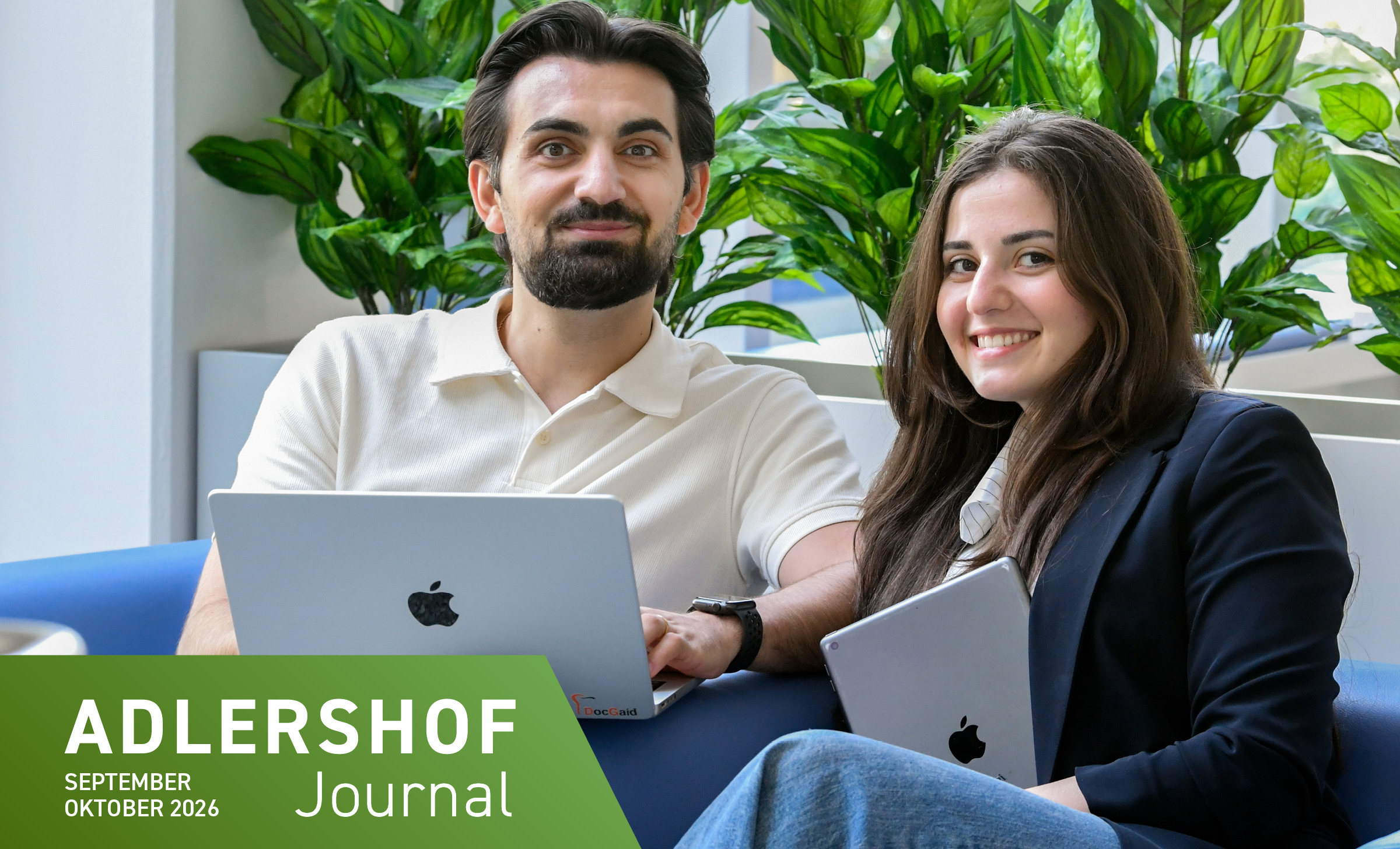
During the coronavirus pandemic, Nelli Wolf is sitting at the reception desk of her mother’s dental practice in Berlin. She’s in the middle of studying dentistry in Hamburg. With in-person classes cancelled and staff in short supply, Wolf takes over reception duties. There, she experiences a practice routine made up of countless small interruptions: medical history forms must be printed, handed out, checked, scanned and filed. Telephone numbers are missing, as are signatures. Patients have to be contacted. This repeats again and again. “I quickly realised how inefficient it was,” she says in hindsight.
None of these are particularly spectacular problems. Which is why they are so conspicuous. Four sheets of paper per patient. Data entered several times. A basement full of filing cabinets. Each individual step seems routine. But add them all up and it becomes clear how much time they consume.
At the same time, Nerses Wolf is experiencing the everyday reality of a medical practice from the patient’s perspective. For weeks, he waits in vain for his bill. Eventually, a phone call reveals the reason: A handwritten “o” was later entered as an “a”. A single false entry was enough.
For the computer scientist, who specialises in medical technology and artificial intelligence, this minor incident becomes the starting point for a bigger question. Why are data still being entered manually more than once? Why does digitalisation in so many practices stop precisely where patients start filling out forms?
These experiences give rise to DocGaid, not as a competitor to existing practice management systems, but as an addition to them. The software takes over the steps that until now have fallen between paper, scanner and keyboard and are prone to error. Patients fill out their medical history forms on a smartphone or tablet. The system immediately identifies missing information. Data no longer has to be entered again. Printing, scanning and filing are largely eliminated.
But the real goal goes even further. During a consultation, the software listens. Not to every part of the conversation, but only to medically relevant information. AI structures the documentation, generates suggestions for findings and later supports staff in billing. “DocGaid listens and documents what is relevant to the treatment,” says Nerses Wolf, describing the approach. It may sound mundane, but in everyday practice it can save minutes during every single consultation.
The founders do not see their software as a collection of individual functions. Online appointment booking, digital medical histories, multilingual forms, electronic consent forms, explanatory videos, and AI-supported documentation all work together. “It’s a chain of functions,” says Nelli Wolf. That, she believes, is what sets DocGaid apart from many isolated solutions.
There is also a notable technical decision behind the scenes. While many providers rely on cloud services, DocGaid is installed entirely within the practice. All data remains on the existing servers. For the founders, this is not simply a matter of data protection. They expect rising computing and cloud costs to make many AI applications more expensive in the future. “Our USP is that we are local,” says Nerses Wolf.
DocGaid is still in the start-up phase. Practices are already using the software, and every piece of feedback feeds into its further development. From the outset, the couple have also received support from their parents. “Without them,” says Nelli Wolf, “we wouldn’t have been able to get started.”
The couple are also receiving support at the Adlershof Startup Lab, a funding programme that is part of the Berliner Startup-Stipendium, a start-up grant. The programme supports young technology companies with workshops, individual mentoring and a strong network of businesses, industry partners and experts.
“We didn’t want to develop only within our own four walls,” says Nerses Wolf. “We benefit enormously from the network here and from the experienced mentors.” The programme’s first cohort has been supporting seven teams since June 2026. It gives the two founders the space to develop their company step by step, without the pressure to grow as quickly as possible or aim for an early exit.
“We want it to grow in a healthy and considered way,” says Nerses Wolf.
The story of DocGaid therefore does not begin with artificial intelligence. It begins with a typo, a stack of paper, and the realisation that innovation often sets in where people encounter the same small problems every day.
Rico Bigelmann for Adlershof Journal
Digitale Assistenz - DocGaid (in German only)