
Laser Passion at the Ferdinand-Braun-Institut, Leibniz-Institut für Höchstfrequenztechnik (FBH)
Susann-Alice Seeger is working on a light-based weapon against bacteria
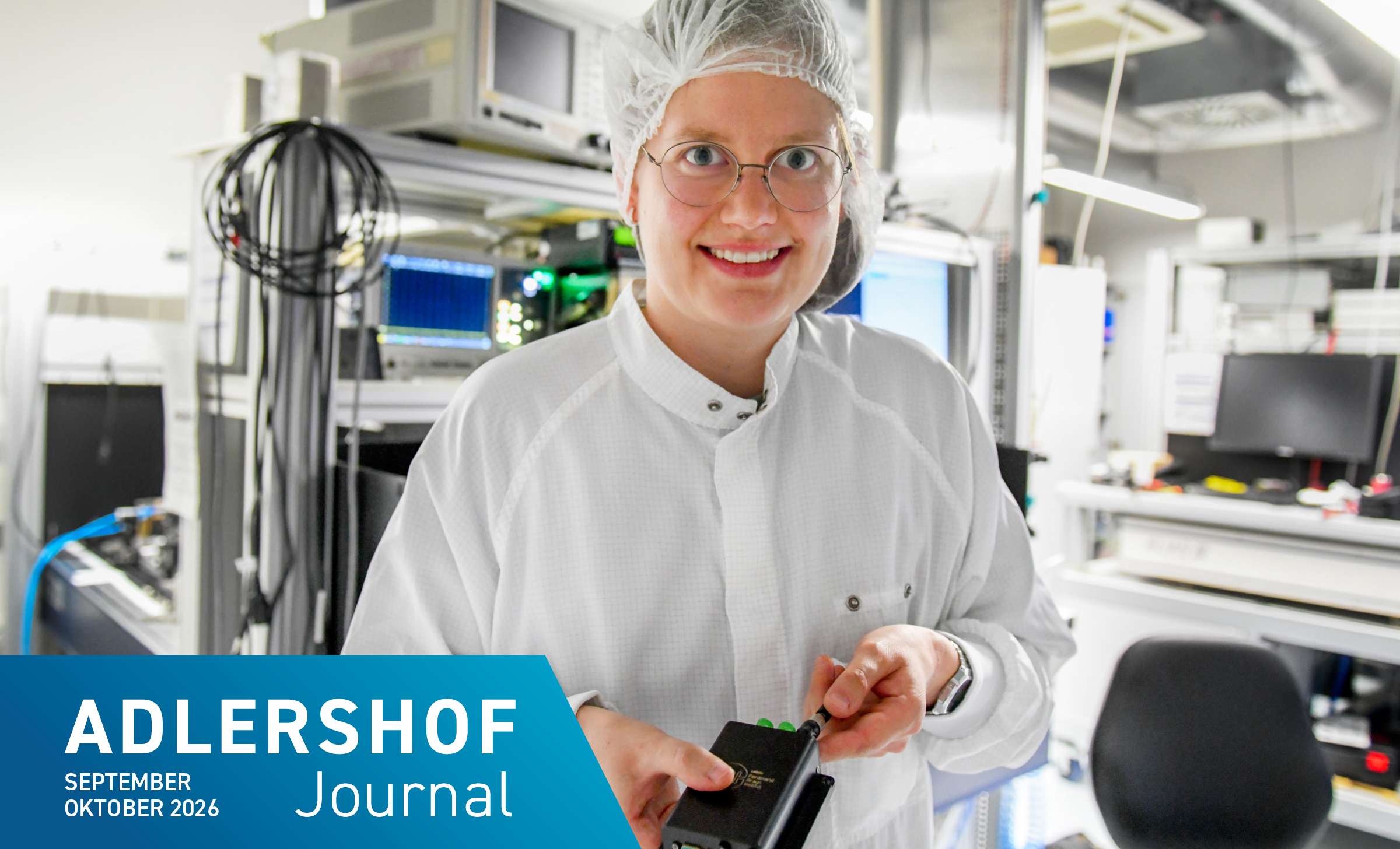
The tiny beasts can hide away in the deepest recesses. But they don’t stand a chance. A glass fibre can reach them in the remote corners of the nose or throat, where they like to lurk. A pulse of light at a wavelength of 210 nanometres travels through the hair-thin cable and puts an end to them.
This is the vision that Susann-Alice Seeger is working to make a reality. Together with colleagues at the Ferdinand-Braun-Institut, Leibniz-Institut für Höchstfrequenztechnik (FBH), she is developing compact laser modules barely larger than a smartphone, in which violet light is converted into ultraviolet light. They are designed to kill bacteria and viruses. “As yet, this is still being investigated in medical research,” she says.
For bacterial infections, medicine has so far relied on antibiotics as a last resort. However, there is a problem: Many pathogens are no longer impressed by this chemical weapon, because they have developed resistance. The widespread use of antibiotics also carries the risk of breeding further resistance.
The FBH project that Seeger is involved in is seeking a way out of this dilemma. Their primary research interest is in generating ultraviolet radiation in a compact form. It is well-known that this radiation can kill germs. Depending on the wavelength, however, it can also damage human tissue. The question here is: Can ultraviolet radiation be generated in a form that makes it suitable for medical applications? “Our goal,” says Seeger, “is to enable a therapeutic effect using a laser source like ours.”
As a schoolgirl, Seeger would have never imagined she’d be working on such topics. “I was pretty bad at maths.” Her interest in science grew after she completed training as an optician and decided to go on to study optical engineering. “Applying physics and mathematics can actually be a lot of fun.”
There are not many educational institutions in Germany that offer courses in optical engineering. One of them is Technische Hochschule Brandenburg in Brandenburg an der Havel. It was there that Seeger not only found a place to study, but also her entry into professional life. The decisive moment was meeting Katrin Paschke, head of the Laser Module Lab at FBH, who gave a talk at the university. Seeger was so impressed that, before completing her degree in 2023, she joined Paschke's research group in Adlershof.
The research into generating UV radiation for use against infectious pathogens is a joint project with Chemnitz University of Technology. In Adlershof, the team is developing the portable laser modules needed for the project. “Our job,” says Seeger, “is to show what is technically possible.” The project has been running since 2025 and the aim is to complete it by 2028.
Born in the Rhine-Main region 28 years ago, Seeger's path took her to Bavaria and Brandenburg before bringing her to Adlershof, where she now appreciates the inspiring environment created by its diverse research institutions and companies.
Dr. Winfried Dolderer for Adlershof Journal