
Harmonising care, prevention and day-to-day work
How advisory services and workplace health promotion can support employees through challenging phases of life
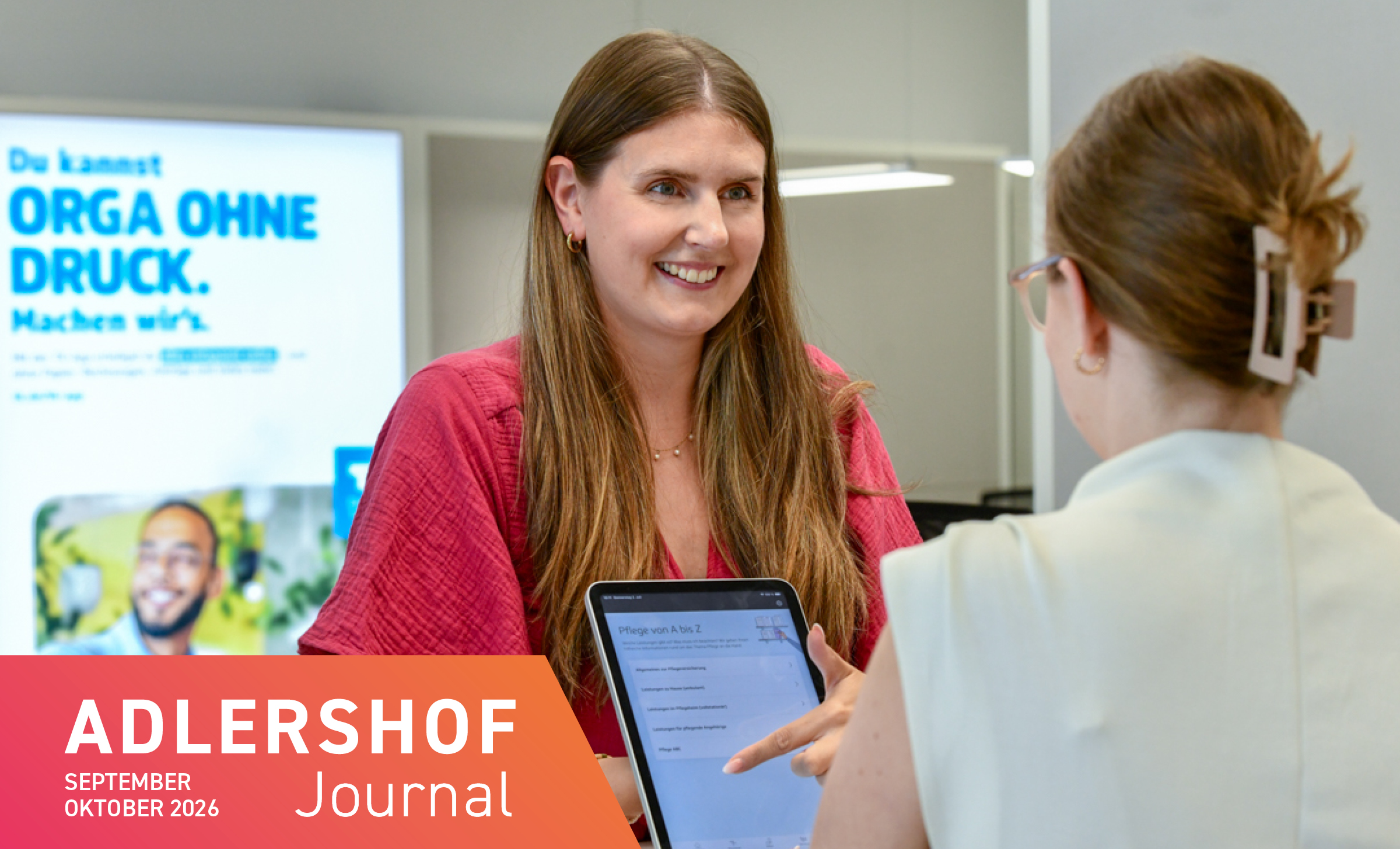
“We want to keep pace with current developments,” says Jennifer Selbmann, a customer adviser at Techniker Krankenkasse (TK), a health insurance provider, in Adlershof. One such development is the growing need for care in Germany. As the population ages, the number of people requiring care is rising significantly, and more and more people in employment are looking for ways to balance caring for relatives with their day-to-day work.
The time commitment for carers is considerable, as is the emotional pressure. Expert advice and help in covering financial shortfalls can make a difference. “Our advice centre is, of course, open to anyone, but for comprehensive advice, people seeking support should contact their own health insurance provider,” says Selbmann. Quite often, help for people who have fallen ill has to be found at very short notice. Carers also make good use of the option of attending a care training course. Where circumstances require it, practical training can also take place at home. Topics include the best ways to manage personal hygiene and bathroom care.
“Most importantly, relatives must be able to find out where to get help quickly,” says Selbmann. Many people didn’t know about the possibility of taking partial leave from work, and the extent and duration of such leave. Employees are entitled to unpaid leave for up to ten working days per calendar year. If this is not enough time to care for an ill relative, family members can also take a longer period of leave, for a maximum of six months within a two-year period. They must, however, continue to work at least 15 hours a week.
“My experience is that the issue of personal initiative in care is a sensitive one,” says Selbmann. Some relatives worry that arranging individual care could have too great an impact on their finances. Still, there were ways of cushioning losses. Carers can receive care support allowance if they need to take time off work at short notice to deal with an acute care situation. Moreover, they can also apply for an interest-free government loan to help bridge at least some of the loss of income resulting from reduced working hours. In some cases, employers also supplement employees' salaries during periods of care, providing additional support. When a care situation arises unexpectedly, relatives often have to deal with many things at once—organisationally, financially and personally. “Health insurance providers do their best to support affected individuals with information, individual advice and other forms of assistance, so that they can better reconcile caring responsibilities with their own life situation,” says Selbmann.
Next to advisory services, prevention is also an important building block to support family carers in employment. At the Technology Park, Techniker Krankenkasse and WISTA Management GmbH provide employees of Adlershof-based companies and scientific institutions with a range of holistic health and prevention services through the Health Network Adlershof. The free courses, workshops and talks cover a wide range of topics and stages of life, with most having a occupational focus. Key areas include recovery and resilience, adapting to modern forms of work, and increasing digitalisation.
The Digital Health Week, held several times a year, for example, offers live, interactive online workshops on holistic stress management, eye yoga, back fitness and cycle-aware living. Other topics include menopause, men's health and healthy ageing, with practical advice that can be incorporated directly into people’s everyday work life.
Dr. Paul Janositz for Adlershof Journal
Offers from the Adlershof Health Network (in German only)
Techniker Krankenkasse (TK) in Adlershof (in German only)