
Physics is movement
Allison Pinto is finding new paths in science communication
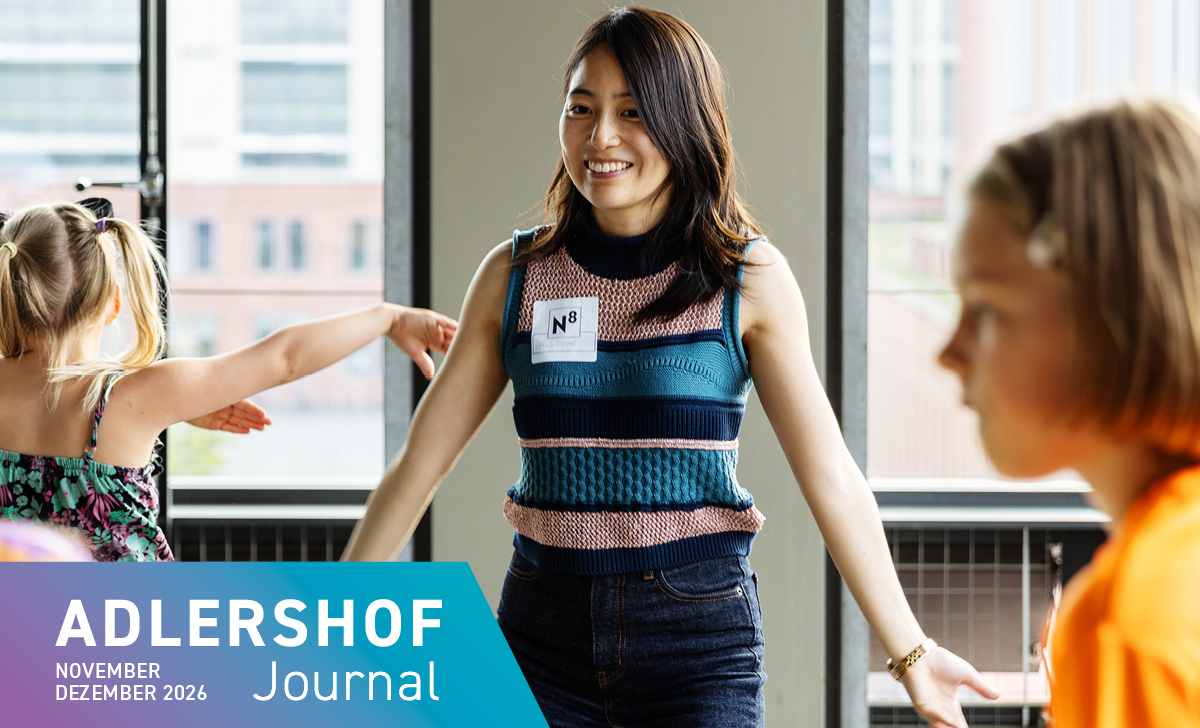
Where are we in the universe? What is relativity? To better understand these and other questions about physics, Allison Pinto is finding new paths in science communication. She has developed entertaining formats for YouTube, Instagram and TikTok, and organises dance projects with school pupils.
When she was young, Allison Pinto wanted to become a doctor. But soon after starting medical school, the American-born scientist realised it was not the right path for her. Her biology, anatomy, and physiology classes were built around rote learning and whenever she asked “why?” she didn’t get the answers she wanted. Why does a cell work? Why does photosynthesis exist? Why does DNA have its characteristic helical shape? “I don’t just want to memorise things; I want to understand them, really understand them in depth,” says Pinto. She missed mathematics and eventually decided to study physics, a scientific discipline that promised answers, even if only provisional ones.
Her journey to Germany also had something to do with physics. While studying at the University of Washington in Seattle, she decided to learn German. “Physics borrows words from German—words like ‘Ansatz’ and ‘Gedankenexperiment’—and, of course, there are great names such as Albert Einstein and Lise Meitner,” says Pinto. An exchange programme took her to Heidelberg. One semester turned into three, and her time abroad became the beginning of an academic career. After completing her BA in Heidelberg, she went on to earn a master’s degree at University of Munich, and a doctorate at Humboldt University of Berlin, which she completed in 2023. She is now also the administrative director at the Department of Physics.
Today, Pinto’s work is concerned not only with mathematical physics but also with how to make it accessible to others. How can complex ideas be explained clearly in a short space of time? “In science communication, we need tools such as metaphors and analogies,” she says, illustrating the point with the example of gravitational waves. These are generated when two massive objects, such as black holes, collide. They disturb spacetime, much as ripples form on the surface of a pond when a stone is thrown into it. The analogy does not replace the physics, but it provides an entry point into a complex subject.
The same approach to sharing knowledge also works on social media. Pinto is a “sciencefluencer”, although she is not particularly fond of the term. She explains phenomena from physics in short videos, usually in English and often in less than 2 minutes. It all began during the pandemic, when she and several fellow doctoral researchers from the Research Training Group “Rethinking Quantum Field Theory” presented their research work on a YouTube channel called Non-Standard Models. Short videos on Instagram and TikTok followed. Today, the physicist has followers around the world who are eager to learn and curious about science—in the USA, India, Brazil, the UK and here in Germany.
To Pinto, it’s not all about entertainment and accessibility. As a physicist, she believes it is important for society that science has a presence on social media. “Social media is a place where fake news and conspiracy theories spread—which is precisely why science absolutely has to be there,” she says with emphasis.
For just over a year, she has also been increasingly interested in formats that bring people together more directly. This is how she developed WisTanz, a dance project for schools, in collaboration with the Institute for Cultural Techniques. To do so, she has been working with her colleague Valentina Forini and choreographer Irina Demina. The idea makes sense considering that “physics is movement”, says Pinto. Where are we in the universe? How do large planets and the smallest particles move through space? What does relativity mean? The children ask questions and try to express the answers through movement. Abstract concepts suddenly become tangible, and the physical experience also helps them remember what they have learnt. The project is aimed at pupils from years 3 to 6. Pinto is convinced that science communication has to get to work long before university. “It should start earlier—ideally before the mobile phone becomes the most important source of information.”
Heike Gläser for Adlershof Journal
Dr. rer. nat. Allison Pinto - Humboldt-Universität zu Berlin