
The perfect blend
Nosh.bio’s superfood arrives at Speisemanufaktur Adlershof
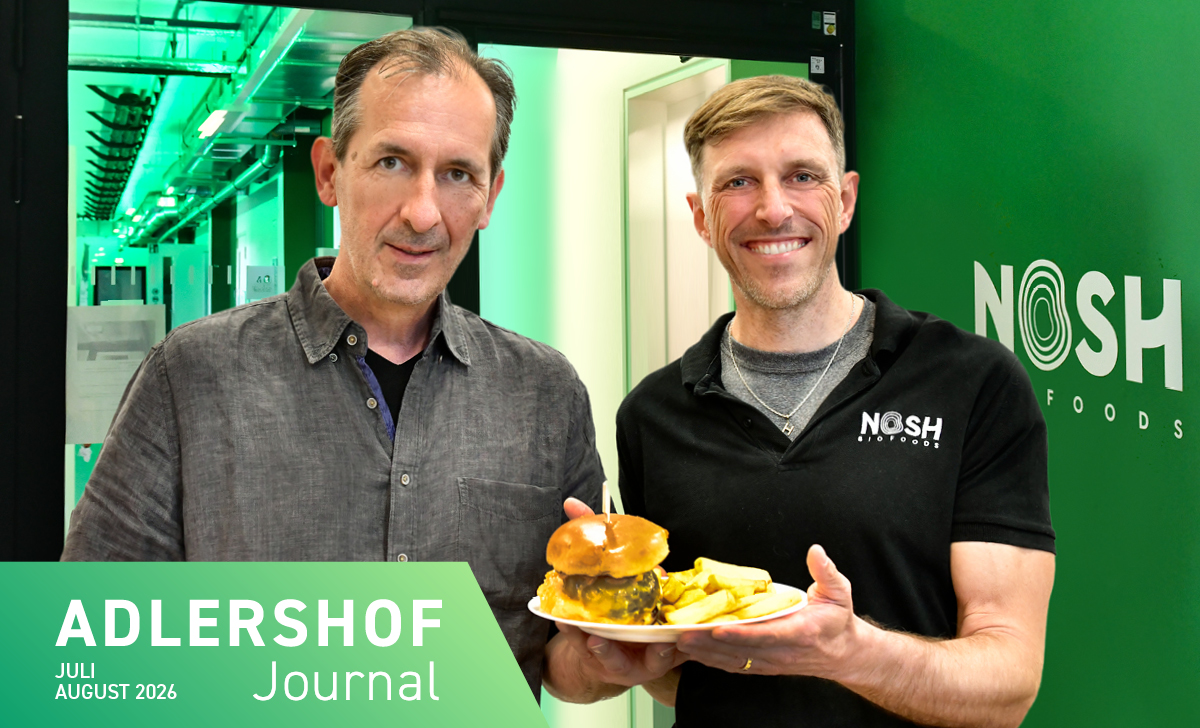
Nosh.bio’s fungal protein is making beef more sustainable. Guests of the restaurant Speisemanufaktur Adlershof can taste the difference for themselves.
Whenever the “Cheeseburger Nosh Style” appears on the weekly menu, Speisemanufaktur Adlershof lives up to its name. The burger patties are grilled over an open flame in the courtyard, before being topped with cheddar, tomatoes, and the house burger sauce in the kitchen—carefully assembled by hand.
The burger has become a firm favourite, alongside the crispy chicken burger coated in panko breadcrumbs. Lunchtime queues at the Centre for Photovoltaics and Renewable Energy (ZPV) are long, and the burgers disappear almost as quickly as they come off the grill.
The flavour speaks for itself. The patties are juicy and packed with umami—despite not being made entirely from beef. Twenty percent of the meat is replaced by a fungal protein developed just two floors above the restaurant by Nosh.bio. The start-up uses fermentation to cultivate a special filamentous fungus whose biomass can be used both as an ingredient for the food industry and as a meat alternative.
Ralf Beseke, manager at Speisemanufaktur, is pleased to offer his guests a more sustainable option. He is not interested in telling people what they should eat and has no desire to preach. “I’m neither dogmatic nor ideological,” he says. “But when you consider that producing one kilogram of beef requires somewhere between 15,000 and 40,000 litres of drinking water, depending on the study you look at, then every tonne we save makes a difference.”
Tim Fronzek, founder of Nosh.bio, shares that view entirely. Sustainability was already at the heart of his first company, Rebuy, an online marketplace for second-hand goods. After more than 15 years, the business graduate was looking for a new challenge and found it in the food industry, which is responsible for around 30 percent of global greenhouse gas emissions. “There’s still enormous potential to make a difference,” Fronzek says about his own motivation. He met his future business partner Filipe Lino completely by chance. Together with Lino, a microbiologist who specialises in fermentation and previously spent many years working in the brewing industry, Fronzek developed the business idea behind Nosh.bio. The pair founded the company in 2022 together with a third colleague. What began as a three-person start-up has since grown into a team with around 20 members.
“The production process is actually quite straightforward,” Fronzek explains. “We fill a tank with water, add a carbon source and then introduce the fungus. We can grow large quantities in a very short amount of time.” In a 75,000-litre fermentation tank, the koji fungus can fill the entire vessel, spanning three storeys, in less than 24 hours.
Nosh.bio currently produces at two locations. One is a contract manufacturing facility in Italy. The other is a former brewery near Dresden, which the company has converted for production. “In addition to the fermentation process itself, we’ve found a way of adapting existing brewing tanks for our technology,” Fronzek explains. This further improves sustainability because existing equipment can be repurposed instead of manufacturing new stainless-steel fermenters. “We’ve traded mash for mycelium.”
Adlershof remains home to the company’s offices and a small research laboratory, where new processes continue to be developed using two tabletop fermenters. This is how the collaboration with Beseke came about. Last summer, Beseke received the fungal protein in frozen form and, together with his head chef, began experimenting with it. They tested different recipes and refined the ideal ratio of fungal protein to minced beef until they achieved the right texture and flavour.
Alongside the popular cheeseburger, the menu occasionally features dishes such as bifteki or lasagne, the latter containing as much as 30 percent fungal protein.
In addition to supplying Speisemanufaktur, Nosh.bio now works with a number of smaller customers, including companies using the protein as a complete meat alternative. Its main focus, however, is on supplying major players in the meat industry, including Tönnies, one of Germany’s largest meat producers. Although the company has attracted negative publicity in the past, Fronzek says it has shown a genuine commitment to improving sustainability. “We don’t always get applause when we say Tönnies is one of our customers,” he admits. “But I’m happy to say it openly because I’ve learned one thing over the past few years: If you really want to change an industry, you have to work with the companies that shape it.”
The aim is to convince them with products such as hybrid meat, which offers no compromise in quality while being less expensive to produce than conventional beef.
Heike Gläser for Adlershof Journal
Nosh.bio | Making sustainable foods delicious and affordable.