
When the chemistry is right
Christoph Arenz at Humboldt-Universität zu Berlin researches a special class of lipids
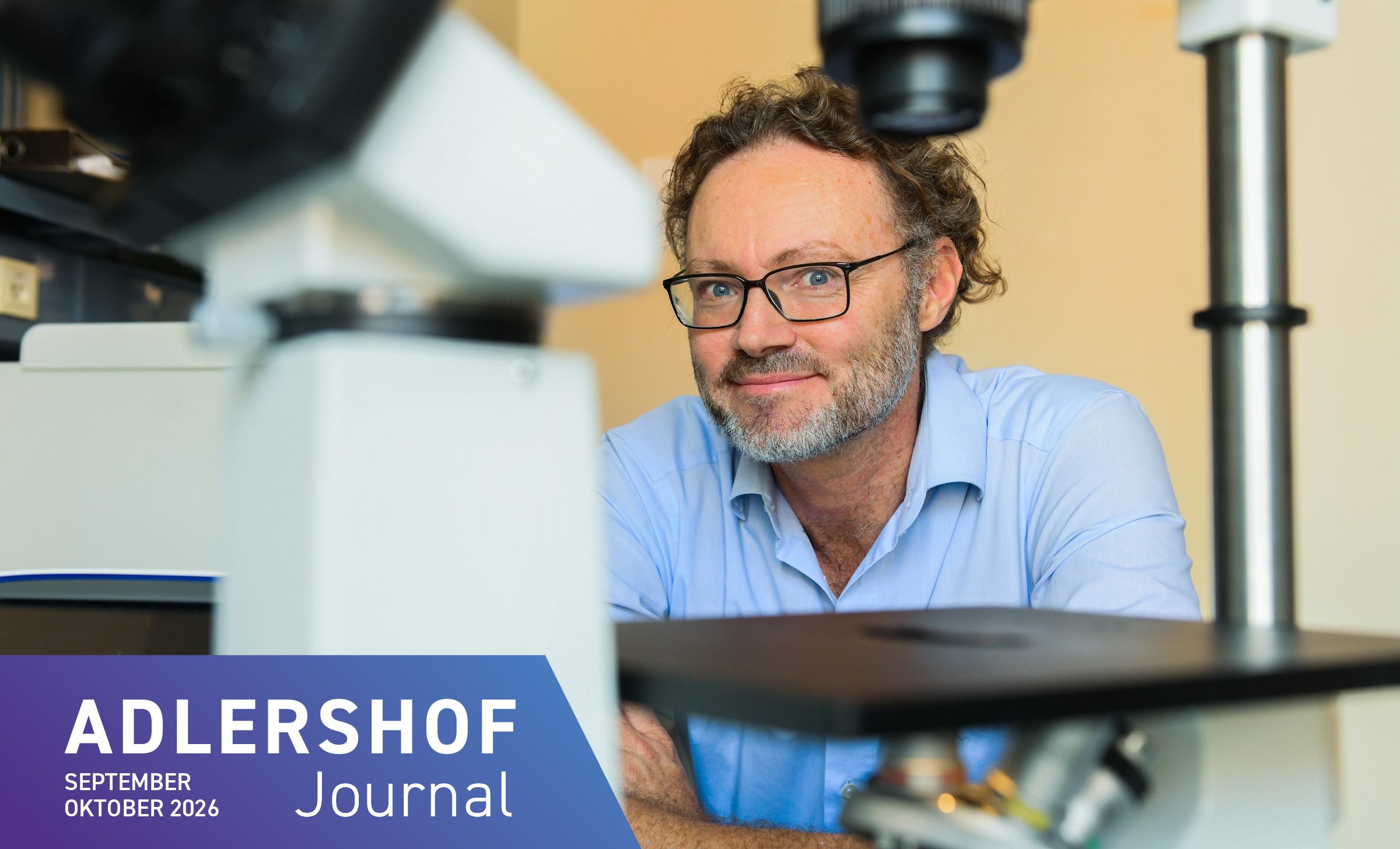
Christoph Arenz, professor at the HU Department of Chemistry, researches a special class of lipids. What sounds abstract at first glance has very concrete applications in medicine. In this way, basic research becomes a diagnostic tool.
When Christoph Arenz talks about his work, he is quite literally in his element. The professor at the Department of Chemistry at Humboldt-Universität zu Berlin (HU) researches lipids. These are chemical compounds that are not soluble in water and therefore cannot simply move freely from A to B within a cell. “Lipids need a chauffeur; they don’t have a driving licence.”
This particular class of substances, known as sphingolipids, therefore has a transportation problem. In the human body, they form the basic structure of the cell membrane. Arenz and his team are researching how these molecular passengers make their way through the cell, how their metabolism is regulated, and what happens when something goes wrong.
What sounds very abstract at first glance has very concrete applications in specialised areas of medicine when looked at more closely. It could even be said that his research helps to cure rare diseases. “We are, so to speak, the mediators between chemistry and medicine,” says Arenz. Doctors and biologists often approach him with their questions when, for example, they lack the tools to make processes visible. “We then try to find solutions at the molecular level.”
Arenz illustrates this collaboration using the example of two rare diseases that can affect children from birth. Niemann-Pick disease types A and B is one of them, a so-called lysosomal storage disorder. The children affected lack sufficient activity of an enzyme that breaks down sphingomyelin. Normally, the lipid enters the lysosome, the “stomach of the cell”. There it is broken down. If the enzyme is missing, more and more molecular waste accumulates, until the cell can no longer function.
In type A, the brain is also affected. The child’s life expectancy then often ist just two to three years. In type B, there is no neurological damage, but the liver and spleen can become severely enlarged and lung function is impaired. Tiny differences in enzyme activity are crucial. “If the level increased from five to ten percent, the disease would be curable,” says Arenz. Even an increase from five to six percent could mean “ten more healthy years”.
But there is a problem: It is difficult to measure enzyme activity precisely in the living cells of people with the disease. Arenz’s team has developed a technology that makes this possible. It works where the enzyme itself does: in the acidic environment of the lysosome. This makes it possible to directly monitor whether a drug restores the missing activity “Only we can do this because we have developed chemical probes that allow us to measure enzyme activity directly inside the cell,” says Arenz.
This is crucial for a planned clinical study. The children already receive an enzyme injection every two weeks. However, the enzyme cannot cross the blood-brain barrier. A drug made up of small molecules that has already been approved for a similar disease could theoretically help. Using the chemical probe, the research team now wants to measure shortly before the next enzyme injection whether the additional drug changes enzyme activity. This can be done directly in the patients’ blood cells.
There is currently a second research project as well. It concerns a disease in which an enzyme is not underactive but overactive. The disease was only discovered a few years ago. It is not genetic; instead, spontaneous point mutations cause developmental disorders and deformities of the brain. Here, too, Arenz’s expertise is in demand. He is working with researchers in Lausanne, a neurologist in New York, and a doctor in Chicago who is caring for an affected child.
“We use chemistry to diagnose and manipulate biological processes inside a cell,” says the scientist. That is precisely where he sees his role. Molecules are designed, synthesised organically and tested in living cells. To do this, he says, it is necessary to understand both worlds.
After completing his doctorate, Arenz himself moved into molecular biology for four years as a chemist. His focus and expertise therefore lie in being able to talk to both biologists and medical professionals. “Everyone always talks about interdisciplinarity, but it is still the biggest obstacle.”
Heike Gläserfor Adlershof Journal