
News
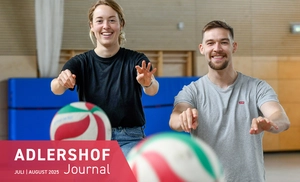
Staying on the ball
Why Humboldt-Universität zu Berlin's sports campus in Adlershof is being expanded:
With an increasing number of places in sports science courses, the demand for university sports courses is also growing. Because of this, Humboldt-Universität zu Berlin is set to expand its Adlershof sports…
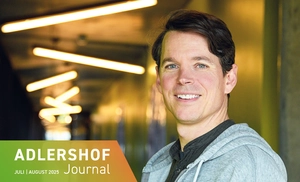
How quantum particles communicate
Nanophysicist Günter Kewes brings complex physics to life during Berlin’s Long Night of the Sciences:
We owe solar panels, smartphones, MRI scanners, and even supermarket barcode readers to quantum physics. For this reason, the UN General Assembly has declared 2025 the International Year of Quantum Science and…
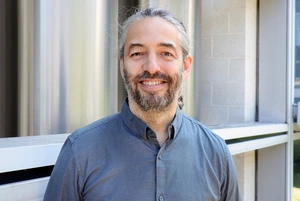
FBH and HU strengthen cooperation in quantum technologies
Another Joint Lab launched / New professorship for Integrated Quantum Sensors:
With the new Joint Lab Integrated Nonlinear Quantum Optics, the Ferdinand-Braun-Institut (FBH) and Humboldt-Universität zu Berlin are strengthening their strategic partnership in the emerging field of quantum…
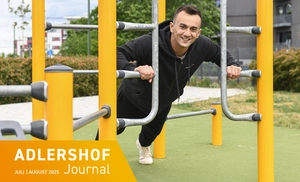
Full of energy: Adlershof is on the move
Fitness, ball games, or running – the campus offers plenty of options. How passionate is its scientific community about sports?:
While working from home, Faruk Garic came to the callisthenics park at Alexander-von-Humboldt-Weg during his lunch break. “I live just one street away with my family. I’ll do exercises for arms, shoulders, and core…

ERC Advanced Grants for two HU research projects
Gökce Yurdakul from the Institute of Social Sciences and Hans Börner from the Institute of Chemistry each receive funding of almost 2.5 million euros:
For her project ‘MENBELONG – Belonging for Single Migrant Men: A Cross-Country Comparative Perspective’, Prof Dr Gökce Yurdakul will receive almost EUR 2.5 million as part of an ERC Advanced Grant, of which around…
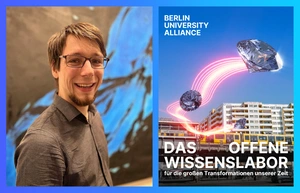
Marco Stucki wins Berlin University Alliance ideas competition
His quantum research project ‘Sawfish Cavity’ is now being used for a poster campaign in Berlin:
Marco Stucki has won the Berlin University Alliance's open knowledge lab competition with a novel process for manufacturing tiny diamond structures for quantum technologies. “Art meets Science” was the motto under…

Joint Berlin Data & AI Center planned
Declaration of intent signed by Helmholtz-Zentrum Berlin, Max Delbrück Center, Berlin University Alliance, and Zuse Institute Berlin:
Data-driven research is crucial for tackling societal challenges – whether in health, materials, or climate research. In a collaboration that is so far unique, Berlin University Alliance (BUA), the Max Delbrück…
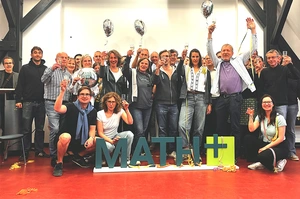
Cluster of Excellence MATH+ to receive funding for another seven years
Berlin mathematics application successful in the Excellence Strategy of the federal and state governments:
A major success for Berlin’s mathematics community: The MATH+ Cluster of Excellence will continue to receive funding for another seven years as part of the Excellence Strategy of the German federal and state…
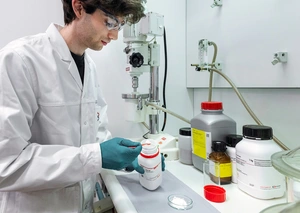
BAM develops powerful alternative to lithium-ion batteries
Innovative approach to make solid-state batteries more sustainable, cheaper, and more efficient:
Researchers at the Federal Institute for Materials Research and Testing (BAM) have developed an innovative approach to make solid-state batteries more powerful and suitable for everyday use. Their goal: batteries that…
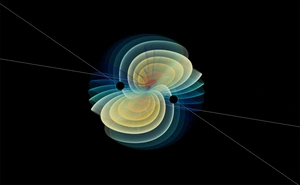
New findings on the scattering of black holes
Calculations by Prof Jan Plefka's research team provide an important basis for understanding gravitational waves:
Black holes are unique objects in our universe. They curve space and time in a way that prevents light from escaping their immediate surroundings. When two black holes approach each other, they spiral around each…
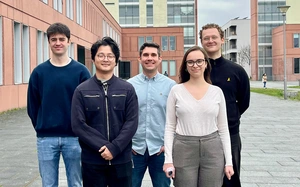
HU junior researcher Alberto Pérez-Bitrián receives Emmy Noether grant
New Research Group OrgXeMet investigates the properties and reactivity of xenon compounds:
The new Emmy Noether research group OrgXeMet, led by Dr. Alberto Pérez-Bitrián has been launched at the Humboldt-Universität zu Berlin (HU). The group will be funded with approximately 1.75 million euros over six…
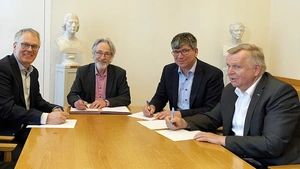
BAM, HZB, and HU Berlin plan joint Berlin Battery Lab
The joint research infrastructure will also be open to industry for battery research projects:
The Federal Institute for Materials Research and Testing (BAM), the Helmholtz-Zentrum Berlin (HZB), and Humboldt University of Berlin (HU Berlin) have signed a memorandum of understanding (MoU) to establish the Berlin…
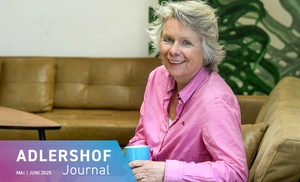
Space for the social question
Housing is many things at once: A basic need, a home for people, a means of investment, an asset—and a driver of generational (in)justice, says cultural and social geographer Ilse Helbrecht:
With the federal debt package being passed in the Bundestag, there is much public debate about its effects. “However, topics like refugee accommodation, homelessness, and the lack of social housing barely register,”…
Berlin Adlershof: Companies surpass 4 billion euros in revenue for the first time and continue to be optimistic about the future
Germany’s largest Science and Technology Park doubles its revenue in just eight years:
The Science and Technology Park Berlin Adlershof continued its positive development in 2024. Revenues and budget funds rose by 3.5% to over 4.0 bn. euros (2023: 3.9 bn. euros). The number of employees grew by 1,100 to…
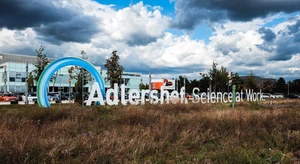
Berlin Adlershof: Facts and figures
Berlin Adlershof is Germany’s largest and most successful Science and Technology Park as well as Berlin’s largest media location—embedded in an overall urban development concept. Spanning an area of 4.6 km², the park…
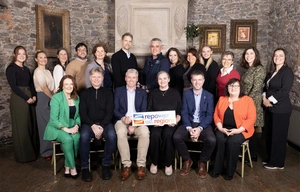
Launch of Repower Regions – Transforming Europe's Heating and Cooling Sector
Steinbeis-SIT joins a project focused on decarbonisation, digital skills, and sustainable solutions in Europe’s heating and cooling sector:
Steinbeis School of Sustainable Innovation and Transformation (SIT), affiliated with Steinbeis University GmbH, dedicates itself to delivering exceptional educational programmes and offering guidance in innovation and…
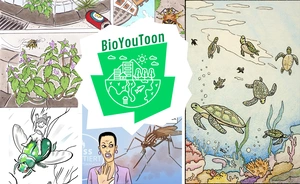
Creative comics against biodiversity loss
BioYouToon, an Erasmus+ project, aims to sensitise young people and raise awareness of biodiversity:
The project consortium of BioYouToon, an EU-funded Erasmus+ project, met at the end of March 2025 to share the results developed during the funding period. The highlight was five Webtoon Comics, available online in…
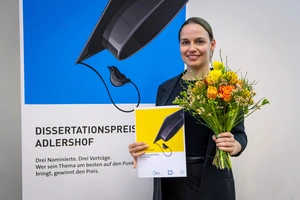
Dr Kristin Klaue receives 2024 Adlershof Dissertation Award
The chemist lays the foundation for targeted, light-based medicine with photoswitchable molecules:
On 20 March 2025, the Adlershof Dissertation Award was granted for the 23rd time in a row. Dr Kristin Klaue received the 3,000 euro prize, which is donated and organised annually by the research network IGAFA e. V.,…
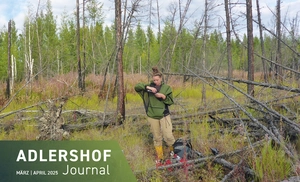
Stünzi’s sense of snow
HU scientist Simone Maria Stünzi studies the vegetation in permafrost soils:
At the Earth Observation Lab of Humboldt-Universität zu Berlin (HU), scientist Simone Maria Stünzi investigates how vegetation interacts with permafrost soil and how these processes are changing against the backdrop…
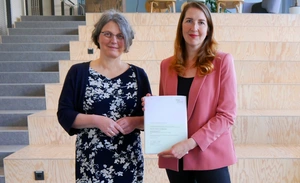
Dr Kathrin Goldammer becomes professor at the Berlin School of Economics and Technology
From summer semester 2025, the Managing Director of the Reiner Lemoine Institute will become a professor at the HTW Faculty Engineering – Energy and Information:
Dr. Kathrin Goldammer complements the Bachelor’s and Master’s degree programs in Renewable Energy with many years of practical experience in the energy industry and expertise in applied energy research. Goldammer has…