Berlin Adlershof. Science at Work.
Discover the myth of Adlershof: founded in 1754, birthplace of German aviation, and site for research, film and television. Today the area has around 20,000 inhabitants, most located in the heart of the "old village". The Technology Park is close to the former airfield, now a landscape park.
The Berlin Adlershof Science City is one of the most successful high-technology locations in Germany—and Berlin’s largest media site. Renowned non-university research institutes, the natural sciences campus of Humboldt-Universität zu Berlin, 1,330 businesses and a rich history await you at Berlin-Brandenburg’s top Science, Business and Media hub. More than 34,000 people work and study in the science city of Adlershof, which covers an area of 4.6 km². Learn more about all the facts and figures…
News

FBH at Photonics Days: from high-power diode lasers to quantum technologies
Ferdinand-Braun-Institut will present the latest developments on 7 and 8 October 2026 in Adlershof:
Ferdinand-Braun-Institut (FBH) will contribute numerous scientific presentations at Photonics Days Berlin Brandenburg on October 7 and 8, 2026. The focus will be on current developments in diode lasers and UV light…

Joint power instead of duplicate structures
The research community in Berlin is pooling its computing power for AI and data research:
Berlin’s research community is further advancing its research excellence by establishing a high-performance, cross-institutional infrastructure for data and AI. With a joint agreement signed on 18 September 2026, the…

New greenhouse gas report identifies main sources of emissions at HZB
Research institute presents greenhouse gas inventory and certification for its energy management system:
For many years, the Helmholtz-Zentrum Berlin (HZB) has been committed to resource-efficient research and working practices. The centre has set itself the goal of becoming greenhouse gas neutral by 2035. To this end,…
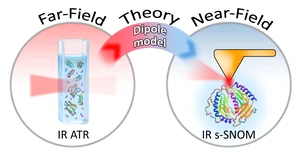
High-resolution insights into individual biomolecules and catalysts
Nanoscale infrared spectroscopy improves the ability to study biological and chemical processes at BESSY II:
Very small biological samples and even individual biomolecules can now be examined under near-physiological conditions with high confidence at the BESSY II infrared beamline with a newly validated and improved…



Current journal issue

Adlershof Journal September/October 2026
Downloads