
News
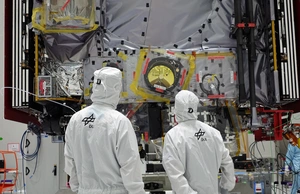
DLR pools expertise in space research
The new DLR Institute of Space Research is being formed from the internationally acclaimed Institutes of Optical Sensor Systems and Planetary Research:
Space is a key technology for the future, essential for exploring planets, Earth observation and security. Satellites and space probes equipped with highly specialised observation instruments are indispensable for all…
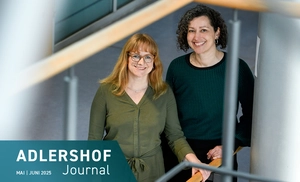
In conversation with Ana Anselmo and Silvia Zerbe
As diversity officers at Helmholtz-Zentrum Berlin, they shape diversity:
When 1,400 employees from 70 nations come together at a globally operating research institution like Helmholtz-Zentrum Berlin für Materialien und Energie (HZB), diversity may seem like a given. And yet, considerable…

Please mind the gap
Three DLR researchers highlight gender-specific knowledge gaps that prevent the surveying of women’s needs in cars, busses, and trains:
Globally, Germany ranks in the top ten percent for gender equality—but persistent gaps remain. The gender pay gap is the most well-known example. The fact that transport systems are still largely designed by and for…
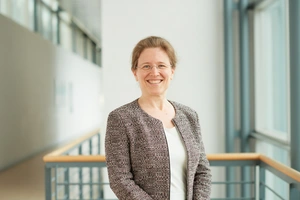
Saskia Vormfelde will be the new Administrative Director at HZB
The successful science manager moves from Freiburg to Berlin on 1 September 2025:
Saskia Vormfelde, currently Administrative Director at the Fraunhofer Institute for Solar Energy Systems (ISE), will take over the administrative management at HZB from 1 September 2025. She succeeds Thomas…

Diversity wins
Berlin is recognised as an outstanding international technology hub. How to maintain this reputation, openness and diversity?:
Berlin is recognised as an outstanding international technology hub, particularly Adlershof. But that reputation is at risk if the political and social climate continues to move away from openness and diversity. After…
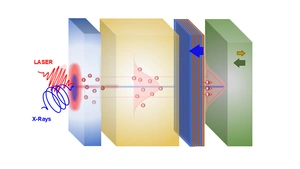
Insight into ultrafast spin processes with femtoslicing
Worldwide unique infrastructure for spintronics research at BESSY II:
An international team has succeeded at BESSY II for the first time to elucidate how ultrafast spin-polarised current pulses can be characterised by measuring the ultrafast demagnetisation in a magnetic layer system…
Ageing processes of lithium button cells made visible
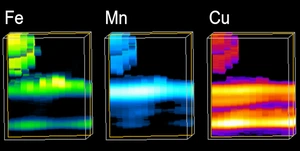
For the first time, scientists were able to observe how the composition of lithium-ion batteries changes during charge cycles:
Lithium button cells with electrodes made of nickel-manganese-cobalt oxides (NMC) are very powerful. Unfortunately, their capacity decreases over time. Now, for the first time, a team has used a non-destructive method…

Nanoparticle shield makes luminescent molecules more durable for high-tech applications
Silica particles shield luminescent molecules from oxygen:
They are tiny but glow intensively: special light-emitting molecules used in environmental analysis, medical diagnostics, and energy research. However, their luminescence intensity can be significantly reduced by…

New instrument at BESSY II for investigating energy materials
OÆSE endstation in EMIL offers insights into dynamic electrochemical processes:
A new instrument is now available at BESSY II for investigating catalyst materials, battery electrodes and other energy devices under operating conditions: the Operando Absorption and Emission Spectroscopy on EMIL…

Ultrafast Plasmon-Enhanced Magnetic Bit Switching at the Nanoscale
MBI researchers demonstrated a way to control and manipulate nanoscale magnetic bits:
Researchers from Max Born Institute have demonstrated a successful way to control and manipulate nanoscale magnetic bits — the building blocks of digital data — using an ultrafast laser pulse and plasmonic gold…

Technology development for semiconductor material gallium oxide launched
At IKZ, a new application laboratory will be set up to produce epitaxial wafers for components in power electronics:
The EFRE project G.O.A.L. “Gallium Oxide Application Laboratory for Power Electronics”, which was launched in September 2024, completes the value chain created at the IKZ in the field of gallium oxide technology…
A cage structured material transforms into a performant catalyst for producing green hydrogen
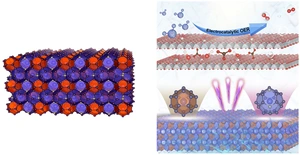
The promising material class of clathrates was investigated at BESSY II:
Clathrates are characterised by a complex cage structure that provides space for guest ions too. Now, for the first time, a team has investigated the suitability of clathrates as catalysts for electrolytic hydrogen…
An elegant method for the detection of single spins using photovoltage
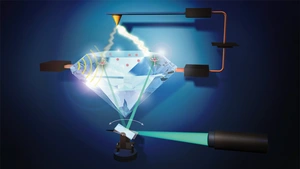
The approach of an HZB team could lead to a much more compact design of quantum sensors:
Diamonds with certain optically active defects can be used as highly sensitive sensors or qubits for quantum computers, where the quantum information is stored in the electron spin state of these colour centres.…
New research unit to study the generation, transport and detection of chiral phonons
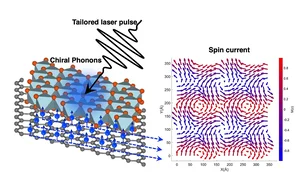
DFG funds spintronics research with 3.2 million euros / MBI involved:
Spintronics is already widely used in data storage, sensor technology and, increasingly, in communication technology. Many of our cars and cell phones already contain components based on spintronics. Spintronics means…

Berlin Adlershof: Companies surpass 4 billion euros in revenue for the first time and continue to be optimistic about the future
Germany’s largest Science and Technology Park doubles its revenue in just eight years:
The Science and Technology Park Berlin Adlershof continued its positive development in 2024. Revenues and budget funds rose by 3.5% to over 4.0 bn. euros (2023: 3.9 bn. euros). The number of employees grew by 1,100 to…
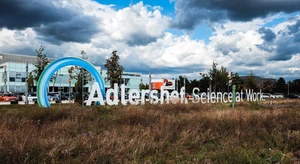
Berlin Adlershof: Facts and figures
Berlin Adlershof is Germany’s largest and most successful Science and Technology Park as well as Berlin’s largest media location—embedded in an overall urban development concept. Spanning an area of 4.6 km², the park…
Initiative launched for better use of data in the energy sector
OEO Foundry aims to make energy research more efficient, transparent and sustainable:
At the end of March, representatives of the Reiner Lemoine Institute (RLI) of the Universities of Osnabrück and Oldenburg as well as the affiliated institute OFFIS – Institute of Computer Science founded the Open…

FBH leads European diode-pumped laser efforts
EuPRAXIA selects second laser-driven accelerator site:
The EuPRAXIA consortium has selected ELI Beamlines at ELI ERIC in the Czech Republic as the site for its laser-driven second plasma-accelerator pillar. This decision marks a major milestone in the consortium’s journey…

Heat storage for a climate-neutral Berlin
RLI project shows potential for better use of waste heat and renewable energy:
Berlin must make its heat supply climate-neutral – this is what the Heat Planning Act stipulates. Heat storage systems play a central role in this. This shows a joint project by the Reiner Lemoine Institute (RLI), the…
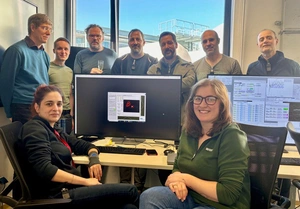
Breakthrough: First electron beam in SEALab advances accelerator physics
HZB team generates and accelerates an electron beam from a multi-alkali photocathode:
The SEALab team at HZB has achieved a world first by generating an electron beam from a multi-alkali (Na-K-Sb) photocathode and accelerating it to relativistic energies in a superconducting radiofrequency accelerator…