
News

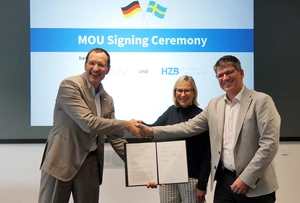
HZB and National University Kyiv-Mohyla Academy start cooperation
Memorandum of Understanding signed for collaborative research, academic exchange, and capacity-building in energy and climate:
Helmholtz-Zentrum Berlin für Materialien und Energie GmbH (HZB) and the National University of “Kyiv-Mohyla Academy” (NaUKMA) have signed a Memorandum of Understanding (MoU). The MoU serves as the starting point for…
MAX IV and BESSY II initiate new collaboration to advance materials science
Helmholtz-Zentrum Berlin signed a 5-year cooperation agreement with the Swedish national synchrotron laboratory MAX IV:
Swedish national synchrotron laboratory MAX IV and Helmholtz-Zentrum Berlin (HZB) with BESSY II light source jointly announce the signing of a 5-year Cooperation Agreement. The new agreement establishes a framework to…
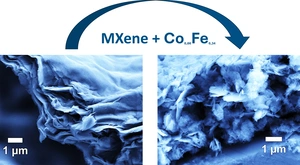
MXenes boost the effectiveness of catalysts for the production of green hydrogen
HZB team shows a new way to highly efficient and inexpensive catalysts:
MXenes are adept at hosting catalytically active particles. This property can be exploited to create more potent catalyst materials that significantly accelerate and enhance the oxygen evolution reaction, which is one…

Joint Berlin Data & AI Center planned
Declaration of intent signed by Helmholtz-Zentrum Berlin, Max Delbrück Center, Berlin University Alliance, and Zuse Institute Berlin:
Data-driven research is crucial for tackling societal challenges – whether in health, materials, or climate research. In a collaboration that is so far unique, Berlin University Alliance (BUA), the Max Delbrück…
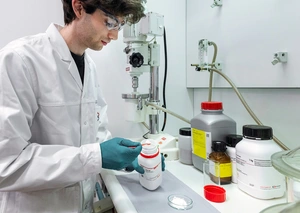
BAM develops powerful alternative to lithium-ion batteries
Innovative approach to make solid-state batteries more sustainable, cheaper, and more efficient:
Researchers at the Federal Institute for Materials Research and Testing (BAM) have developed an innovative approach to make solid-state batteries more powerful and suitable for everyday use. Their goal: batteries that…
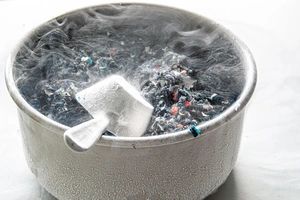
BAM develops certified PFAS reference material made from used outdoor clothing
Important step on the road to a circular economy:
The Federal Institute for Materials Research and Testing (BAM) has developed a reference material for per- and polyfluoroalkyl substances (PFAS) in outdoor textiles. It serves to ensure the reliability of analytical…

Customised electrification: How the PeopleSuN project is advancing the energy supply in Nigeria
Findings from RLI research project published:
Four years of research, 4,700 households and businesses surveyed, two tools and a knowledge pool: the PeopleSuN project shows what it takes for off-grid solutions to advance sustainable power supply in Nigeria. The…
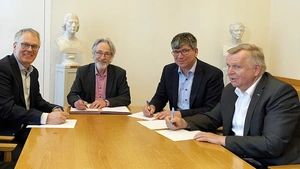
BAM, HZB, and HU Berlin plan joint Berlin Battery Lab
The joint research infrastructure will also be open to industry for battery research projects:
The Federal Institute for Materials Research and Testing (BAM), the Helmholtz-Zentrum Berlin (HZB), and Humboldt University of Berlin (HU Berlin) have signed a memorandum of understanding (MoU) to establish the Berlin…
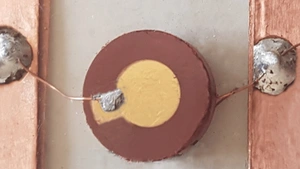
New materials as highly sensitive X-ray detectors
Organic-inorganic hybrid materials are ideally suited and can be produced in a green way using ball milling:
New bismuth-based organic-inorganic hybrid materials show exceptional sensitivity and long-term stability as X-ray detectors, significantly more sensitive than commercial X-ray detectors. In addition, these materials…

Technology development for semiconductor material gallium oxide launched
At IKZ, a new application laboratory will be set up to produce epitaxial wafers for components in power electronics:
The EFRE project G.O.A.L. “Gallium Oxide Application Laboratory for Power Electronics”, which was launched in September 2024, completes the value chain created at the IKZ in the field of gallium oxide technology…
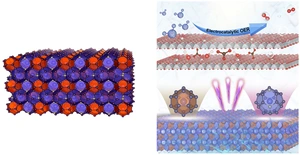
A cage structured material transforms into a performant catalyst for producing green hydrogen
The promising material class of clathrates was investigated at BESSY II:
Clathrates are characterised by a complex cage structure that provides space for guest ions too. Now, for the first time, a team has investigated the suitability of clathrates as catalysts for electrolytic hydrogen…
Berlin Adlershof: Companies surpass 4 billion euros in revenue for the first time and continue to be optimistic about the future
Germany’s largest Science and Technology Park doubles its revenue in just eight years:
The Science and Technology Park Berlin Adlershof continued its positive development in 2024. Revenues and budget funds rose by 3.5% to over 4.0 bn. euros (2023: 3.9 bn. euros). The number of employees grew by 1,100 to…
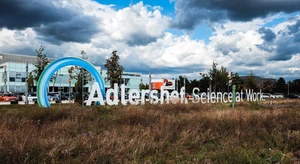
Berlin Adlershof: Facts and figures
Berlin Adlershof is Germany’s largest and most successful Science and Technology Park as well as Berlin’s largest media location—embedded in an overall urban development concept. Spanning an area of 4.6 km², the park…

Heat storage for a climate-neutral Berlin
RLI project shows potential for better use of waste heat and renewable energy:
Berlin must make its heat supply climate-neutral – this is what the Heat Planning Act stipulates. Heat storage systems play a central role in this. This shows a joint project by the Reiner Lemoine Institute (RLI), the…

Optical innovations for solar modules – which are the most promising?
Experts provide a comprehensive overview of the state of solar research:
In 2023, photovoltaic systems generated more than 5% of the world’s electrical energy and the installed capacity doubles every two to three years. Optical technologies can further increase the efficiency of solar…
STELE supports electromobility and the electricity grid in Austria
The platform for networking stakeholders ensures faster results in the expansion of charging infrastructure:
With more and more battery-electric trucks and buses on Austria’s roads, the need for charging infrastructure and the demands on the electricity grid are increasing. To support this ramp-up of e-mobility, the Reiner…
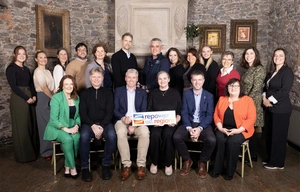
Launch of Repower Regions – Transforming Europe's Heating and Cooling Sector
Steinbeis-SIT joins a project focused on decarbonisation, digital skills, and sustainable solutions in Europe’s heating and cooling sector:
Steinbeis School of Sustainable Innovation and Transformation (SIT), affiliated with Steinbeis University GmbH, dedicates itself to delivering exceptional educational programmes and offering guidance in innovation and…

Creative comics against biodiversity loss
BioYouToon, an Erasmus+ project, aims to sensitise young people and raise awareness of biodiversity:
The project consortium of BioYouToon, an EU-funded Erasmus+ project, met at the end of March 2025 to share the results developed during the funding period. The highlight was five Webtoon Comics, available online in…
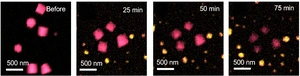
Catalysis research with the X-ray microscope at BESSY II
Scientists studied changes in catalysts during the synthesis of ammonia from waste nitrates:
Contrary to what we learned at school, some catalysts do change during the reaction: for example, certain electrocatalysts can change their structure and composition during the reaction when an electric field is…
The future of energy: recommendations from science to politics
Helmholtz-Zentrum Berlin involved in drafting position papers on energy and materials research and circular economy:
Experts from HZB have contributed their expertise to the position papers briefly presented here. The topics include the development of innovative materials for a sustainable energy supply and the circular economy.…