
Two ERC Starting Grants for HU projects
Dr Michael Kathan will receive 1.5 million euros in funding for the project “CATENATOR: Fabricating Interlocked Nanochains with Molecular Machines”, and Dr Maxime Le Calvé will receive the same amount for “Aporia – Augmenting Poiesis: Relational Inquiries in the Age of AI”
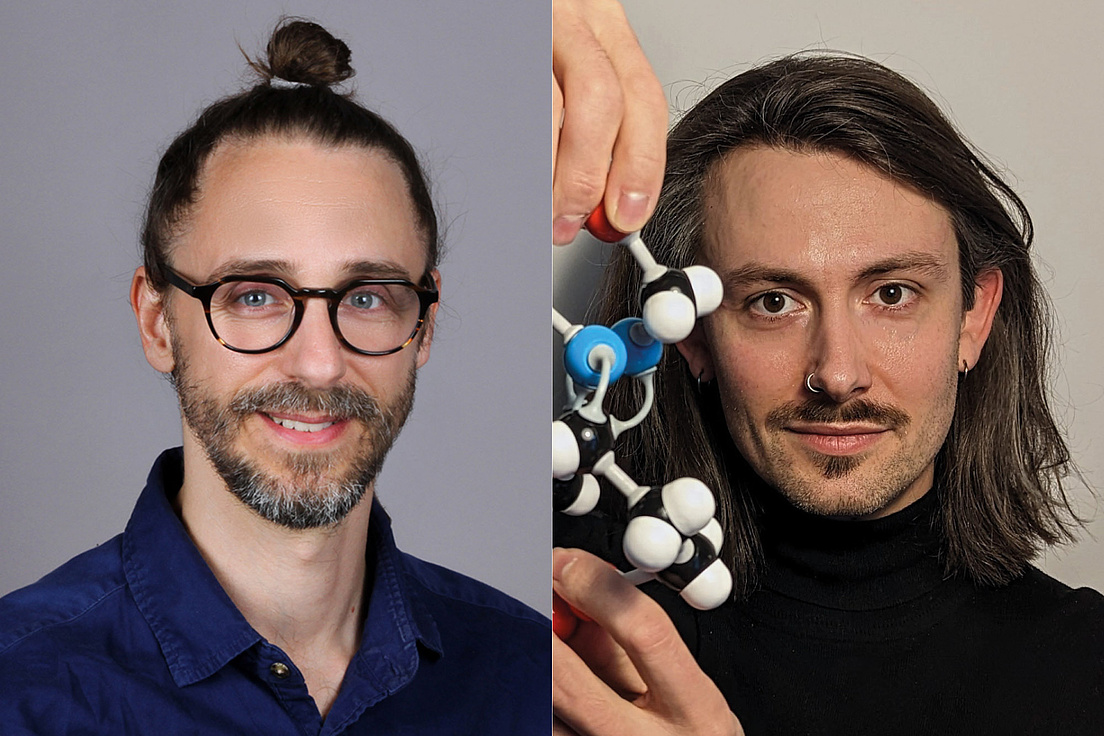
Dr Michael Kathan, a researcher at the Department of Chemistry at Humboldt-Universität zu Berlin (HU), has been awarded a Starting Grant from the European Research Council (ERC) for his research project “CATENATOR: Fabricating Interlocked Nanochains with Molecular Machines”. Together with his research group, he aims to use artificial molecular machines to construct complex molecular chains of defined length and sequence, held together solely by mechanical bonds. This will open up the possibility of creating molecular architectures that cannot be produced using current synthetic methods. In the long term, this could open up new possibilities for drug discovery, chemical biology and functional materials. Dr Michael Kathan: “Our research to date has shown that artificial molecular machines can shape molecules in a targeted manner. CATENATOR is now pursuing a new objective: we aim to develop a general synthetic strategy from this that allows complex molecular chains to be constructed in a controlled manner. In the long term, mechanical bonding could thus become a new design principle in organic synthesis, alongside chemical bonding.”
Dr Maxime Le Calvé, at the ‘Matters of Activity’ (MoA) Cluster of Excellence, has been awarded the ERC Starting Grant for his research project ‘Aporia – Augmenting Poiesis: Relational Inquiries in the Age of AI’. In this ERC-funded research project, Maxime Le Calvé is investigating whether, and in what ways, AI technologies tend to devalue human creative abilities and knowledge, or whether they contribute to further enhancing them. Whether at work, whilst learning or in research, there are frequently situations for which no immediate solutions or answers can be found. This triggers a process of reflection, creativity and trial and error in humans. However, when using AI tools, these steps are often bypassed. AI tools present clear answers and specific perspectives, enabling a work process to continue smoothly. For their research, the scientists will evaluate the day-to-day use of AI tools in the increasingly digital fields of design, anthropology and neurosurgery. The focus is on the process of gaining insight and the significance of moments of confusion and incomprehension for understanding a given issue. To this end, the researchers are developing playful experiments in which AI is used alongside other tools, without providing ready-made solutions or dominating the process of gaining insight.
Michael Kathan
Michael Kathan is currently the Emmy Noether Group Leader at HU and is working on controlling chemical syntheses using molecular machines. Previously, he conducted research with Nobel Laureate Prof. Dr Ben Feringa at the University of Groningen and completed his PhD under Prof. Dr Stefan Hecht at the Department of Chemistry, HU. He studied chemistry at the Free University of Berlin and undertook a research stay at ETH Zurich. In 2026, Michael Kathan was awarded the Sauvage-Stoddart-Feringa Junior Award.
Maxime Le Calvé
Maxime Le Calvé is a research associate at the “Matters of Activity” Cluster of Excellence at HU Berlin. He holds a joint PhD in Social Anthropology and Theatre Studies from EHESS Paris and the Free University of Berlin, and has worked as a visiting scholar at the University of Oxford and Concordia University in Montreal. In September 2026, he took up a post as a research fellow at the ‘Machine Learning’ Cluster of Excellence at the University of Tübingen.
ERC Starting Grant
The European Research Council (ERC) funds groundbreaking project ideas from outstanding researchers across all fields of research. The decisive criterion for evaluation is the scientific excellence of the proposed research project and the applicants. The ERC offers funding through various funding lines tailored to the appropriate career stage. Under the ERC Starting Grant, researchers within two to seven years of completing their PhD are awarded up to 1.5 million euros over a maximum of five years.
Kontakt:
Humboldt-Universität zu Berlin
Department of Chemistry
Dr. Michael Kathan
michael.peter.kathan@hu-berlin.de
Cluster of Excellence ‘Matters of Activity’
Dr. Maxime Le Calvé
maxime.le.calve@hu-berlin.de
Press release by Humboldt-Universität zu Berlin 03.09.2026.