
News

4-Inch Aluminum Nitride Crystals for Future Markets in Power Electronics and UV Photonics
Innovation project launched by IKZ, PVA TePla AG and Siltronic AG:
Three leading players in semiconductor research and development – the Leibniz-Institut für Kristallzüchtung (IKZ), the PVA TePla AG, and the Siltronic AG – are combining their expertise in a pioneering project to…
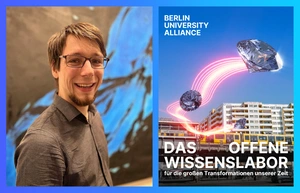
Marco Stucki wins Berlin University Alliance ideas competition
His quantum research project ‘Sawfish Cavity’ is now being used for a poster campaign in Berlin:
Marco Stucki has won the Berlin University Alliance's open knowledge lab competition with a novel process for manufacturing tiny diamond structures for quantum technologies. “Art meets Science” was the motto under…
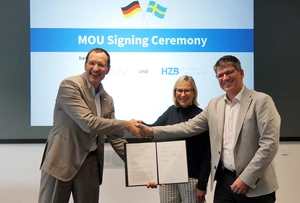
MAX IV and BESSY II initiate new collaboration to advance materials science
Helmholtz-Zentrum Berlin signed a 5-year cooperation agreement with the Swedish national synchrotron laboratory MAX IV:
Swedish national synchrotron laboratory MAX IV and Helmholtz-Zentrum Berlin (HZB) with BESSY II light source jointly announce the signing of a 5-year Cooperation Agreement. The new agreement establishes a framework to…
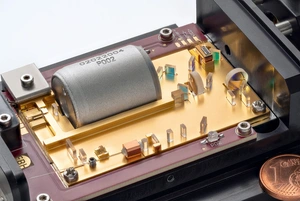
From laser chips to complete systems – FBH at Laser World of Photonics
Ferdinand-Braun-Institut demonstrates its comprehensive expertise in the field of diode lasers / More than 20 presentations at the accompanying CLEO Europe conference:
Once again, the Ferdinand-Braun-Institut, Leibniz-Institut für Höchstfrequenztechnik (FBH) will be presenting its comprehensive range of photonics expertise and solutions at Laser World of Photonics in Munich from…
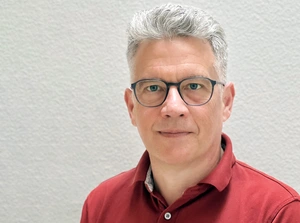
Bodo Richter Appointed as Managing Director of greateyes
greateyes GmbH is pleased to announce the appointment of Dr. Bodo Richter as its new Managing Director, marking an exciting new chapter in the company’s continued growth and innovation. Bodo brings over two decades…
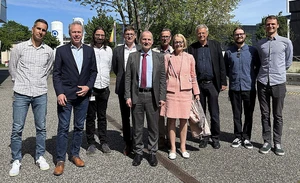
Parts for ESA's NewAthena X-ray telescope are produced in Adlershof
Agreement on the production of mirror modules in the PTB laboratory at BESSY II:
For more than 30 years, there have been cooperation agreements between PTB and the European Space Agency (ESA) on the use of synchrotron radiation for the characterisation of detectors, filters and mirrors for X-ray…

New cluster of excellence with MBI participation approved
The aim of the “Center for Chiral Electronics” is to harness chiral properties in solids and molecules:
The Center for Chiral Electronics is one of the 25 new clusters of excellence approved in May 2025 as part of the Excellence Strategy of the German federal and state governments. The successful initiative was…
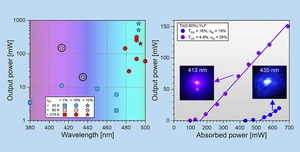
New violet laser developed at IKZ
Researchers at the Center for Laser Materials (ZLM) at the Leibniz-Institut für Kristallzüchtung (IKZ) have developed the most efficient direct violet-emitting solid-state laser:
Lasers with short-wave visible light in the blue or violet range have many practical applications. They are used in metalworking, for example, especially with metals such as copper, which strongly reflect infrared…
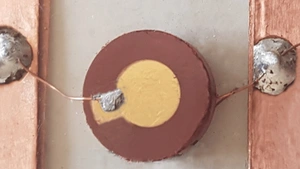
New materials as highly sensitive X-ray detectors
Organic-inorganic hybrid materials are ideally suited and can be produced in a green way using ball milling:
New bismuth-based organic-inorganic hybrid materials show exceptional sensitivity and long-term stability as X-ray detectors, significantly more sensitive than commercial X-ray detectors. In addition, these materials…
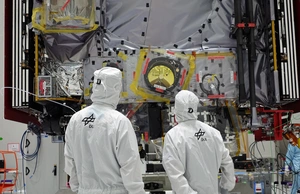
DLR pools expertise in space research
The new DLR Institute of Space Research is being formed from the internationally acclaimed Institutes of Optical Sensor Systems and Planetary Research:
Space is a key technology for the future, essential for exploring planets, Earth observation and security. Satellites and space probes equipped with highly specialised observation instruments are indispensable for all…
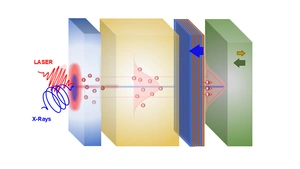
Insight into ultrafast spin processes with femtoslicing
Worldwide unique infrastructure for spintronics research at BESSY II:
An international team has succeeded at BESSY II for the first time to elucidate how ultrafast spin-polarised current pulses can be characterised by measuring the ultrafast demagnetisation in a magnetic layer system…

Ultrafast Plasmon-Enhanced Magnetic Bit Switching at the Nanoscale
MBI researchers demonstrated a way to control and manipulate nanoscale magnetic bits:
Researchers from Max Born Institute have demonstrated a successful way to control and manipulate nanoscale magnetic bits — the building blocks of digital data — using an ultrafast laser pulse and plasmonic gold…
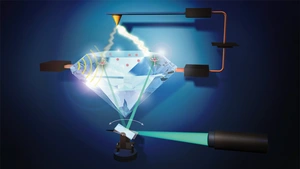
An elegant method for the detection of single spins using photovoltage
The approach of an HZB team could lead to a much more compact design of quantum sensors:
Diamonds with certain optically active defects can be used as highly sensitive sensors or qubits for quantum computers, where the quantum information is stored in the electron spin state of these colour centres.…
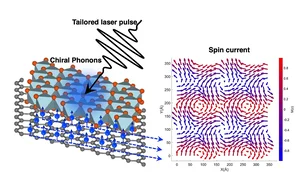
New research unit to study the generation, transport and detection of chiral phonons
DFG funds spintronics research with 3.2 million euros / MBI involved:
Spintronics is already widely used in data storage, sensor technology and, increasingly, in communication technology. Many of our cars and cell phones already contain components based on spintronics. Spintronics means…

FBH leads European diode-pumped laser efforts
EuPRAXIA selects second laser-driven accelerator site:
The EuPRAXIA consortium has selected ELI Beamlines at ELI ERIC in the Czech Republic as the site for its laser-driven second plasma-accelerator pillar. This decision marks a major milestone in the consortium’s journey…
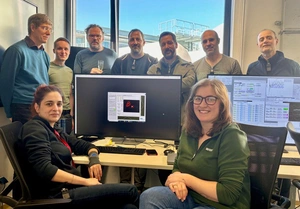
Breakthrough: First electron beam in SEALab advances accelerator physics
HZB team generates and accelerates an electron beam from a multi-alkali photocathode:
The SEALab team at HZB has achieved a world first by generating an electron beam from a multi-alkali (Na-K-Sb) photocathode and accelerating it to relativistic energies in a superconducting radiofrequency accelerator…

Efficient soil analysis – high-tech for sustainable agriculture
Mobile sensor platform from Leibniz Institutes ATB and FBH can precisely detect the composition of soil on the move:
Precise information about agricultural soils is key to managing them more efficiently and sustainably. Researchers at the Leibniz institutes FBH and ATB have recently enhanced an existing sensor platform for mobile…
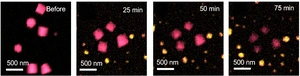
Catalysis research with the X-ray microscope at BESSY II
Scientists studied changes in catalysts during the synthesis of ammonia from waste nitrates:
Contrary to what we learned at school, some catalysts do change during the reaction: for example, certain electrocatalysts can change their structure and composition during the reaction when an electric field is…
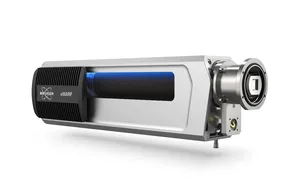
Bruker introduces a new EBSD detector for advanced materials characterization
eWARP combines direct electron detection and CMOS technologies:
Bruker announces the launch of eWARP, a new detector for Electron Backscatter Diffraction (EBSD) that marks the advent of a new era in EBSD technology. Featuring a revolutionary Bruker-engineered camera that combines…
Agreement on EUV reflectometry between PTB and ZEISS extended until the end of 2029
Cooperation strengthens the European technology network:
PTB's laboratory for metrology with synchrotron radiation in Berlin-Adlershof is an important node in the network of European research infrastructure that has helped to enable the monopoly position of European…